
You would think that since Casablanca is my favorite film, I would give its director, the Hungarian expatriate Michael Curtiz, the praise he deserves.
Nope.
That’s because I watched The Charge of the Light Brigade (1936) yesterday on Turner Classic Movies. Several grievous errors appeared.
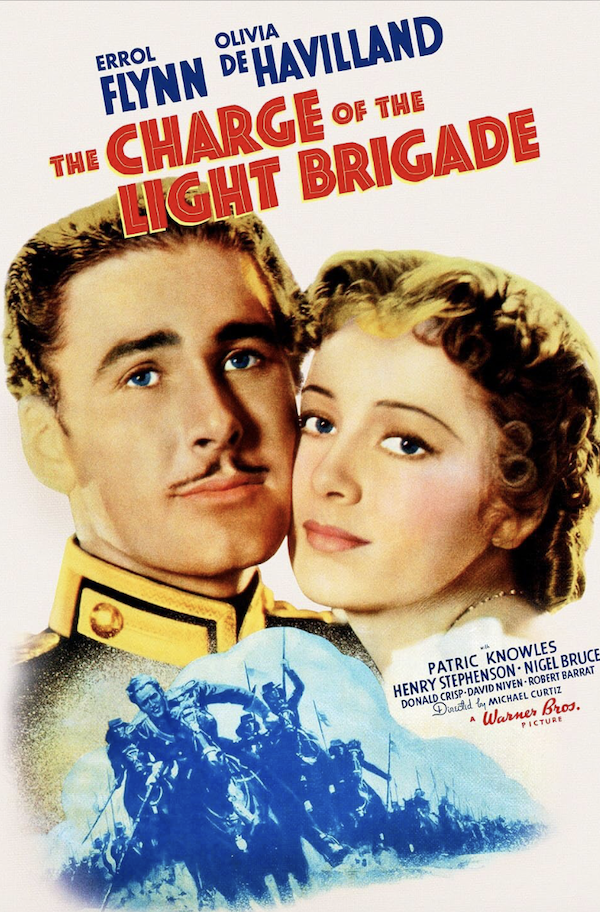 1. It stars Errol Flynn, whom I dislike for his smugness. He was brilliant playing an alcoholic swashbuckling actor in 1982’s My Favorite Year—unfortunately for the then-deceased Flynn, that film actually starred Peter O’Toole.
2. Light Brigade also stars Olivia de Havilland, the insufferable Flynn’s co-star in several Curtiz films. Did this poor woman not suffer enough as Melanie in Gone with the Wind? (The correct answer is “yes.”)
3. The Light Brigade script called for killing off David Niven halfway through the film. YOU DO NOT KILL DAVID NIVEN OFF HALFWAY THROUGH ANY FILM! Errol Flynn is expendable, but they wait far too long in this film. At least Raoul Walsh had to wait to send Flynn’s Custer, in They Died with Their Boots On, to the Underworld, but Flynn was Australian, after all.
4. The script called for a stiff-upper-lip British defense against the Sepoy Mutiny in British India (Sepoys were Indian soldiers and were treated with spectacular insolence) followed by the Charge of the Light Brigade in the Crimea. But some fuddy-duddy historian—possibly the one in Monty Python and the Holy Grail—pointed out that the Sepoy Mutiny occurred three years after the Charge of the Light Brigade. Damn. Get me rewrite. The British, by the way, dealt with the Sepoy Mutiny with all the charm of, say, David Niven. They lashed the accused mutineers to the ends of cannon barrels. Then they fired the cannons.
5. People more informed about weapons than I am also have pointed out that the British, in this film, are using Model 1873 Springfield carbines, difficult to do in the mid-1850s. Custer’s troopers—there’s Errol Flynn again!—used them at the 1876 Battle of the Little Bighorn. A fat lot of good it did them. (The shells, supplied by a Department of War just as competent as today’s, refused to eject properly.)
 6. Flynn was known for his affection for children, especially teenaged girls. Light Brigade provides a gratuitous chubby little boy, the son of a Sepoy non-commissioned officer. The boy advances the plot, thankfully, by getting killed. His killer, an evil prince, leads the savages that kill women and children (that terrible man) after fooling Flynn with a fake truce, sort of like the one that today governs the Strait of Hormuz. Boy howdy, I guess you can learn stuff from history.
7. Somehow, the evil prince winds up in the Crimea with the Russians. Maybe it’s because Putin has a dacha there, I don’t know. Flynn charges with the Light Brigade and becomes dead, but not before making the evil prince more dead. Justice is served.
8. Back to the main order of business: hating Michael Curtiz.
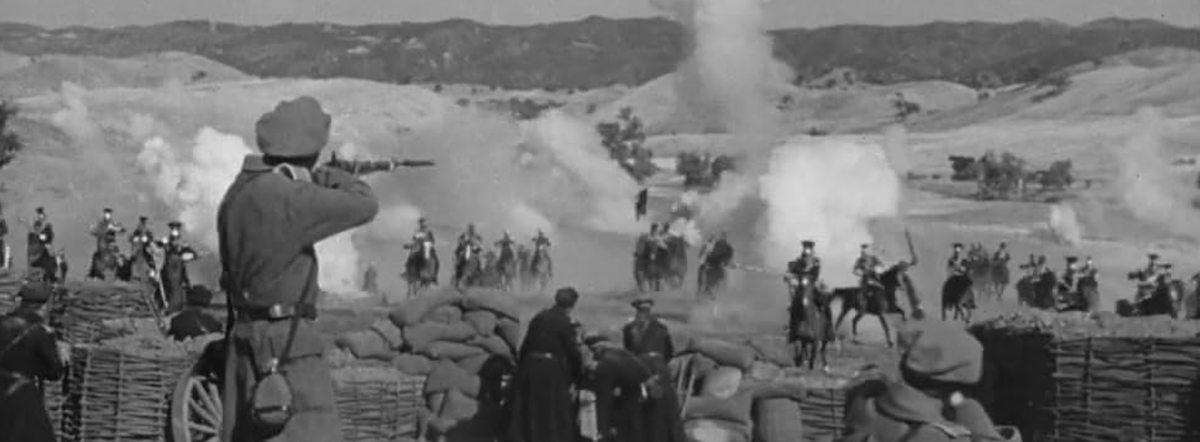
Most of this film is set in India, where it alternates among treacly romance, casual racism and leaden humor. But the last 15 minutes, the cavalry charge, is one of the most stunning action sequences I’ve ever seen on film.
“How did they get the horses to fall like that?” I asked my wife, Elizabeth, as they were mowed down by Russian cannonballs. It turns out that Michael Curtiz used tripwires. Of the 125 horses used in the final sequence, 25 of them were killed.
If justice is truly served, Michael Curtiz is shoveling horse manure in hell. Or, to borrow from Patton, in Louisiana.