
Photos by Chiara La Mark
Shakespeare’s A Midsummer Night’s Dream is usually associated with magical forests and landscapes of ancient Athens. But in Cal Poly’s production (running through October 31), director Karin Hendricks-Bolen has reimagined the world of the play.
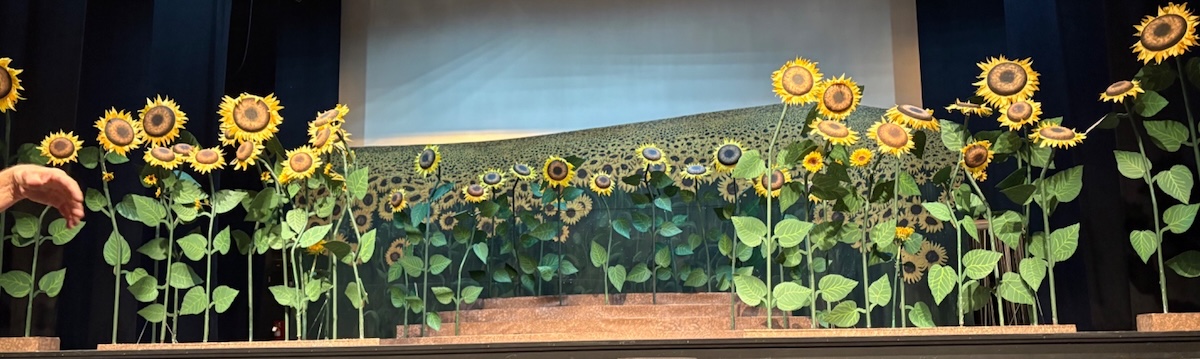
Set in Renaissance Florence, this version draws inspiration from the Medici family for its court, while replacing the traditional forest with a field of sunflowers. Through these choices, the production creates a new world for Shakespeare’s famous story.
This fall I’ve been helping build the sets for Cal Poly productions as part of a stagecraft class led by instructor Richard Jackson and technical head Zach Thayer, who assigned us different tasks each day. Some involved heavy construction, including cutting wood, assembling structures, and recycling old flats. Others focused on the artistic details that would eventually define the stage for this Dream.
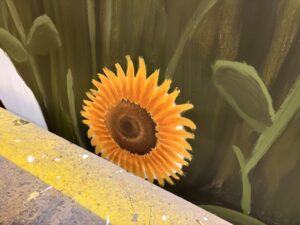 I spent most of my time helping construct sunflowers: cutting yellow fabric dipped in glue to harden into petals, attaching them to bases, and painting leaves and stems. I also worked with scenic charge April Clark to paint the backdrop, including sunflowers on the back flats and marbling on the Medici building and steps.
Although I prefer the more artistic tasks, a wide range of work happened in the shop every day. Students cut and welded metal to assemble the sunflower backdrop and Medici wall, built wooden structures, and prepared materials. Each job contributed to turning original designs into a finished set.
Working on sunflowers gave me a firsthand look at how much time goes into creating something that might seem simple from an audience perspective. Each flower required multiple steps, and with more than 50 sunflowers onstage, the process had to be repeated until the field was complete.
While construction began in late August, the overall design process started months earlier. Having worked on the set firsthand, I wanted to learn more about the process that came before construction and how the initial ideas developed into the finished design.
So I spoke with Josh Schneider, the production’s scenic designer.
What audiences see onstage is only the finished product of a much longer creative process . . .”
For Schneider, the sunflower field was one of the most successful parts of the design. Although he modeled the flowers in 3D, figuring out how to build them became a team effort. The original design was cut by around 30 flowers, leaving approximately 55 onstage. Athena Godwin, the sunflower lead, crafted the petals, Thayer cut the centers from foam, Clark painted the pieces, and Paul Tungol, one of the lighting designers, used a laser cutter to create the leaves. Schneider hand-bent most of the PVC pipes used to shape the flowers.
Schneider described the sunflowers as a “beautiful labor of love,” reflecting how the project grew from an individual design into a shared creative process.
“It was really cool to be able to craft those with a whole team of people after I had just modeled them solo,” Schneider said. Helping create the production’s magical atmosphere, Schneider worked with lighting designer Brian Healy to incorporate small lights into the back wall of sunflowers and hang hundreds of crystals overhead. Reflecting light like stars, the crystals create a sparkling sky above the stage. Together, the lighting and scenery establish the production’s ethereal atmosphere.
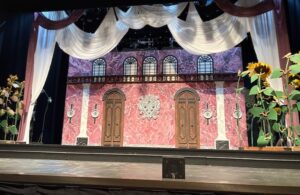 Not every part of the design came together as easily. One of Schneider’s biggest challenges was creating the Medici family crest that hangs on the court wall. Since the production draws inspiration from Renaissance Florence, the crest needed to reflect the family’s wealth and power while remaining unique to this production.
Costume designer Thomas Bernard helped solve this challenge by contributing a floral motif that appeared in the court’s costumes and was later incorporated into the crest. This detail connects the scenic and costume designs, creating a cohesive visual world.
Turning the crest into a physical piece required Schneider to model it in 3D before using a CNC machine to cut it. The piece was then hand-carved and painted. Schneider admitted that the crest was one element the team worried might not make it into the final production, but hours of work brought it to life. Though it may appear to be just one detail of the court, the crest reflects the careful design and craftsmanship behind the production.
Seeing the set come together gave me a better appreciation for the amount of work that goes into bringing a production to life. Before working on it myself, I hadn’t fully considered how many people and how many different skills were involved in creating the world of A Midsummer Night’s Dream.
From sunflower petals to a Medici crest, each detail is the result of hours of work and collaboration. What audiences see onstage is only the finished product of a much longer creative process, making the world created in the play that much more impressive.