
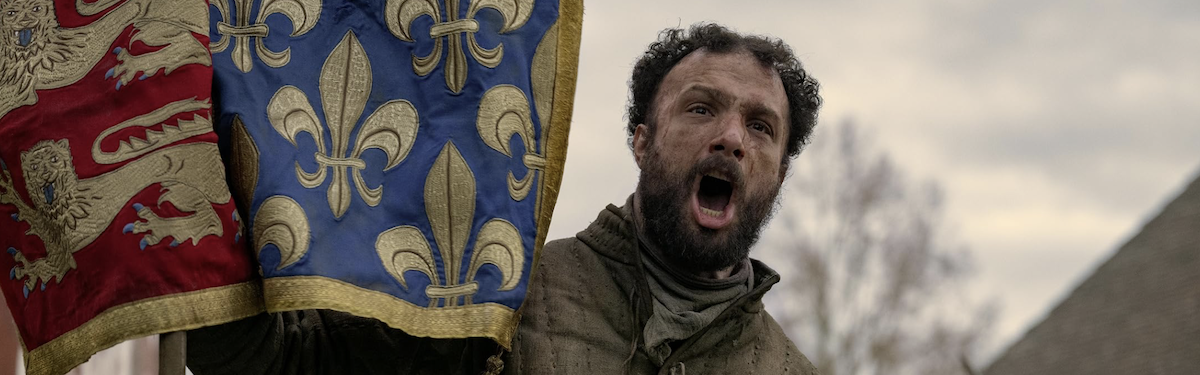
“The Uprising” (2026) Photo by Betina La Plante © 2026 Focus Features
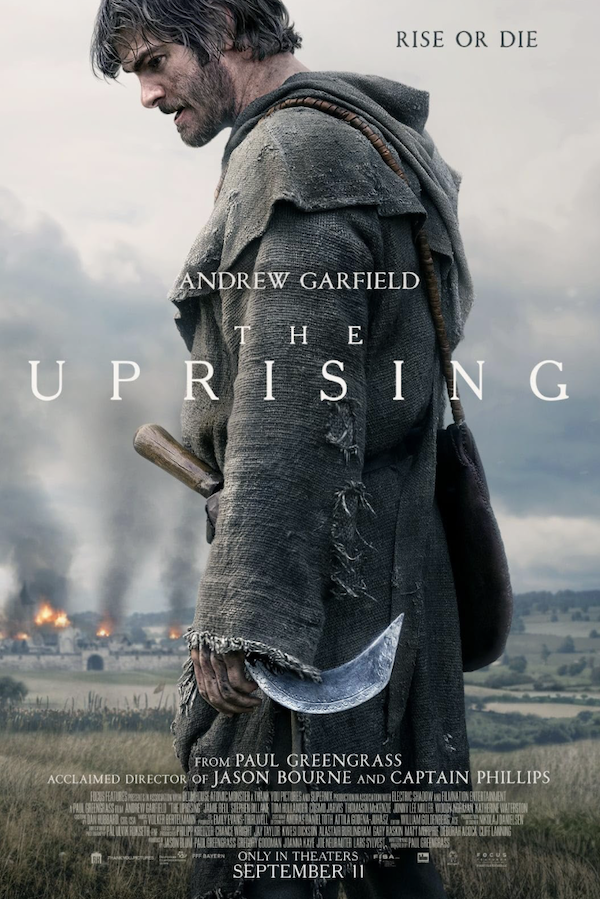
The Uprising (2026): In this film, written and directed by Paul Greengrass, Andrew Garfield stars as the leader of a ferocious rebellion against the tyranny of King Richard II. Set against the true events of the Uprising that helped inspire the legend of Robin Hood, he forms an army of the people to face the King’s might in a fight for justice.
There’s nothing more relentlessly boring than somebody else’s family tree, so I will try to be brief.
 It’s probably wishful thinking, but my family tree’s noble ancestry abruptly ends—we came to England with the distressing Normans in 1066—during the reign of Richard II, when “Richard Lord Asfordby Gregory” is succeeded by plain old “John Gregory,” a name handed down to my elder son.
[My mother’s family (Irish) came from ancestors in County Wicklow, south of Dublin, among people (the poorest in Europe) who lived their entire lives without once tasting meat. When the Great Famine came, desperate Irishmen on the coasts pried shellfish—periwinkles, mussels and barnacles—from the rocks and ate them fast. The shock from such unaccustomed protein killed them.]
The Gregory side goes back to Asfordby, a town in the besooted Midlands, recently known for two events: the spectacular implosion of two coal-mine hoisting towers, and an absent-minded serial killer who kept leaving body parts behind.
But as to King Richard II?
On September 23, 1387, England’s King Richard II hosted John of Gaunt at a banquet that consumed 14 oxen, 120 sheep, 1,200 pigeons and 11,000 eggs.
The Uprising, in theatres now and soon to stream on American television, is about the 1381 peasants’ revolt—Wat Tyler’s Rebellion—that began Richard’s unraveling. It was crushed without mercy.
Richard II’s failures transcended even mercilessness.
He was so indifferent to the starvation of his subjects that England began to founder. His own noblemen toppled him. We Gregorys are a quarrelsome lot, so maybe we lost our nobility during this king’s reign.
I sure hope so. I have the same inchoate but powerful hope in finding a DNA match with one of the 13 human beings my third great-grandfather claimed to own in 1850 Kentucky.
Centuries before, a captive Richard II died of starvation—stunningly fitting—in Pontrefact Castle in Yorkshire on Valentine’s Day 1400.
We are, all of us, bound to each other. When kings forget this self-evident truth, we are, all of us, in terrible danger. But so are the kings among us.”
History does NOT repeat itself, and I am not suggesting that it should. But it sure rhymes.
And it rhymed for the next Richard, Richard III, killed at Bosworth Field in 1485, whose little bent skeleton, so prominent in Shakespeare’s great play, was found in 2012 buried in a parking lot 16 miles southwest of Asfordby.
Richard III’s skeleton proved without a doubt that he’d suffered from the bent of his upper spine—from lifelong scoliosis. He was never close to the hunchback that Shakespeare imagined for his Tudor audience, Bosworth’s victors.
The loser, Richard III, was found with a deep puncture wound at the base of his spine, inflicted post-mortem. He’d been stabbed—forgive my choice of words—in the ass. It was a wound intended to humiliate.
The latter Richard, whose reputation is steadily improving, didn’t deserve that. But starvation, it seems to me, is a just end for kings who ignore the hunger of their people.
History will not let us go. My seventh great-grandmother is buried in a churchyard in London. She died three years before Elizabeth confronted the Armada. My Irish great aunt, Sister Loreto, cared for orphans in a home willed to her order by Hamilton’s wife, Elizabeth Schuyler.
This December, my younger son Thomas and I will go to Oahu to remember a cousin of ours, his remains still unidentified, killed on the USS Arizona. Hopefully, a DNA sample from me will match one set of remains to be disinterred from the Punch Bowl Cemetery of the Pacific on the attack’s anniversary.
And I hope that another DNA sample will reveal cousins from the 1850 Kentucky Slave Census.
We are, all of us, bound to each other. When kings forget this self-evident truth, we are, all of us, in terrible danger. But so are the kings among us.