
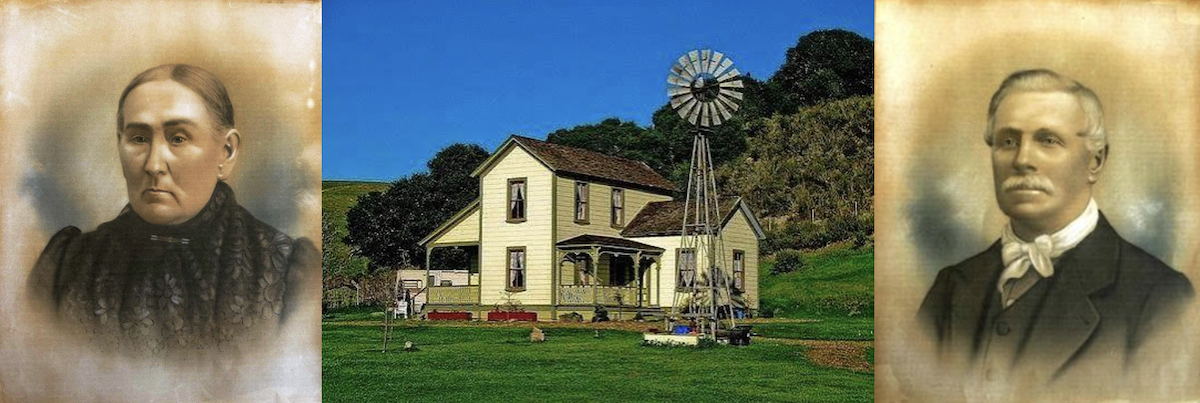
Andrea and John Price with their Anniversary House as it exists today
Whaler, Vaquero, Rancher, and Founder of Pismo Beach
Editor’s Note: Read Part 1 here.
Part 2: The Love Story
Love stories can sometimes start with complications and end in joy. This one spans three generations in its making.
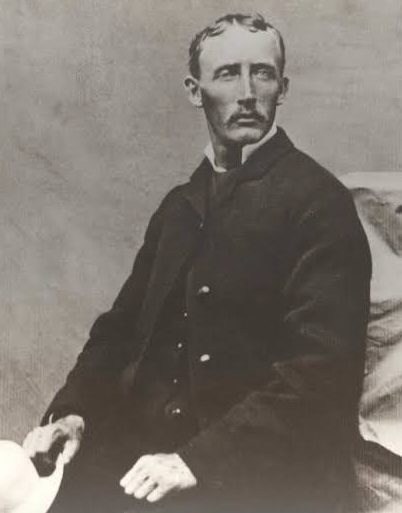
A tear slipped from the corner of 11-year-old Andrea’s eye. Seeing that tear after just having told his wife and her sister that their neighbor—John Michael Price—had been arrested by Mexican soldiers, Francis Branch added “I see that you like Señor Price, Andrea.”
Majordomo of Capt. William Dana’s Nipomo Rancho for the last few years, John had been swept up in the 1840 “Graham Affair” along with more than 100 other British and American citizens. The prisoners, onboarded in Monterey or Santa Barbara, were transported by ship to San Blas, Mexico, and marched inland to Tepic.
Within a year none were tried, all were exonerated, and they were provided a return voyage to Alta California, this time in more comfortable circumstances. While no firsthand account has been found of Andrea’s tender moment when learning about the arrest, the story has been passed down through subsequent generations.
Maria Andrea Carlón, known as Andrea, was a pretty child, the fifth of seven children born to Jose Antonio Zeferino Carlón and his second wife—Maria Dominga de la Transfiguracion Cota. A widower and father of an infant son, Jose married Maria Dominga in May 1813, having lost his first wife the previous summer. Andrea was born on January 10, 1829, more than 15 years later, the sixth of eight children of this marriage.
Jose’s mother was the oldest child of Josef Fernando de Velasco y Lara, born in Spain, and Maria Antonia Campos, a Ladina woman born in Mexico of mixed parentage, who spoke Spanish and whose family were likely business and/or property owners. They arrived in Los Angeles among its 44 initial settlers in 1781 and moved on to Santa Barbara the following year.
Jose’s use of the surname Carlón—from a man with whom he had no biological connection—is noteworthy. Having used the surname of his mother’s second husband, Nicolas Felipe Cortes, for more than 20 years, he did not know Cortes was not his father. Jose only learned about his true father’s identity in 1814. In 1790 Juana Maria de Jesus Lara had married Hilario Carlón, a soldier of the Presidio of Santa Barbara. Carlón was killed by hostile Native Americans within a few months of their marriage while on assignment away from the Presidio. Lt. Don Felipe Antonio de Goycoechea, the second Comandante and primary builder of the Santa Barbara Presidio, felt responsible for unknowingly sending her husband to his death and sought to comfort the widowed Juana Maria.
Over time this developed into a deeper, mutual relationship resulting in her pregnancy. The “Royal Decree of 1766” prohibited army officers from marrying without express permission and allowed them only to marry women of their class with a specific amount of dowered wealth. Caring about Juana Maria yet unable to marry her, Goycoechea worked discreetly to find her a good husband, and she married Cortes in May, just three months after Jose’s birth in February 1792. Jose lived, not in Juana’s home, but in Goycoechea’s household throughout his childhood and was made a cadet by Goycoechea in the army at age 13, while never knowing the true nature of his relationship with Goycoechea.
As Jose’s mother and Goycoechea were not married, in 1814 he began using the surname of his mother’s deceased first husband. While he married both of his wives in the Cortes name, most of his children are listed with the Carlón surname.
It is notable that in 2026, our focus is neither on Jose’s illegitimacy nor on his mixed heritage. It is on the care taken by his parents to give him an unsullied start and on his own effective use of it. From his early start as a soldier, Jose went on to become a blacksmith, cattleman, and ranchero after he was granted Rancho Arroyo Grande in 1842. After developing and living on the Rancho for 10 years, he then sold it to his son-in-law, Francis Branch of Rancho Santa Manuela, in 1852.
Oblivious to the controversy surrounding her father’s birth, Maria Andrea Carlón enjoyed the first five years living in Santa Barbara with both of her parents and siblings: an older half-brother, three older brothers and one older sister, and two younger sisters. When her mother died in 1834, five-year-old Andrea and her family remained in Santa Barbara a few more years with the support of Jose’s mother, until moving in with her older sister Manuela and her husband four years later.
Manuela had caught the eye of Francis, a former sailor, trapper, and trader, and they were married in May of 1835. Francis soon began the work necessary to apply for a land grant on property just east of modern-day Arroyo Grande. His efforts paid off and Francis was granted Rancho Santa Manuela by Governor Alvarado in 1837.
Francis built two homes on the property: one for himself, Manuela and their children, and the other for his father-in-law Jose Carlón and his family, with the exception of Manuela’s youngest sisters, who stayed in Santa Barbara, and nine-year-old Andrea, who was invited to live with Manuela and Francis. It was here that Andrea met and began a friendship with John, initially in his role as the majordomo for Capt. William Dana’s Rancho Nipomo and starting in 1843 as the majordomo for Isaac Sparks at Rancho Huasna.
John and Isaac had been acquainted before John was arrested in the Graham Affair. Isaac was eager to have a trustworthy man to care for his newly granted Rancho Huasna, as he preferred living and tending to his businesses in Santa Barbara.
We have no way of knowing the details of John and Andrea’s first meeting, but it probably took place at her sister’s home when Andrea was nine. As Francis and John quickly became friends, living within a three-to-four-hour ride between Rancho Nipomo and Rancho Santa Manuela, it is known that they met both socially and for mutual benefit, including safety. With visits back and forth in the two years before John was arrested, Andrea had ample time to develop a fondness for him resulting in her getting teary-eyed at the news of his arrest.
John had learned Spanish in Mexico after jumping ship there and perfected it in the Monterey area. After coming home from the arrest year, John assumed the name Juan Miguel Prais and converted to Catholicism. Little is known about his activities except that he seems to have remained in the area, taking his pay in wages, livestock, and land.
His friendship and visits with Francis and his family continued. A Spanish-speaker, John was not only intelligent, but well-mannered, well-liked, and easy on the eyes. It is not surprising that Andrea found this handsome man in his early 30s pleasing.
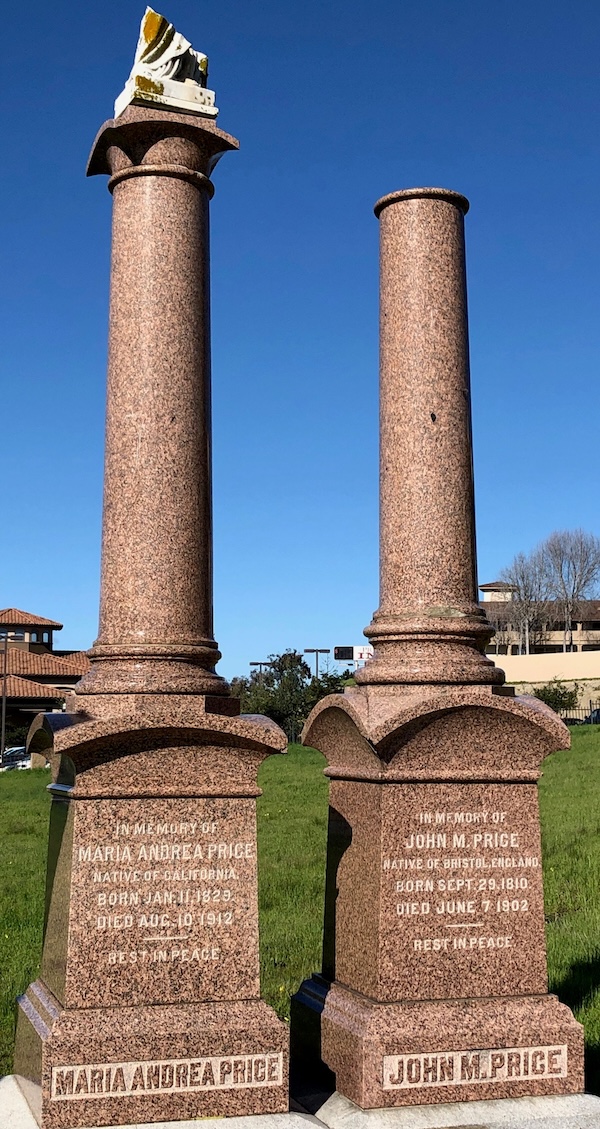
Andrea was also easy on the eyes. She had been learning from her sister how to keep a gracious home even in rustic circumstances—learning to sing and play the piano as well. Both Andrea and John were hard-working and it seems inevitable that their attraction would grow. On May 13, 1844, the couple wed. The bride was 15 and the groom 34. It was a love match that lasted until his death at age 91. Andrea lived 10 more years, dying on August 10, 1912, at 83. Their marriage lasted 58 years, a notable accomplishment at the time.
Their marriage was known to be a happy one, with John affectionately referring to Andrea as Mrs. P. They divided the work between them, with her assisting him in ranching duties until the children began arriving: 15 in all—13 surviving into adulthood. Maria Francisca died at age four and William at just three weeks old.
Now staying primarily in the house while tending the children, Andrea kept an immaculate home, scrubbing the floors daily and keeping things tidy. She cooked meals for the family, and likely the hired help as well, until she became ill later in life. Loving fresh fruit, Andrea cultivated an orchard of more than 200 trees and was locally recognized for her baking, including favorites that incorporated figs.
John worked hard on the ranch, but also believed in educating his children. In addition to their home and ranch buildings, John built a two-story schoolhouse near their home and hired a teacher, paying her $156 annually in addition to room and board. As they grew older, John paid for the children, both boys and girls, to go to Catholic schools in San Francisco. While they lived at home, Andrea taught the children Spanish songs to liven their evenings after chores. The family was happy, working and playing side by side.
It is because of John’s consideration of Andrea and others that I fell in love with him, especially in his devotion to Andrea in her later years.
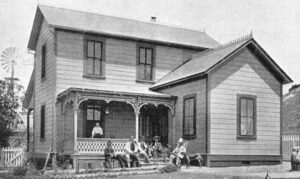
As a new Price Anniversary House docent in 2023, I learned that when they were preparing to move into the Anniversary House that John built in honor of their upcoming 50th anniversary, Andrea fell ill. It would have been difficult for her to climb the stairs to the second story, so John put her bed in the parlor downstairs, and had a new parlor built, giving the house a more interesting footprint in the process.
To spare her the discomfort of having to go outside or use a chamber pot, John also had an outhouse built and attached to the house directly onto her room, accessible from the inside (but we believe emptied from outside). It remains visible in some of the older photos at Price House.
Earlier, John had hired Chumash and Chinese helpers to assist her with cleaning, preparing meals and doing laundry. His consideration for her comfort speaks volumes about their relationship and enduring love.
The cherry on top of this love story comes in the form of an item I found listed among John’s late-1800s journal entries (John recorded all purchases and sales in his journals). In their time together Andrea had learned to speak, but not write, some English. Imagine my surprise as I read that John bought Andrea a book for $34. The equivalent cost today would be more than $1,000. True love!
Share the Story
 Friends of Price House is offering prospective volunteers an orientation and tour of John and Andrea’s home at 2 p.m. on Sunday, November 8. If you are interested in exploring opportunities for volunteering three or more hours a month as a docent telling stories of the Price family and the community, please join us for this overview. Additional volunteering options include helping with educational or fundraising events, the history collections, our gardens, and the development of the Pismo Beach History Center at Meherin House on the same grounds. In addition, we are seeking board members to help guide our future.