
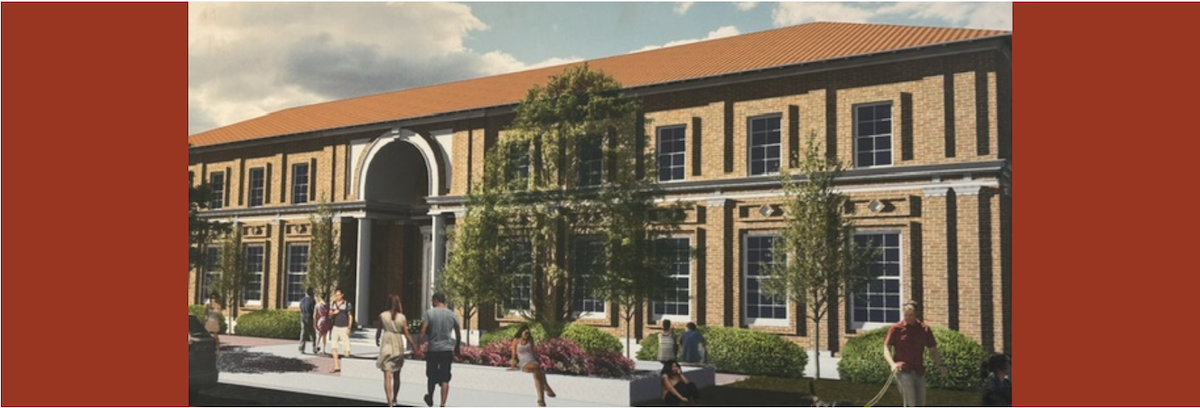
A rendering of the Printery’s planned restoration
Editor’s Note: Support the historic Atascadero Printery when the Atascadero Printery Foundation hosts its annual “Start the Presses” gala November 15, 2026.
Two blocks east of Astascadero City Hall is a remarkable building, with a remarkable history, and a remarkable group of local citizens determined to give it new life.
The storied history of the Printery begins with the construction of publisher E. G Lewis’ 1915 Atascadero Press. In an Italian Renaissance Revival style with a grand Palladian entryway, the architecture was a major addition to the planned community of the City of Atascadero.
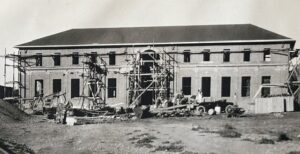
Between 1915 and 1927, thousands of national magazines were printed on multiple high-speed printers, with color printing for the San Francisco Chronicle and the LA Times. But management problems led to Lewis’ bankruptcy, and in 1927 a business school opened on the site, followed in 1928 by a young men’s prep school and a junior college in 1935.
In 1941, the building was leased by the National Youth Administration for a training camp that employed a young man named Jackie Robinson as assistant athletic director.
From 1943 to 1950 the building housed a polytechnic academy, and in 1950 the building was purchased by the Masons who used it as their temple and rented space to various groups including the Naval Reserves and the sheriff’s department for a substation.
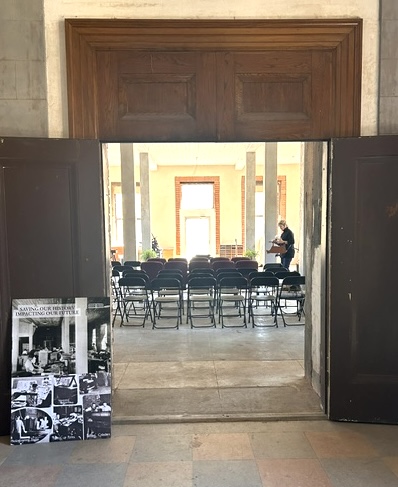
In 1994 the Masons gave the building to the City of Atascadero as a youth center, but in 2003 the San Simeon earthquake ended its public use. In 2004, The Printery was officially included on the National Register of Historic Buildings, and in 2005, the City returned the gift to the Masons who transferred it to developer (and later convicted felon) Kelly Gearhart, whose bankruptcy opened the building to auction in 2017.
During its abandoned years 2003 to 2017, the Printery became a prime target for vandals. As it stood unmaintained, windows and doors were broken, roofs leaked, and earthquake-damaged walls were left open.
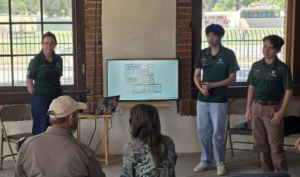
A few local residents boarded up windows and doors, attempting to protect a historic building that they did not own. When the Printery came up for auction in 2017, they organized a non-profit, the Atascadero Printery Foundation.
The APF managed, with a large anonymous donation, to purchase the building for $300,000. Partnering with the Atascadero Performing Arts Center, fundraising began to renovate the 19,000-square-foot Printery for public use including a theatre, print shop, and youth and arts organizations.
A variety of community rooms, an outdoor stage, catering kitchen and an interactive museum of Printery historical displays are among the building’s planned future uses.
Initial work has included installing historic multi-light windows, reinforcing the solid masonry building for structural seismic requirements, repairing the roof and cleaning the interior for temporary community use while work is underway.
Restoration of cast stone work thought to be crafted by artisans shared with the Hearst Castle is planned, as is restoration of 100-year-old murals by the artist Ralph Holmes.
The APF has major financial and physical obstacles ahead, but the determination and success to date of its many volunteers bodes well for the Printery to once again become a major public asset to the City of Atascadero. The group is seeking both funds and volunteers, with details available on the group’s website.