
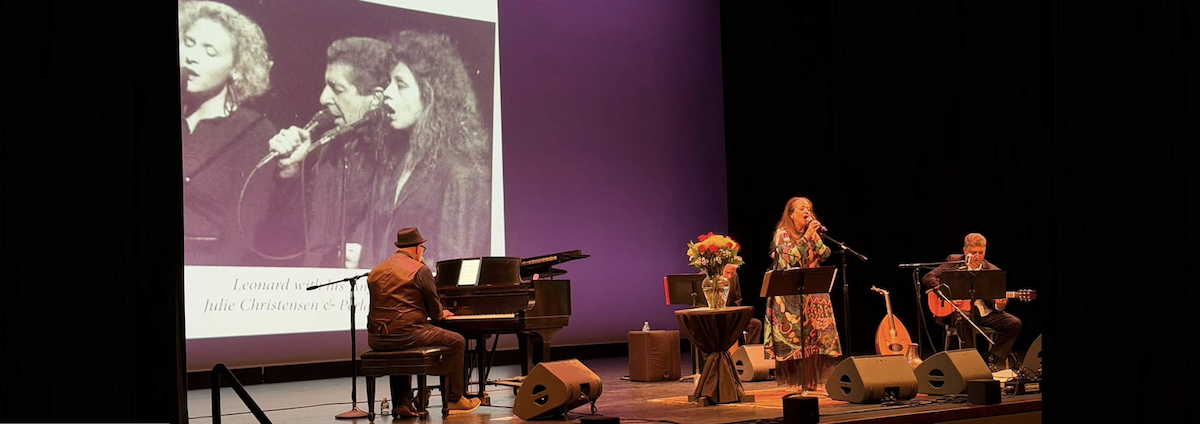
Her power unfolded without a single word.
Taking Arroyo Grande’s Clark Center stage on November 11, barefoot in an artistic outfit that magically kept its A-line shape using only the quality of its fabric, Perla Batalla and her dress swayed to the strumming of an oud as photos of her time touring with Leonard Cohen filled the screen behind her.
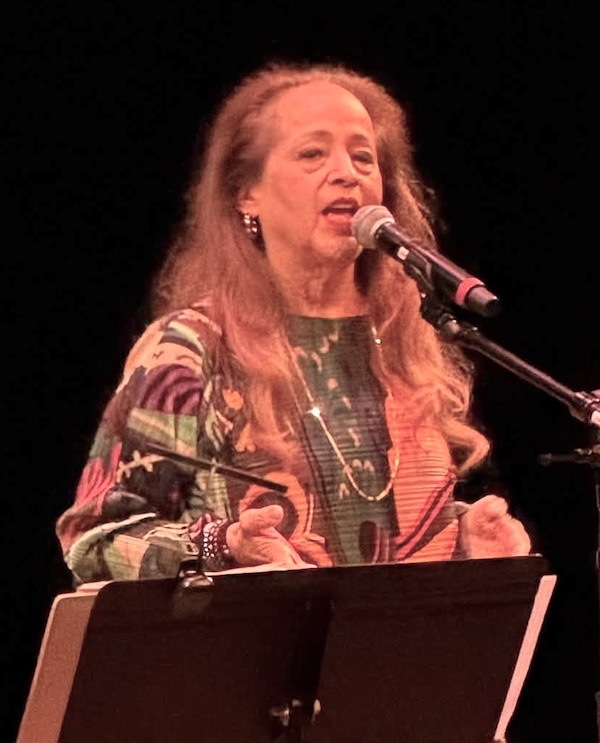 She took ownership of the stage within a space defined only by a carpet behind the mic stand. As the photos ended, she picked up the mic to share her story.
Born in Los Angeles, Batalla was raised in an immigrant household with a father who sang Mariachi and a Venezuelan mother who managed the popular family record store, Discoteca Batalla on the west side of LA.
She was steeped in music throughout her childhood yet was initially not interested in it as a profession. Leaving home at 16, she studied with the goal of becoming an attorney before music called her, too.
After some local successes, Batalla thought she had hit it big when a successful rock band hired her. It wasn’t long before the band fired her for not fitting into their culture—sex, drugs, rock and roll—and she returned home.
She is forgiven for believing in Divine timing when, within 24 hours, a friend who was singing backup for Leonard Cohen called with an interview opportunity. Batalla described buying Cohen tapes and preparing for the interview. Her biggest concern? “What should I wear?” She arrived all in white.
“Leonard began walking towards me, all in black, giggled, and took my hand saying, ‘Darling, look at us, we’re a match made in heaven.’”
 She also referenced the first time he asked her to cover one of his songs. Her first response? “No!” Leonard asked her to reconsider, and she spent a weekend with a girlfriend singing variations of it until she finally said “I can do it. I now own this song!” When she told Cohen, he replied, “Don’t kid yourself, the song owns you.”
They toured together over 10 years and forged a friendship that lasted another 20 years until his death—with his mentoring her throughout.
Batalla’s voice has both power and range, at the upper end reminiscent of Edith Piaf’s mezzo soprano, yet her power and richness as a contralto command even more respect.
Some of the songs that stood out for me in this concert:
- “1,000 Kisses Deep,” speaking to the shallows and depth of love, its impermanence, surviving, and the memories remaining;
- “Ain’t No Cure for Love,” celebrating the attraction and addictive quality of deep love, whether it lasts or not, regardless of woulda-coulda-shoulda’s, and maintaining that there’s nothing pure enough to be a cure;
- “You Want It Darker,” encouraging us to lean into our darkness, confront our mortality, life and love, inherent illusions, including immense appreciation and joy, yet also pain, longing, and regret;
- “Take This Waltz,” providing rich imagery in scenes of love never actualized but richly imagined, reflecting the yearning for love so often found in Cohen’s original works. It’s his tribute to poet Federico Garcia Lorca, whose poetry captured both the sacred and profane in love, and in acts of love.
Batalla did justice to them all, reflecting deep emotions and the struggle to accept life as it is, not sterile and perfunctory, but messy, passionate, and yearning for something just out of reach. Her passion is to represent Cohen’s legacy honestly rather than put her own embellishments on the songs. She makes them her own, certainly, but within Cohen’s framework and discipline.
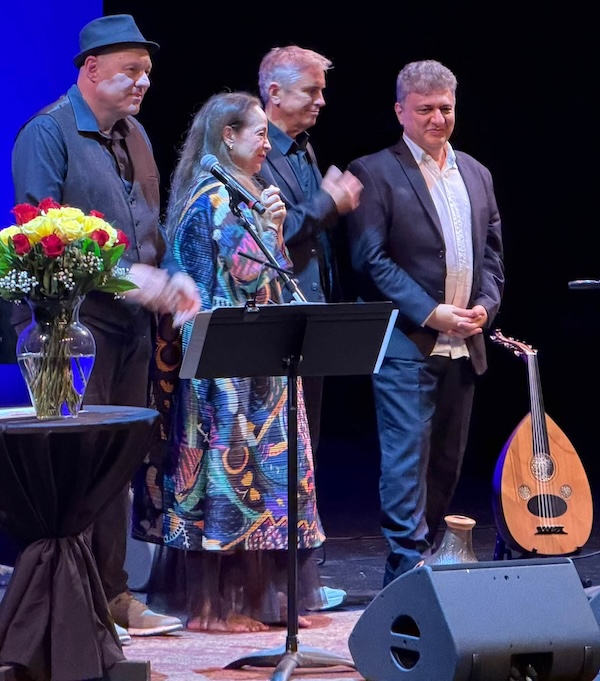
 The audience loved her for it, and for generously introducing her three colleagues on stage: husband Claud Mann, a talented chef and drummer with whom she shares homes in New York and Barcelona; master pianist Willie Aron, with exquisite chops on the piano, composing credits, and a passion for playing to children; and Greek musician Dimitris Mahlis, who has mastered the oud, a precursor to the guitar and other stringed instruments that bridges spirituality and culture, and provides a soulful quality to its notes.
In the end, having spent a remarkable evening with four remarkable musicians, we were invited to join them in the final number: a faithful rendition of Cohen’s “Hallelujah.” We sang, we cried, we cheered and left enriched and grateful, our hearts full of love and life.
Many thanks to Leonard Cohen, to Perla Batalla and her colleagues, and to the Clark Center for an evening well spent.