
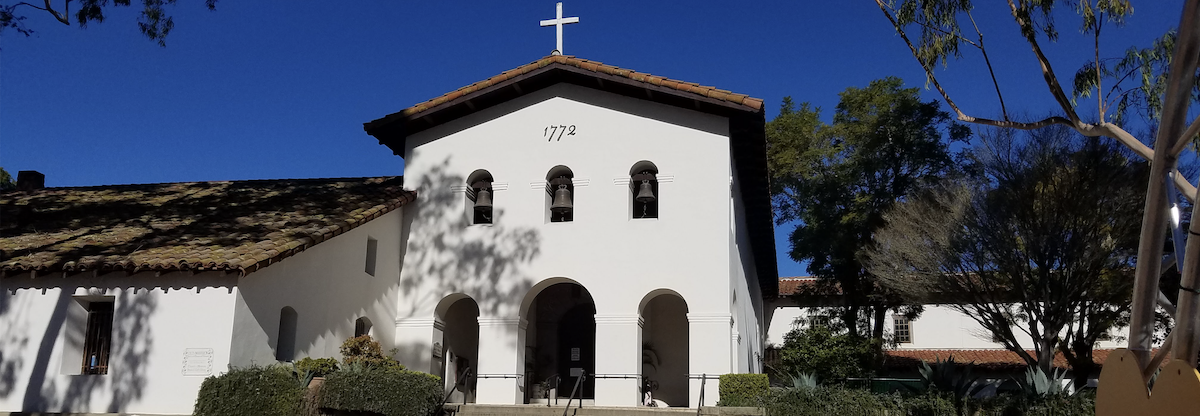
Photo by John B. Ashbaugh
“Why did they crucify Jesus?”
The question came from a boy, probably nine years old, one of the fourth grade students in the group I was guiding through Mission San Luis Obispo.
It was a Friday morning, the first Friday in Lent. I’m a docent at Mission San Luis Obispo, one of many activities that have sustained my sanity after retirement. I hold a great reverence for this Mission, even though I’m the grandson of a Congregationalist minister and not Catholic.
Every time I lead a tour, I learn something new about our Mission and about the faith that built it. It still surprises me how much I learn, especially from leading a school tour. As I guided this group of children into the church and seated them in the pews, I couldn’t know that these students were about to give me a lesson that is vitally important for any Christian. It was a Lenten lesson, if you will.
What Are the Two Most Important Commandments?
Our school tours are very popular with out-of-town schools, but these students were unusual: They were locals. In fact, they had walked to the Mission from Hawthorne Elementary, only a few blocks away.
There were about a dozen in our group, including two parent volunteers and their teacher, Ms. Hightone. Several students appeared to be Hispanic; one used a wheelchair. Indeed, Hawthorne Elementary School has the most diverse student body in San Luis Obispo. It’s situated in our historic downtown where there are some very high-end houses occupied by affluent families, but most students would qualify for free lunches, and their families live in modest circumstances. Rosella, one of the parent chaperones, was a Mexican immigrant. Her son Juan Carlos spoke perfect English, and he was one of the most talkative in the group.
We had just stepped inside the more than 250-year-old adobe church, and the children were standing in the middle of the nave when Juan Carlos raised his hand and asked that powerful question. “Why was Jesus crucified?”
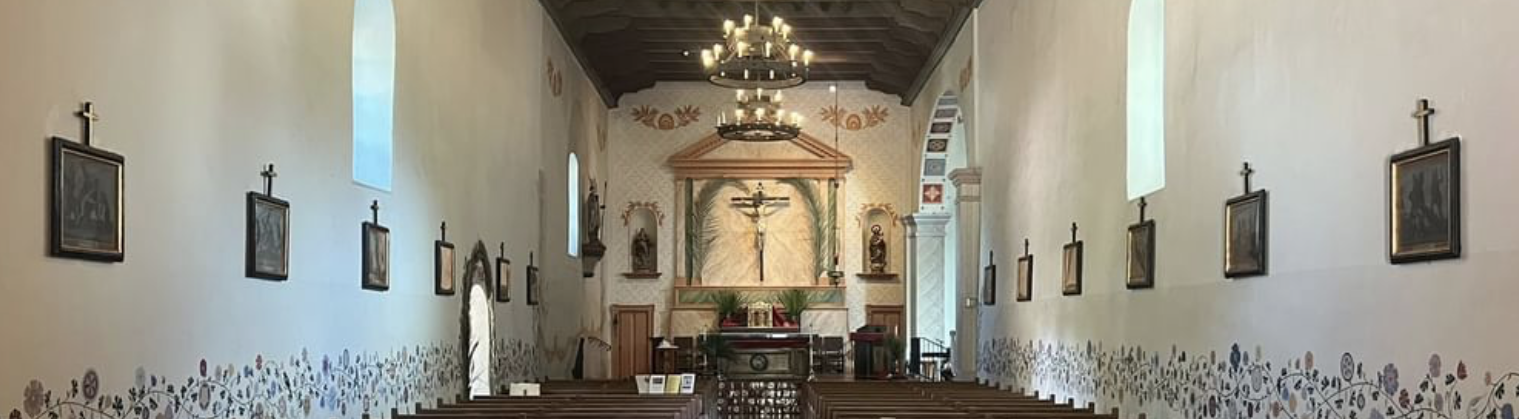
It was the perfect place for that question to be asked, and because we were just entering Lent, it was exactly the right time for him to ask it. Come to think of it, is there ever a wrong time to ask a question like this? Still, it threw me for a loop.
I told Juan Carlos that it was a great question, and I asked the other students to help me answer it. I told them that there were many possible answers, but I wanted to know what they thought. One of the girls raised her hand, and she hesitated a little before offering up one answer: “He died in order to cleanse us of our sins.”
These students had obviously given this question a lot of thought. I thanked her for her answer and told her that many people believe that, and that was as good an answer as any other. I then explained that there was another possible answer, one that is grounded in history: Jesus had angered the rulers in Jerusalem. These rulers believed that people should follow a long list of detailed rules about how to live, rules that only they could explain, and that was a source of their power. These rulers were not happy that Jesus was teaching a very simple message: There were only two commandments that were most important. I asked them if any of them could tell us, what were those two commandments?
Another girl raised her hand and confidently answered that very difficult question this way:
“To love God and to love your neighbor.”
From a child’s mouth to God’s ears . . . I was beaming, and I probably didn’t need to say anything more. But I did, of course. I elaborated on the first: “To love God with all your heart, and with all your soul, and with all your mind.”
And I followed up by asking these very bright students the same question that Jesus was asked about the second commandment (“Love thy neighbor as thyself.”): “But who is your neighbor?”
But Who Is Your Neighbor?
Just then I realized that our time was short—there are so many stories about the Mission that I wanted to tell them—and this wasn’t Sunday School. In fact, we always need to be mindful of the fact that many of our visitors are not Christian—and these were public school students!
 So I simply summed it up and said, “Maybe you know just who your neighbor is, but if you want to know what Jesus said about that, ask your parents. Or your teacher. They’ll help you find out.”
And we went on to visit the statue of Saint Louis, Bishop of Toulouse, looming over the altar. Then we walked to the rear of the Annex to see that beautiful painting of our patron saint, one of the oldest paintings in our Mission. I shone my flashlight on the barely visible crown at the feet of Saint Louis, asking them what they saw. Right away, several knew what they were looking at.
I told them how this very young man who had lived more than 700 years ago had decided to give up his crown as a French prince in order to become a priest, to serve God and his people. I told them how this humble priest, once ordained, had almost immediately been named a bishop.
I then told them how he died only a few months later, exhausted from the heavy responsibilities of feeding the hungry, sheltering the homeless, tending to the sick—in short, from loving his neighbors. His reward came 20 years after his untimely death, when the Pope declared him a saint. Now, I told them, you know why our city is named San Luis Obispo.
We continued the tour into the garden, where I talked about how bustling with activity these quiet gardens must have been in the Mission era: the well in the center, the kitchen where the Youth Center now stands, the aroma from big pots of pozole, the sounds of hundreds of people mingling and working and children playing.
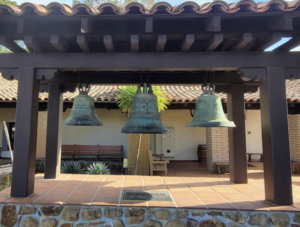 Then it was time to gather at the display of the three historic bells, where we took pictures and said our goodbyes.
Our tour leader was Robert Stewart, and he had enlisted four other docents (including me). Peter Zajac, Deborah Fialkowski, and Roy Hartnell, one of the most senior docents, had joined us. All five of us gathered on the steps of the Mission, as we usually do, to debrief after the tour.
We all agreed that it was one of the best school groups that we’ve ever hosted. The students were asking great questions, and they seemed to be fully engaged—occasionally distracted but never bored. The teachers had prepared them well, even providing an eight-page handout for the children to fill out to show some of what they’d learned.
But I always learn so much more from these kids than they’ll ever learn from me. I was thrilled to see that some of them already understood the most important thing they can learn from any school, or any teacher, or any field trip: how to ask good questions!
And it’s so important to leave some questions for them to think about later. For me, as we stood there on the steps in front of the Mission, I was thinking about how they might be trying to answer the question “Who is your neighbor?” The answer Jesus gave to that question was a parable, of course—the story of the Good Samaritan.
I was about to experience the very essence of that teaching.
Can Anyone Help Me?
At the very moment that our little gaggle of docents had broken up to go home, a woman came running up the steps, pleading “Can anyone help me? My granddaughter has just fallen in the Plaza!”
She was an older woman, at least as old as me (73), with white hair—but what I noticed more than anything else was the panicked look on her face. This was a situation of the utmost seriousness. I dropped everything, dashed to the bottom of the steps and began to sprint to keep up with her as she coursed through the plaza along the Mission colonnade. There on the concrete was a young girl, looking lifeless, flat on her back. Her mother was pumping up and down on her chest, performing CPR like a pro.
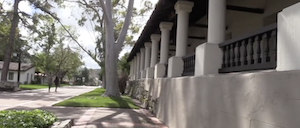 At this point, I wasn’t thinking of the Good Samaritan. I didn’t consider that I, like the Samaritan, had just crossed a boundary, ignoring that instinct that spurs most people just to stand by, or to walk away. I was responding to a crisis. I was there, and maybe I could help somehow.
There were already about a half dozen people standing nearby, and I noticed that one or two had their phones out. “Has anyone called 911?” I asked—the answer was yes. I told the grandmother that they would probably be here any minute.
I approached the mother working hard to revive her young daughter. I offered to help if she got tired, and assured her that she was doing a great job. Her daughter had apparently stopped breathing; she was pale, her face frozen and angled up in a position that hinted to me that she’d had a seizure.
I looked around to see how I might be able to help. What would a Good Samaritan do in those circumstances?
The grandmother was distraught, and next to her was another little girl, terror written all over her face, trembling with fear. I confirmed with the grandmother that this was a younger sister, and asked if I might try to help her calm down. She nodded.
With the grandmother’s consent, I beckoned the younger girl to come sit with us on a bench just a few feet away. I assured her that her sister was going to be all right (although of course, I really had no way of knowing this). I told her it’s OK to be scared, but that she needed to be strong for her sister.
I suggested that she take a deep breath—and she did, immediately. As soon as she had exhaled, her face changed from abject terror to determination, even resolve. It was obvious that she would do anything to see her sister through this ordeal.
While none of us yet knew what had happened to her big sister, I urged this girl to believe that there were people on the way who could find out, and they would get her to a hospital right away.
Just then the city fire truck pulled up and all of us turned our attention to these uniformed first responders as they took charge of the scene. Right away they relieved the mother, and it appeared that her heroic efforts to save her daughter had paid off: She was breathing again. I could see that she even moved her legs a little.
 Though she seemed to be back from the brink, the young teen was by no means out of danger. The paramedics lifted her onto the stretcher as their supervisor spoke to the mother, and circled back to the grandmother, the younger sister, and ultimately even to me to see if anything more could be learned from us.
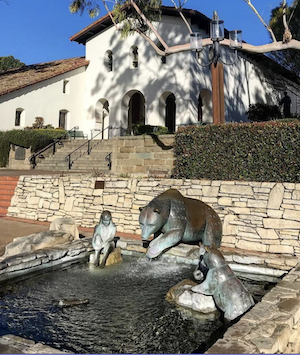
Just then, the ambulance pulled up a block away, at the upper end of the Plaza by the bear statue—much too far from the scene. They were blocked from traversing the plaza by bollards installed there by the city. This dilemma prompted the grandmother to start running toward the ambulance, shouting and pointing the way to get around the Mission and proceed to the scene. I followed her, both of us trying to get the ambulance driver’s attention. We hadn’t gotten far before he realized his mistake and, turning his siren back on, proceeded up Chorro Street to come the three blocks around to the action.
Back at the scene with the paramedic, I confirmed that the girl was to be taken to Adventist Health Sierra Vista Hospital, several blocks away and across the freeway. They seemed optimistic. The mother and grandmother were trying to figure out what they needed to do, so I suggested that the mom should go with her daughter in the ambulance, and she gave her car keys to the grandmother.
What Would a Good Samaritan do?
As the ambulance departed, the grandmother seemed to be more than a little uncertain as to how to get to the hospital. Assuming the family was not familiar with the strange street system of San Luis Obispo, I offered to help. My assumption was sound—I learned later that the mom and two daughters were from the Santa Ynez Valley and the grandmother was from Michigan.
Anyone who’s been to Adventist Health Sierra Vista knows that the route to its emergency room is actually complicated and confusing.
She told me that their car was parked in a garage, but couldn’t remember exactly which one. I offered to walk with them to find their car, then to follow me in my car as I showed them the way.
As we walked back up through the Plaza, I learned their names. The stricken girl was Nissa and the little sister was Haley. She had valiantly pulled herself together, and informed me that her big sister’s name was the Zapotec word for water.
The grandmother’s name was Grace.
I led the two of them on a shortcut up the first set of steps to the Mission, and there by the bell tower a thought occurred to me. I asked Haley if she might want to go into the Mission to light a candle for her sister. Haley very quickly responded with a clearly audible “Yes.” I looked to Grace for affirmation and she nodded her consent.
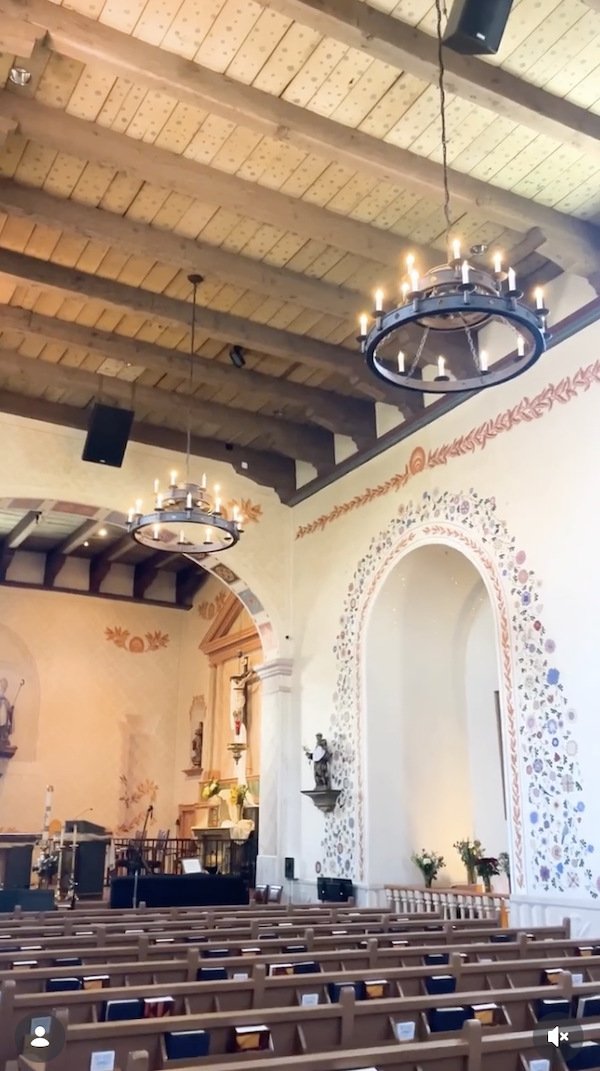 I ushered them through the Mission doors and led them quietly down the aisle to the prayer room. I lifted a candle from the rack, helped Haley place it next to the Pieta, and showed her how to light it. I then left her with Grace and stood outside while they had some time to think, perhaps to pray. I thought to myself that maybe I should pray too. Maybe I did.
When they emerged a few minutes later, Grace asked me where to find a bathroom. I walked them through the side door into the courtyard and walked with them to the parish office. I knew the staff there wouldn’t mind this small favor, but before I could even ask, I saw Father Martin Cain was there, getting ready to officiate over the noon mass.
So it was that our parish priest led them through a locked door to the interior of the office and gave directions to the bathroom. While Grace and Haley were inside that particular sanctuary, I walked outside with Father Martin. I shared what had happened with the older sister, and he graciously waited for them to come out, shaking their hands and assuring them that he would be praying for Nissa at mass. I had already shared with him the meaning of her unusual name, as well as the names of her sister and grandmother.
At that point, I knew they would be anxious to get to the hospital, and that getting there would not be easy in this unfamiliar town. I had parked in the Old Mission parking lot, so I offered to drive them to their car in my car, Grace in front and Haley in the rear. I then navigated up the twisting aisles of the garage to the very top level where Grace pointed out their silver Honda SUV.
They followed me down through the spiraling route to the exit and out to Palm Street. From there, I led our small motorcade along the few blocks to the hospital, making sure that they did not follow the misleading “EMERGENCY” signs along Murray Avenue. Those misplaced signs must drive people crazy once they lose their bearings in the labyrinthine parking lots surrounding the hospital.
Knowing the faster route, I led them further along Murray, then left on Casa and directly to the Emergency portico. I was practically a regular customer there, having needed its services in the past few years after a couple of bicycle accidents.
We parked our cars and I helped them get to the admitting desk, where Grace and Haley obtained their “Friday” wristbands. We shook hands and said our goodbyes.
I walked through the parking lot to my car, finding my way back across all those boundaries that might have prevented me from assisting this family in their hour of need. I felt drained, but happy; Haley would be by her sister’s side, Grace was ready to help with their mom, and that family would be strengthened, together, as they prepared for whatever came next.
At the very least, I knew this family would probably never forget their visit to Mission San Luis Obispo. And I’ll never forget the special opportunity that was afforded to me, to be a neighbor for Haley and her family at a time of crisis, guiding them into the Mission and then to the hospital. That surely proved the Lenten lesson delivered to me just moments earlier by the fourth graders from Hawthorne: We are all neighbors to each other.
—
Text message from Haley’s mother, H.S., sent the following Wednesday:
Dear John,
Thank you for your kindness last Friday morning when you assisted me, my mom, and my daughters during those traumatic moments when my oldest daughter had a grand mal seizure in the mission plaza. I am so grateful for your help in getting my mother and my youngest daughter to the hospital.
My daughter is okay now, back to her normal self, just so you know. They haven’t found a cause for the seizure, interestingly enough.
If you are ever in [our town], we would be happy to offer you a tour or treat you to lunch or coffee as a small gesture of our thanks. Again, you have our deepest gratitude.
H. S.