
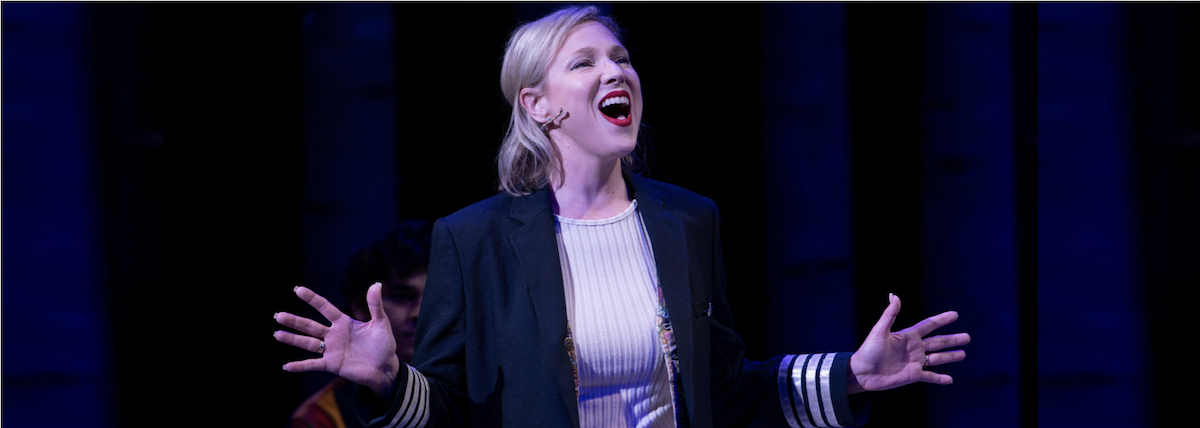
Karin Hendricks-Bolen in PCPA’s “Come From Away” (photo by Luis Escobar)
Karin Hendricks-Bolen is a true triple threat, bringing singing, dancing, and acting talent to every stage on which she steps. She currently appears in multiple roles in PCPA’s Come From Away (closing June 27 at Solvang Festival Theater)
Beyond performing, she teaches and directs mainstage productions at Cal Poly, and is preparing to direct the university’s fall production of A Midsummer Night’s Dream.

As a former student, I’ve seen firsthand her passion for theatre and dedication to her craft, so I was eager to sit down with her and learn how she manages it all with such enthusiasm and purpose.
How does she simultaneously balance teaching, performing in a Tony-winning production, and preparing to direct one of Shakespeare’s most beloved plays? Rather than focusing on the challenges, she emphasizes her passion for the work.
“If you really want to do something, you prioritize it and find a way to make it work,” Hendricks-Bolen says, explaining that although it requires long commutes and sacrificing much of her free time, the opportunity is worth it because performing remains deeply fulfilling for her.
I am especially interested in how she put herself out there and advocated to be in Come From Away. Many young actors hesitate to champion themselves, respecting professional boundaries or wanting to seem humble.
Hendricks-Bolen explains that there is a balance between persistence and professionalism. She made sure PCPA’s artistic team knew she was interested, prepared the audition material in advance, and was ready if the opportunity arose. “Luck is preparation meets opportunity,” she says. “Opportunities sometimes come and sometimes they don’t, but what you can control is your preparation.”

Balancing the roles of educator and performer comes naturally to her, as she was as a resident artist at PCPA from 2009 to 2018, which helped shape her philosophy. I asked whether returning to the stage changed the way she approaches teaching. “I see my students as colleagues that I just happen to be the one holding the space for,” she says. Rather than viewing the classroom as a hierarchy, she believes in mentoring students while respecting them as fellow artists.
Does she think an actor’s education is ever truly finished? “The second that you think you’re done is when you start to slide back in your skill set,” she says without hesitation. “Training and growth should continue . . . nobody’s ever done.” For her, acting is a lifelong practice that evolves alongside personal experiences and self-discovery.
When the conversation turns back to teaching, I wondered whether she still learns from being in the classroom. “I’m inspired by my students every day,” she says. “I’m on the journey with every single student.” She describes approaching each class by working through challenges alongside her students rather than simply observing from the outside.
That collaborative mindset is reflected in her coaching style as well. As someone who has taken her classes, I note that she never seems interested in telling students exactly how she would perform a role. Instead, she encourages them to develop their own perspectives. “I don’t coach from an exterior place,” she says. “I get in the trenches with the stories and with the actors.” Her goal is not to impose answers but to help performers discover their own.

Hendricks-Bolen reflects on why storytelling matters. While universities often celebrate technical or academic achievement, she notes that theatre develops another equally valuable skill.
“There’s different kinds of intelligence. The kind of intelligence that we value in performance and storytelling is emotional intelligence, and I think that’s incredibly valuable.” Her passion for cultivating that kind of understanding is evident in both her teaching and directing.
Cal Poly recognized her excellence in teaching as this year’s recipient of its 2025–26 Distinguished Teaching Award. Recipients are nominated by students and alumni, and are selected after thorough written evaluations and classroom observations.
Does giving so much emotional energy to students and productions ever become exhausting? She quickly dismisses the idea. “If I’m working with actors who want to learn and want to risk and want to invest, I could go for hours and not need a break.” For Hendricks-Bolen, the creative process is where she finds her energy.
We talk about Come From Away and what she hopes audiences take away from the production, and she gives an insightful description of the show. “It’s not really a musical about 9/11,” she says. “It’s a musical about 9/12.” Rather than focusing on tragedy alone, she explains the story celebrates the extraordinary kindness shown by strangers in the days that followed that fateful day.
“It’s a beautiful story about the best of humanity,” she says. “It reminds us that people can come together, and I think that’s something a lot of people might find healing right now.”