

Writer MaryFrank Sanborn redefines the term “slow starter,” waiting until the age of 80 to publish her first novel, The Lightning Field (Coalesce Press, 2026). Inspired by multiple visits to a real-life, albeit mysterious, art installation in rural New Mexico, Sanborn found her narrative voice through a strong circle of women and the late owner of an iconic Morro Bay bookstore. It’s been an incredible creative journey and this conversation suggests Sanborn is just getting started.
David Congalton: You divide your time between Santa Fe and Cayucos. How did you first discover the Central Coast?
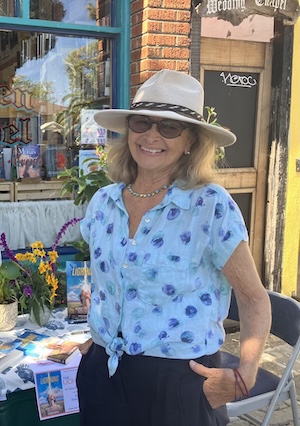 MaryFrank Sanborn: It was Christmas of 2004. I was visiting Santa Barbara, where my two sons and grandchildren lived, and I met a man through mutual friends who had just bought a ranch along Highway 1 just north of Cayucos. I did end up falling in love, just not with the man, though it was confusing at first. The truth was I fell in love with the place.
DC: And so you decided to stick around? At least for a while?
MS: Yes, instead of retreating back to Santa Fe, I rented a cottage in Cayucos and began forming my own relationship to the ocean and surrounding area. It was then I wandered into Coalesce Books in Morro Bay and Linna Thomas offered me a job on the spot. They had just lost a clerk and Linna and I had an immediate connection. I’d been involved in the arts—photography and clay—and had never had a real job out in the world, so even the concept was foreign to me. But I happily took the job. Eventually, I went back to Santa Fe, but I formed lasting friendships with the women at the bookstore and the woman who rented me the cottage.
DC: You define yourself as a “closet writer.” Why did you publish a book at the age of 80 and how does it feel?
MS: I say “closet writer” because writing wasn’t something I shared with very many people through the years. I did start keeping a journal on Valentine’s Day 1979 when I was 33. That kind of deep and reflective investigation, along with my first therapist, and coupled with my return to Boston University to finish my degree, led me to write other things as well—poems, essays, stories, fantasies. But my writings were so personal, not to be shared. It was more of an attempt to find and understand myself. So, I didn’t just sit down at 80 and write for the first time. In my 70s, I began to think that my writings might be of some value to others. I gained some confidence, I guess, to even think that way. Also, at that age, you can really say, “What the #%&!?” What’s the worst that can happen? Public humiliation? So what! And the publishing world is such now that you can get something published—no more needing to have an agent and wait years for the process to happen. As for the feeling? It feels great! My inner and outer self is more cohesive. I am a writer. The closet door has opened. More to come!
DC: You first started researching this novel in 1997. How much did the story change before you finally saw it published?
MS: The story line is the same. I had read Joseph Campbell’s The Hero with a Thousand Faces, and I wanted to tell a hero’s journey (or heroine’s, as I was more interested in that). I placed a character in a tough situation, gave her the opportunity to say yes, which the hero has to do to open herself up to something new, have an awakening, and return larger than when she left. The original story was about twice the size. I had to pare it down greatly when I began my rewrite last year.
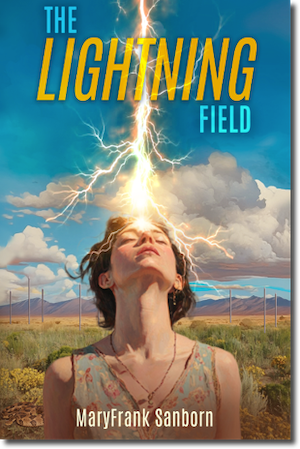 DC: From 1997 to 2026? That’s a long creative gestation period.
MS: I had written a first draft of The Lightning Field which Sherri and Joanne from Coalesce had read, but not Linna. When I got back to Santa Fe, I put it in a drawer along with years of other writings. Eighteen years passed. I grew tired of winters in snowy Santa Fe, and began dreaming of Cayucos again. In 2025 I spent two months there and reconnected with Linna. I told her about the old novel I was thinking of resurrecting. She said, “Send it to me. I believe in you. We’ll get it published.”
DC: Linna was such a wonderful, lovely spirit. What do you think she saw in your writing? Why did she respond so strongly to your book?
MS: Sadly, Linna never got to read The Lightning Field. On the very day I sent it—May 31, 2025—she died. I found out the following week. I’m not sure if Linna ever read very much of mine, other than a poem or two back in 2006. Her support of me was mysterious. For some unknown reason, Linna believed in me, the person. I was very moved by her gracious offering, and there’s a dedication to her in my acknowledgments. It really was because of her that my book was published. I felt she guided it from another realm.
DC: Your novel draws inspiration from a real place in New Mexico. What exactly is The Lightning Field? How did you first discover it?
MS: In 1980 on a PBS program on modern art, I learned of a land sculpture in Quemado, New Mexico, by the late artist Walter De Maria. The following year when a friend and I were planning a cross-country trip, we included a night there. I’ve been to The Lightning Field eight times over the years and always thought it would be a perfect setting for a story. I described it in detail in the book, but as “they say,” the menu is not the food. You have to experience the place on your own to receive the full impact of it. Put it on your bucket list!
DC: I confess I had never heard of this place before reading your novel. How did you feel visiting there? How did this experience inspire you to actually sit down and write a book?
MS: I feel a sense of awe every time, but other things as well, from fear and anxiety to the very heady feeling of being at one with infinity! The Lightning Field is an inspiring place, but it, in itself, didn’t inspire me to write the book. What it gave me was the most expansive and grand setting where the story unfolds.
DC: You’ve been both a photographer and artist, living in Santa Fe for more than 40 years. How does creative writing compare to these other art forms for you? More difficult? Any similarities?
MS: I remember an article I read years ago and have pasted in my studio called “The Talent of the Room,” by Michael Ventura. He said, “Unless you have ‘that,’ your other talents are useless.” He means, you have to be able to be in a room alone, for that’s what’s required. Being an only child, and an introvert, I’m comfortable in a room alone, but still writing is the most challenging for me, and most rewarding.
DC: I was really drawn to your central character. Is Clair Cassidy McKendrick based on a real person? How did you come to create such a memorable character?
MS: Thank you. I really like Clair too. She’s not based on a single person but more of a palimpsest of various women I’ve known, or been myself—with strengths and weaknesses and unknown parts yet to be discovered.
DC: I have to ask: given everything Clair experienced in her 28-year marriage, why do you think she stayed so long? Is this a common situation for women of your generation?
MS: I am at the very leading edge of the Baby Boomers, one foot just leaving the Silent Generation, so it was very much part of what came before, what we saw. You stayed. And stayed quiet. Until you didn’t. Remember there was a revolution beginning in the ’60s and ’70s. Only one friend of my mother’s got divorced and it was scandalous. But I had many friends, myself included, who left marriages, at some point.
DC: The bond between women is an incredibly important theme here. Clair has this strong female support group. I imagine you do, as well. Why isn’t Clair enough for this journey to succeed? Could she have made it on her own? How about you?
MS: In the beginning of the story, Clair is lacking in friendships, but is introduced to what it means to have true women friends, and then with their love and support learns—has the courage—to make different choices. I have to say, I love women! My friends mean everything to me. I have felt most deeply seen and supported by them, and I know I wouldn’t be who I have the courage to be myself without my friends. And as far as Clair making it on her own? I don’t think we ever really do anything completely on our own. We all need a helping hand, a leg up.
DC: I loved your book. I find your journey inspiring to people who might be older, but still have “that story” to tell, regardless of their age. What advice do you offer?
MS: Thank you so much! I’m glad you liked the book. So many more women have read and relate to it, so I’m happy to hear that men can read and get something out of it. As to what I’d say to others? “Yeah, man, tell your story!” or “Get out the canvas and oils!” I’d say, “Whatever you know is still untried inside you. Do it!”
DC: Finally, the obvious question: Will “lightning” strike twice for you as an author? Do you have a second book in progress?
MS: Yes, I have other books. I plan to publish another one next year called Pink’s Folly.
Editor’s Note: This interview has been edited for clarity and length.