
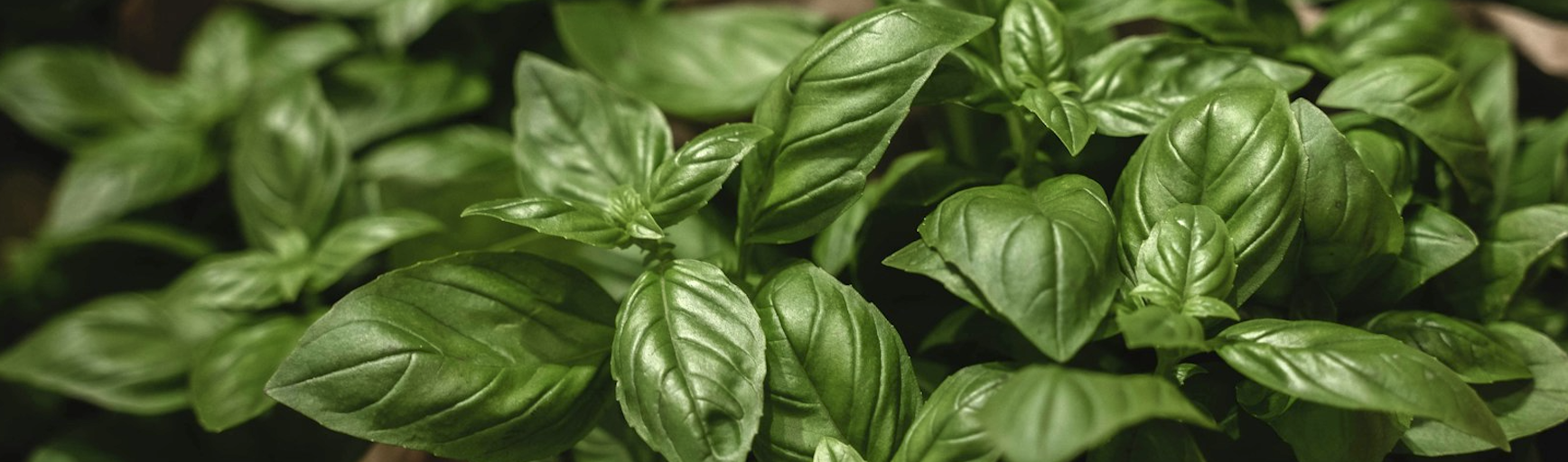
Photo by Paul Steuber
March arrives as it always does—with ambition slightly out of proportion to available space.
The Balcony Gardener draws up three lists.
Seeds to order.
Seeds she does not need.
Seeds she will order anyway.
She circles two varieties of basil as though considering marriage. Genovese: dependable, serious, inclined toward pesto. Purple Opal: dramatic, faintly operatic, perfectly capable of stealing the scene from a geranium. She tells herself she must choose. The balcony is not elastic. It already performs daily acts of spatial diplomacy between lemon balm, last year’s indignant thyme, and three pots whose original purpose no one remembers.
Still, she dreams of basil.
She sits with her blueberry and orange zest tea—an infusion so virtuous it seems capable of balancing accounts . . .”
At dawn, she sees neat rows of Genovese, fragrant and disciplined. By mid-morning, Purple Opal glows in her imagination like minor royalty among the terracotta. By tea time, she is calmly calculating that both could fit if the chair were quietly retired.
She sits with her blueberry and orange zest tea—an infusion so virtuous it seems capable of balancing accounts—when a postcard slides under the door.
Tasmania. Australia.
It is from her neighbor, Madame Dupont, who has travelled there expressly to attend the dahlia shows. Her script loops across the card with theatrical confidence: The dahlias are outrageous. You would approve. Also, I have eaten something involving rhubarb that defies explanation.
The Balcony Gardener holds the card to the light as if it might release pollen. For a moment she smells wet grass, apple orchards, the faint sweetness of distant soil. She considers whether dahlias would survive on the balcony. She considers whether she would survive dahlias on the balcony.
A crow lands on the railing with the authority of a visiting tenor. He clears his throat—audibly—and begins a series of declarations that, to her receptive ear, resembles “La Vie en Rose.”
She does not question this. Paris permits such interpretations.
“Encore,” she says gravely.
He obliges—but halfway through, the melody shifts. The tone grows sterner. Less Piaf, more parliament.
“Caw. Caw. Caw.”
She narrows her eyes slightly.
The crow fixes her with one bright, judicial eye and repeats the warning, louder.”
To anyone else it is noise. To her it sounds distinctly like: Beware the Ides of March.
She considers the thyme. She considers the basil. She considers her online seed cart.
“Is that about over-ordering?” she asks.
The crow fixes her with one bright, judicial eye and repeats the warning, louder.
She nods. “Very well. I shall beware.”
Apparently satisfied that prophecy has been delivered, he resumes something approximating romance, though slightly sharp on the high notes.
Emboldened by this recital, she sketches a horticultural idea that borders on reckless optimism.
Cross-pollination.
Perhaps a black hollyhock with a white cosmos—tall spires of near-midnight velvet softened by the airy, star-like looseness of cosmos petals. A flower both dramatic and forgiving. She would call it Midnight Constellation. Or possibly Hollycosmos, should humility prevail.
Or (and this feels delightfully improper) a liaison between nasturtiums and sweet peas. Peppery exuberance entwined with fragrant elegance. A vine with impeccable manners and edible rebellion.
She pauses.
She owns precisely forty-three pots.
There is no room for revolution.
The crow leans forward and inspects her tea.
“No,” she tells him.
He answers with what might be a minor chord.
As the light thins, she decides. Both basils. Smaller pots. Disciplined growth. Restraint.”
By late afternoon no seeds have been ordered, but the balcony has been rearranged four times. Imaginary trellises have been measured. She has stood quite still, attempting to discern which pot might secretly desire basil.
As the light thins, she decides. Both basils. Smaller pots. Disciplined growth. Restraint.
She goes inside for her notebook.
When she returns, the crow has departed. In his place rests a small, unmistakable offering, botanical in origin, if not in intention.
She studies it without alarm.
“Well,” she says softly. “Art requires sacrifice.”
She fetches a cloth. She wipes. She sighs. She laughs—not loudly, but with recognition.
March, she understands, is never about having room.
It is about believing there might be.
She goes inside, orders both basils, and—in a moment of quiet extravagance—adds black hollyhock to the cart.
The balcony will negotiate its own terms.
Teddy stretches into the warming sunlight, yawns with composure, and appears entirely unconcerned with prophecy, politics, or spatial diplomacy.
Editor’s Note: Read more of the Parisienne horticulturist’s adventures here and in The Balcony Gardener Volume 1.