
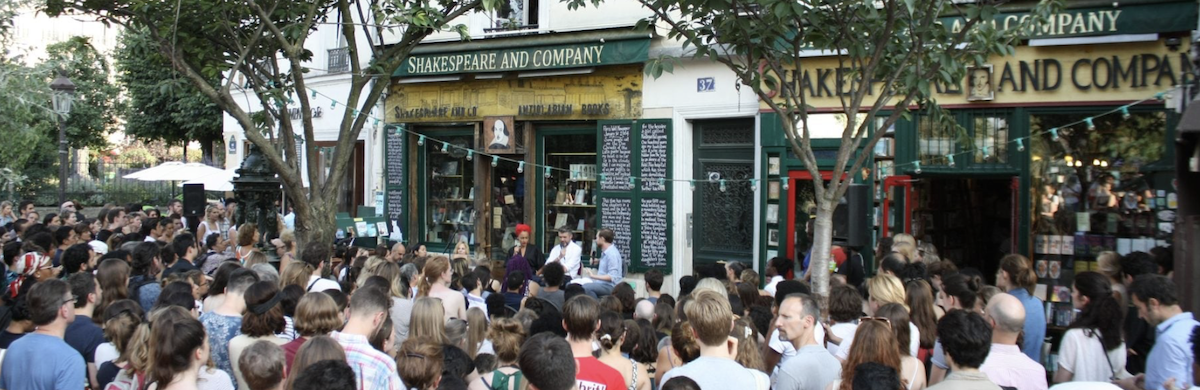
Photo courtesy Shakespeare and Company
In preparing for a recent trip to Paris, my first ever, I had my “to do” list pretty well mapped out. Drink Champagne at the top of the Eiffel Tower. Smile back at Mona Lisa. Wander the streets of Montmartre amidst the street artists and performers. Sample the Nutella crepes along Rue Cler.
But, being a writer, going to Paris also meant the opportunity to finally experience Shakespeare. One might call it a novel experience, because when the Bard is mentioned in Paris, it is typically in reference to what has become arguably the most famous independent bookstore in the world.
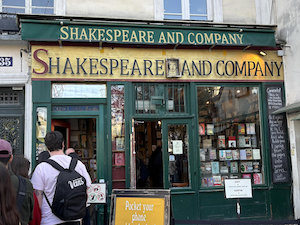
Shakespeare and Company is located kitty-corner, just across the Seine, from the historic (and newly reopened) Notre Dame Cathedral. Since its opening in 1951, this labyrinth of small, cramped rooms and dark, narrow passageways has become a point of pilgrimage for bibliophiles and writers of all genres and experience.
For years, it has been de rigueur to stuff a copy of Hemingway’s A Moveable Feast in your backpack, head over to 37 Rue de la Bûcherie and pay homage to the so-called “Lost Generation” of writers.
The original Shakespeare and Company was opened in 1919 by Sylvia Beach, an American expatriate in Paris. Her bustling shop on the Left Bank quickly became a gathering place and salon for some of the most important writers of the 20th century, including Gertrude Stein, F. Scott Fitzgerald, Ernest Hemingway, James Joyce, and Ezra Pound.
The bookstore eventually closed in 1941 during the Nazi occupation of Paris after Beach reportedly refused to sell a book to a German officer.
Fast forward ten years when George Whitman, another American expat, opened his own bookstore, Le Mistral, in 1951. In 1964, Whitman decided to honor Beach by renaming his store Shakespeare and Company. Whitman’s daughter, Sylvia, currently carries on the tradition.
You may recognize the famed location from multiple Hollywood films over the years, including Midnight in Paris, Julie & Julia, Before Midnight, and Jane Austen Wrecked My Life.
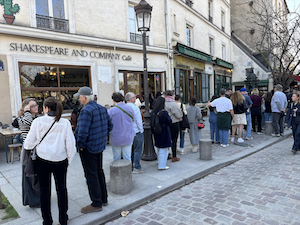 But nothing quite prepares you for an actual visit. Be forewarned: You’re likely to wait in line for about 15 minutes at the front door before entry. This place can be quite popular, even at 2:30 on a Friday afternoon, so customer flow is tightly controlled.
And put your cell phone and camera away. No photos nor videos are allowed inside. You’re here to browse and contemplate. Not distract nor disrupt (though there are multiple videos online that give you a tour).
What’s inside? Books. And more books. And even more books. Crammed and jammed and piled in every dark crook and nanny. The wooden floors creak. Minimal light drifts in from the front windows. Handwritten notes offer staff recommendations.
Frankly, the experience at Shakespeare and Company on the main floor is not unlike other independent bookstores I’ve encountered over the years. The real magic, I discovered, is when you venture up the incredibly narrow wooden steps to the smaller, second floor. Then history takes over.
These steps seem a bridge to the past. The wall on your left is dominated by a series of framed black & white photographs—famous writers who have visited or done readings (Allen Ginsberg, William S. Burroughs, Salman Rushdie), a nod to the Lost Generation of the earlier store incarnation (Joyce, Hemingway, Stein), as well as Beach and Whitman.
Painted on the actual stairs is a quotation, supposedly biblical: “Be not inhospitable to strangers lest they be angels in disguise.” The phrase captures Whitman’s well-known support of visiting unpublished writers—“tumbleweeds”—who are offered actual beds at the store and given the chance to find inspiration among the stacks as they scribble away.
. . . the second floor of Shakespeare and Company is like being in a special church—a cathedral, if you will—where every other congregant is also a writer.”
This second floor was smaller, quieter. More books, but none for sale. Classics, available just to thumb through and inhale. A table with a single typewriter over by the window. A young man, perhaps the next Hemingway, made notes furiously at a little desk in a cubbyhole. This was more my style.
I plopped down in the worn armchair and just tried to soak up the atmosphere, thinking about the writers who have come and gone in this space since 1951. What did they think when they sat in this same chair? What did this experience inspire them to go write?
I reflected on my own work over the years—what I am proud of. The times I came up short.
The best way I can explain those private 15 minutes is that the second floor of Shakespeare and Company is like being in a special church—a cathedral, if you will—where every other congregant is also a writer. You sense proximity to the Writing Gods and all that has come before you creatively. The moment is illuminating and quite moving—no other space has given me such a feeling.
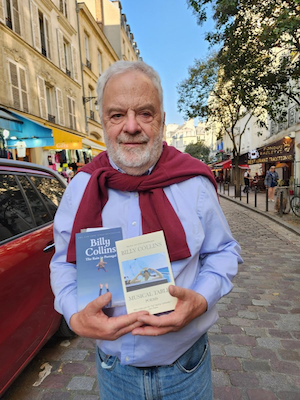 A writer visiting Shakespeare and Company and not buying at least one book is decidedly sacrilegious. I bought two, both collections of poetry by the great Billy Collins.
At the busy counter downstairs, the young clerk asked if I wanted a bag (for a fee). I declined, but I did let him stamp both books on the inside: SHAKESPEARE AND COMPANY KILOMETRE ZERO PARIS.
The clerk explained that this refers to the point in Paris from which all distances in France are measured. That “point” is back over by the cathedral, suggesting the bookstore is at the center of literary Paris.
Once outside, curious, I peeled off the price tags on the back of each book. Shakespeare and Company had charged me an extra five Euros over the published price. Per book. I shrugged. C’est la vie.
My friend Michael Kirtley is an American documentary filmmaker who has lived in Paris for 30 years. Mention Shakespeare and Company, he turns up his nose. “Tourist trap,” he says dismissively.
The man, I think, doth protest too much. There are currently more than 400 bookstores in Paris. If you’re just looking for something to read, then any of them likely will do.
Despite the dash of obvious commercialism, Shakespeare and Company still offers something more, something deeper. History. Appreciation. Inspiration. Belonging.
Key ingredients to a moveable feast. Enjoy.