
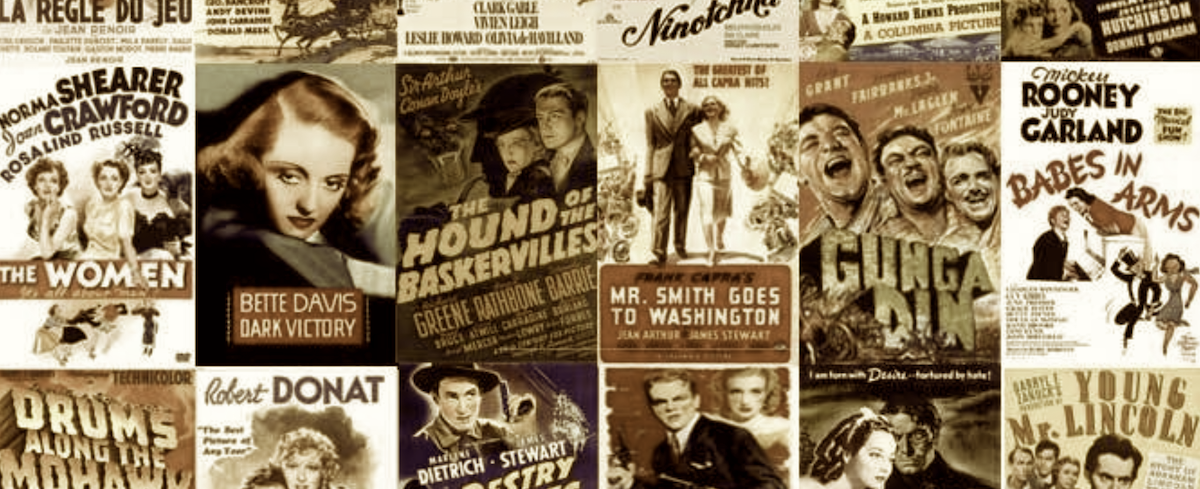
These are my parents, Robert Wilson Gregory and Patricia Margaret Keefe Gregory. They lived then in Taft, where I was born. But I remember that painting of the Monterey cypress on the wall. It was on our wall later, in Arroyo Grande, where I grew up.
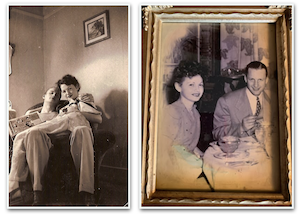 In the first photo (left), my folks are newlyweds. The second photo (right) shows them after Dad had come home from the war in Europe. They’re at the Biltmore in Santa Barbara, as far a remove from a tough oil town like Taft as you can get.
They met in 1939, in a candy store/soda shop owned by my mother’s parents. Dad ordered a banana split and struck up a conversation with the soda jerk, my future mom, a senior at Taft High School. They were married in September 1940.
What came in between was their courtship, during a year of some of the most enduring films in American history: 1939. Hollywood made me possible many years later.
I will now embark on a fool’s errand. If I had to pick 1939 films that mean something to me personally, which would I choose? Nearly all of them, of course. But that would be cheating. I decided on three. Here they are:
 Young Mr. Lincoln
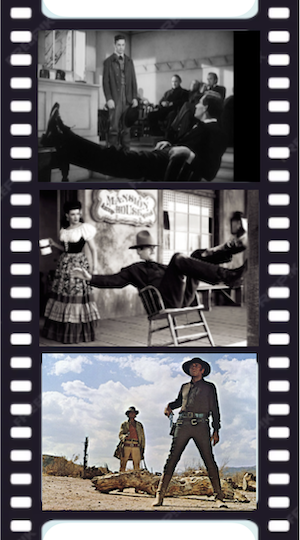
You can criticize me for omitting John Ford’s Stagecoach, and you can condemn his Lincoln hagiography (as naive as a sixth-grade textbook), but this is the first film in which Ford emphasized, of all things, Henry Fonda’s legs.
They are inordinately long, and young Abe (a nickname Lincoln detested) is far more comfortable resting them on the grass alongside a Sangamon County riverbank than he is in trying to deploy them inside a Sangamon County courthouse.
Ford used those legs again, in Gunfight at the OK Corral, in a brief but delightful scene where Fonda’s Wyatt Earp attempts to balance his chair along a Tombstone boardwalk.
Sergio Leone even used them, in a low-angle shot, as Charles Bronson guns down evil Fonda in Once Upon a Time in the West, nearly 30 years after Young Mr. Lincoln.
Ford understood the integrity that Fonda communicated: if Daniel Day-Lewis became my favorite Lincoln, Fonda, in the Cold War thriller Fail-Safe, is my favorite movie president.
Mr. Smith Goes to Washington
If you want to know my politics, they’re hopelessly romantic (I’m Irish). They are embodied in Mr. Smith Goes to Washington.
One of the threads that makes these films so powerful is their leading actors, Fonda and James Stewart. They were the best of friends, going back to Depression-era summer stock. They later shared a cheap apartment in New York City. (Gene Hackman’s roommates, in his New York stage days, included Robert Duvall and Dustin Hoffman). You can imagine the young actors splitting a can of pork and beans or putting a bucket below a roof leak.
Fonda and Stewart loved America, but expressed it in vastly different ways. Fonda was the Hollywood liberal, and Stewart the lifelong conservative from Indiana, Pennsylvania. Mr. Smith’s love for America is illuminated, as well, by its immigrant director, Frank Capra.
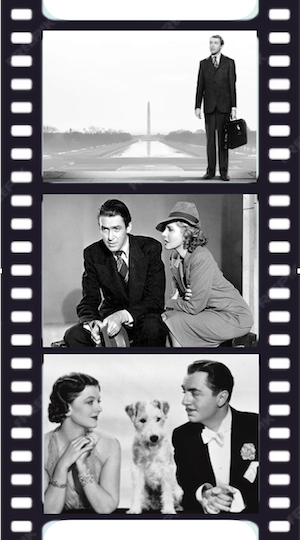 It’s Stewart’s dogged idealism that makes Mr. Smith so appealing to me, but he’s not my favorite part. My favorite part is his co-star, Jean Arthur.
Arthur was smart, spunky and very funny, yet she suffered, all her career, from debilitating stage fright (even on film sets). Yet in Mr. Smith, she is near-perfect as a cynical reporter, Saunders, who reluctantly takes Stewart (Sen. Jefferson Smith) under her wing.
After young Smith, a newcomer, is humiliated on the Senate floor, he decides to resign and leave town. Saunders finds Smith and there’s a quiet streetside dialogue where she helps him find his courage again. It’s a stunning scene. What makes it so is the generosity of Arthur’s performance.
Another Thin Man
Nick and Nora Charles—he, a worldly private detective, she a light-hearted socialite—are an odd couple. But in this entry in the film series based on San Francisco novelist Dashiell Hammett, the couple must struggle their way through a mansion-load of snooty people to find the one who is a killer.
If solving a murder case can be charming, Nick (William Powell) and Nora (Myrna Loy) make it so. The chemistry between the two is such that many Americans thought that they were married in real life.
Their relationship is marked by witty comebacks, a disobedient terrier named Asta, Nick’s old San Francisco crime friends (most of whom he’d put in jail) dropping by to visit, and a diet that seems to be comprised mostly of martinis. Nick especially is frequently pixilated.
Despite all that, Nick and Nora are very much in love. He makes her scrambled eggs when she can’t sleep.
Powell and Loy weren’t married, of course. The woman who wanted to marry the impossibly suave Powell was the actress Jean Harlow. They spent time together at Hearst Castle, where Harlow tried to wear down Powell’s reluctance to marry her. But Powell wasn’t ready for that kind of commitment.
When Harlow died of kidney failure in 1937, the impact on Powell was overwhelming. He had lost the love of his life. Loy had lost one of her best friends.
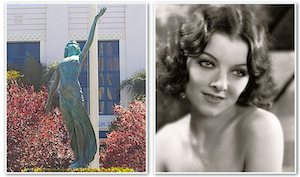 I am not ashamed of my fondness for Myrna Loy. She could play light roles like Nora, but she was layers-deep in The Best Years of Our Lives as a World War II wife who realizes her soldier-husband has come home an alcoholic.
I’m not alone in my admiration for Loy. As a teenager, she was the model for a statue that remains in front of her alma mater, Venice High. She had a devoted fan in Holland, too. Some of my Arroyo Grande High School history students and I visited the Anne Frank House in Amsterdam many years ago. In Anne’s room, inside the Secret Annex, she’d cut a photo of Loy from a movie magazine and glued it to the wall. It was still there, carefully preserved beneath plexiglass.