
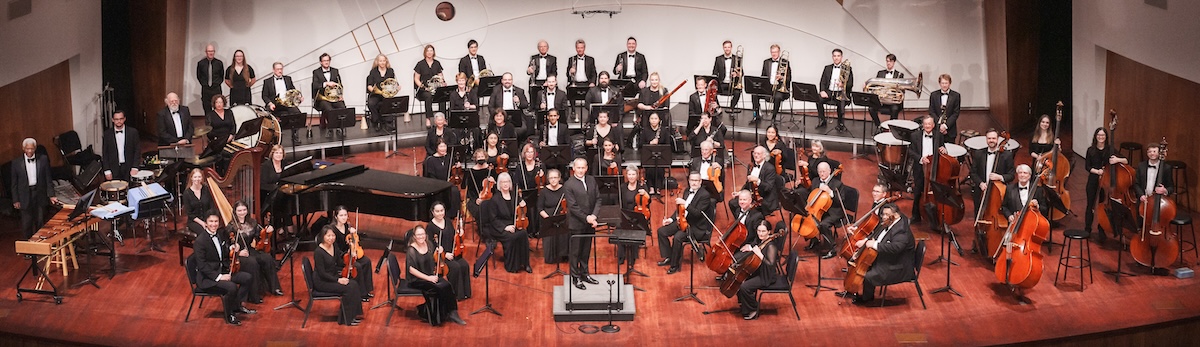
The San Luis Obispo Symphony‘s October 4 Classics I concert, “Rites of Passage,” features both legacy and innovation with the pairing of Stravinsky’s The Rite of Spring and the world premiere of A Sense of Place by local composer Stefan Podell.
The program opens with Samuel Coleridge-Taylor’s Danse Nègre, but all ears at the symphony’s 2026-27 season opener are sure to be on Podell’s 33-minute-long tone poem, inspired he says by views of Zabriskie Point, San Francisco Bay, and San Diego’s Pacific Beach, as well as videos he found of green flashes at sunset and foghorns.

A Sense of Place was commissioned by SLO Symphony patrons Garrett Foulke and Dorothy Correa, facilitated by the American Composers Forum. “I think there is great value in supporting new original works,” Foulke says. “In music, it ensures the ongoing talent of composers and gives the audience new sound, and new perspectives that I think is appreciated on a local and global level.”
The idea for a long work by the composer began with a conversation between Foulke and SLO Symphony Maestro Andrew Sewell while the two were discussing a short piece that Podell volunteered to write for a Symphony charity auction.
“The Rite of Spring” is my favorite piece of music in the world, so I’m sure there’s some of that influence in there.”— Stefan Podell
A formal commission through the symphony was problematic—Podell serves on the Symphony’s board of directors. Searching for another route, Foulke discovered the American Composers Forum and its mission to support new compositions by American composers. “They were the perfect instrument for our needs,” Foulke says.
Foulke and Podell began discussing their mutual music interests and favorite pieces, and Stravinsky’s The Rite of Spring was close to the top of both their lists. Podell says other influences are at work in A Sense of Place as well.

“The Rite of Spring is my favorite piece of music in the world, so I’m sure there’s some of that influence in there,” Podell says. “But I grew up on progressive rock bands like Rush and Yes, and film scores from John Williams, James Horner, Elmer Bernstein, and so many others. So those might show up, too.
“Hopefully,” Podell continues, “All that background has been flavored with some creative spark of my own.”
He started developing themes in October 2025, and the shape of the first movement soon thereafter.
“Work at that stage was pretty spread out,” Podell says. “In March of this year, I stepped things up and completed the piece in mid-August. I tend to find writing large pieces quite intense and could only write a couple of hours a day.”
As he began working on the orchestration, editing, and preparing the score for the conductor and musicians, he says he worked eight to 12 hours a day. “The oncoming deadline also helped motivate me,” he admits.
“Rites of Passage” has been scheduled as a special Sunday afternoon performance, and audiences are invited to walk the red carpet as the Symphony opens its season.
“There’s no better way to open a season than by honoring where this music comes from while embracing where it’s going,” according to SLO Symphony’s executive director Rachel Sabalboro. “Pairing a world premiere with a work as revolutionary as The Rite of Spring reminds our audiences that great music has always been about pushing boundaries, and we can’t wait to share that spirit with our community.”
The impact of premiering a new piece goes beyond this one performance, Foulke says. “Without new works, art would just be art history, and how would we nurture the next great artist?”