
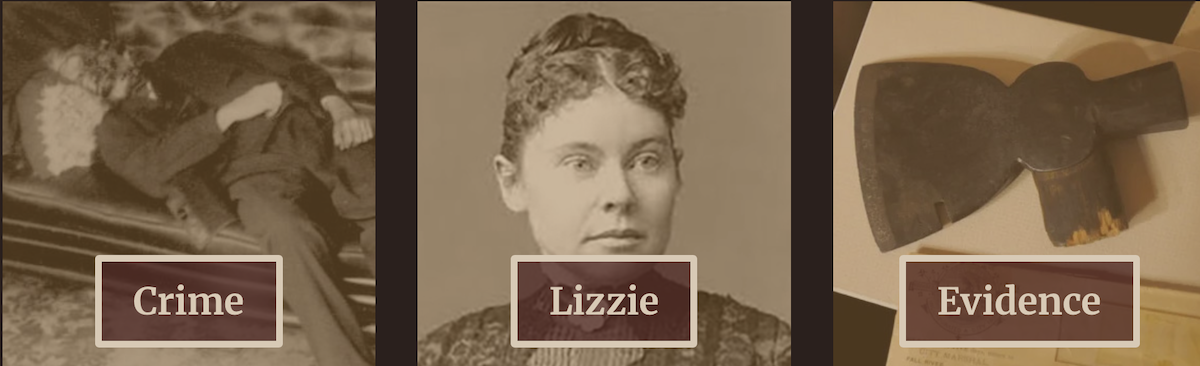
Editor’s Note: The case of Lizzie Borden, accused of taking an axe to her parents in 1892 Victorian-era Massachusetts, remains a subject of discussion and fascination.
This week Netflix released Monster: The Lizzie Borden Story, as an eight-episode drama from producer Ryan Murphy, starring Ella Beatty and Charlie Hunnam.
Teena Booth, a Central Coast screenwriter with more than 50 credits to her name, knows the Borden story well, having served as co-producer on the 2014 movie Lizzie Borden Took an Axe. Booth, who has visited the historic Borden home in Fall River, Massachusetts, recently launched a new website, Lizzie Borden Encyclopedia, for those interested in all the grim and gory details.
Booth weighs in on why she believes the jury made the right decision in acquitting Borden. And she does so with no apparent axe to grind.
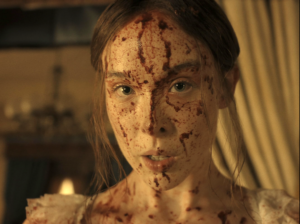
Her wide blue eyes look out at us from between the spatters of blood on her face as if she is surprised at what she has just done.
Lizzie Borden, the world’s most infamous axe murderess, has killed her father and stepmother yet again, but it is not really a surprise to us. Before we even turned on the TV we knew Lizzie was guilty.
The hypnotic rhythm of the jump-rope rhyme that begins “Lizzie Borden took an axe” long ago induced cultural amnesia, making us forget that she was tried and acquitted of the 1892 murders.
It can be irritating to learn that Lizzie was found “not guilty.” We don’t want to think of her as a persecuted innocent, wrongly accused. We prefer her in the role of avenging Fury, delivering herself from her patriarchal oppressors.
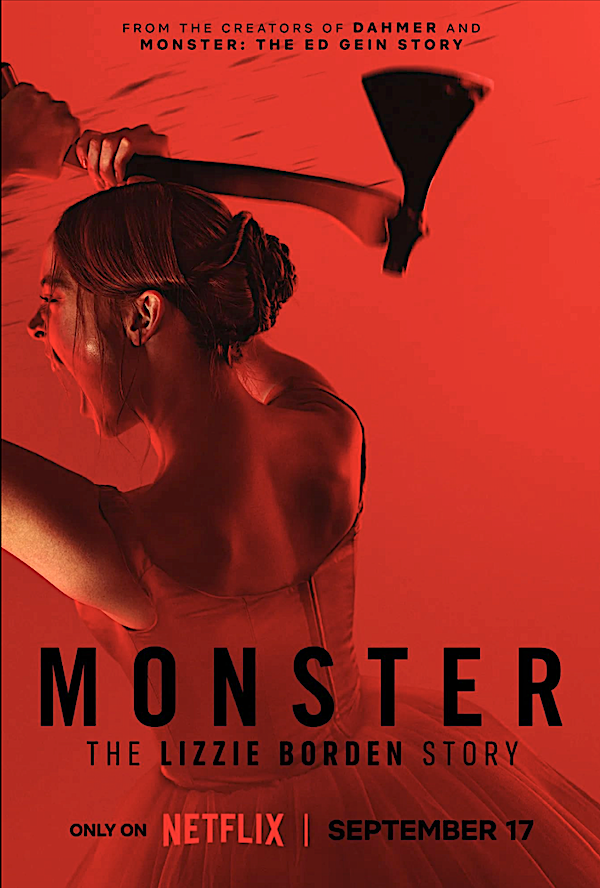 We want the catharsis of watching her take a gleaming axe and deliver those brutal whacks to the elder Bordens’ heads as she grunts from the effort.
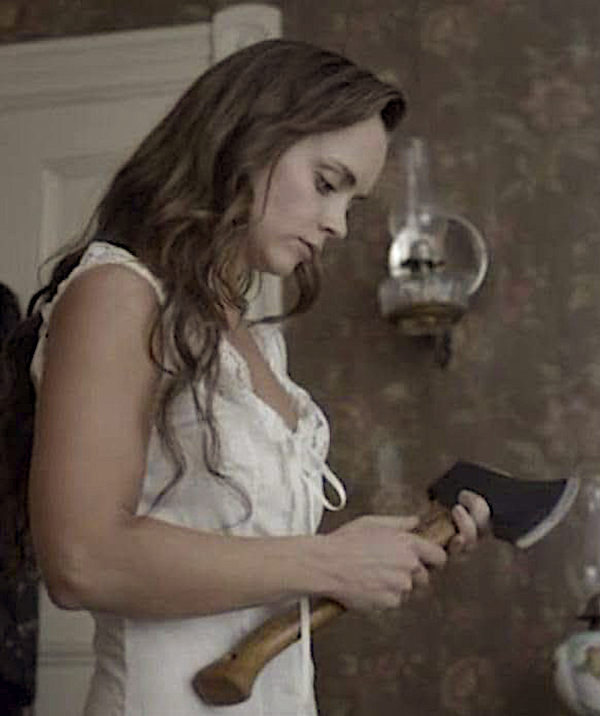
Indeed, over the decades we have watched her kill many times—in plays, a ballet, an opera, a rock musical, and multiple works for the screen, with another depiction of her orgiastic murder spree coming in season four of Netflix’s Monster series.
If we couldn’t put the axe in Lizzie’s hand there’d be no reason to depict her at all, or so reasons the filmmaker.
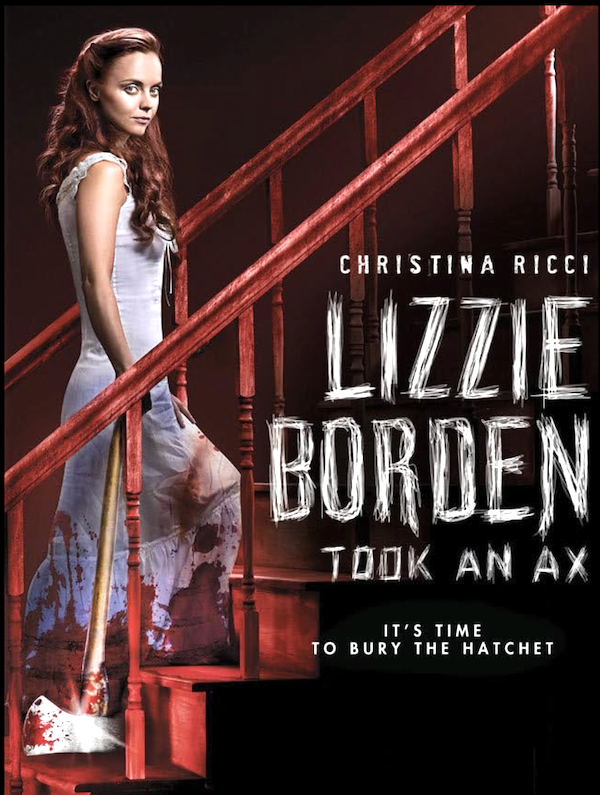
I know this because I have written a dozen true crime scripts for television and I am credited as an executive producer on Lifetime’s 2014 movie about Lizzie. This means every account of the Borden murders is a whydunnit, rather than a whodunnit, which necessarily turns it into a work of fiction.
Authorities found so little motive to explain why a Sunday school teacher known for her good works would rise up and slay her parents that a filmmaker, like the district attorney who prosecuted Lizzie, has no choice but to dream up a motive for her.
And so, we get invented lesbian love affairs, vindictive pigeon beheadings and the morally problematic villainization of the victims.
Yet, the whydunnit, however interesting for the course of a two-hour movie or the eight episodes of a limited series, is not the reason the Borden murders are considered preeminent in the annals of American crime.
 It is not why, decade after decade, a subculture of amateur sleuths has printed newsletters, published magazines and filled blogs and message boards with millions of words dissecting every detail of the case. It is the perplexing, never-solved whodunnit that seizes the imagination over the long term.
As crime journalist Edmund Pearson wrote in his 1924 book Studies in Murder, it is the “astonishing puzzle,” in which “the perpetrator of the double murder was protected by a series of chances which might not happen again in a thousand years,” that has made the case an ever-enduring fascination.
Or, in the words of a 1978 American Heritage Magazine headline about the murders, “She Couldn’t Have Done It, Even If She Did.”
It was Pearson, the first serious writer to do a close examination of the case, who ultimately decided that Lizzie’s jury had been wrong to acquit her, and that she had been the perpetrator.
His conclusion was so influential that it held sway for most of the 20th century. By the time of the 1992 centennial conference on the murders in Fall River, Lizzie’s guilt was accepted as a given; only one of the 29 papers in the published proceedings of the conference held out the possibility she could have been innocent.
Yet today we have access to so much more information than Borden scholars had then. Thanks to the tireless work of the historians at Lizzie Andrew Borden Virtual Museum & Library, we can now read transcripts of the inquest, the preliminary hearing and jury trial, along with witness statements taken by the police.
We also have recently published books of archived newspaper articles as well as letters and journals from both the prosecution and the defense. Plus, we have the masterwork of the curators of the Fall River Historical Society, Parallel Lives: A Social History of Lizzie Borden and Her Fall River, allowing us never-before-seen glimpses into Lizzie’s life before and after the murders.
After a careful study of the resources available to us today, what emerges—at least for many and certainly for me—is that her jury got it right, and Lizzie Borden was likely innocent.
One cannot be certain, of course. The insoluble core of the case remains, as does the macabre mythology that clings to the murders, attracting the interpretations of creative artists to this day.
There is no doubt those interpretations entertain. But as we watch, let’s remember that what is playing out on our screens is not an accurate window into the tragedy-stricken Borden family; it is more a window into the storyteller’s mind.
Perhaps the next filmmaker who takes on the murders will be able to resist the temptations of the fictional whydunnit and give us a fact-based whodunnit equal to the astonishing puzzle.