
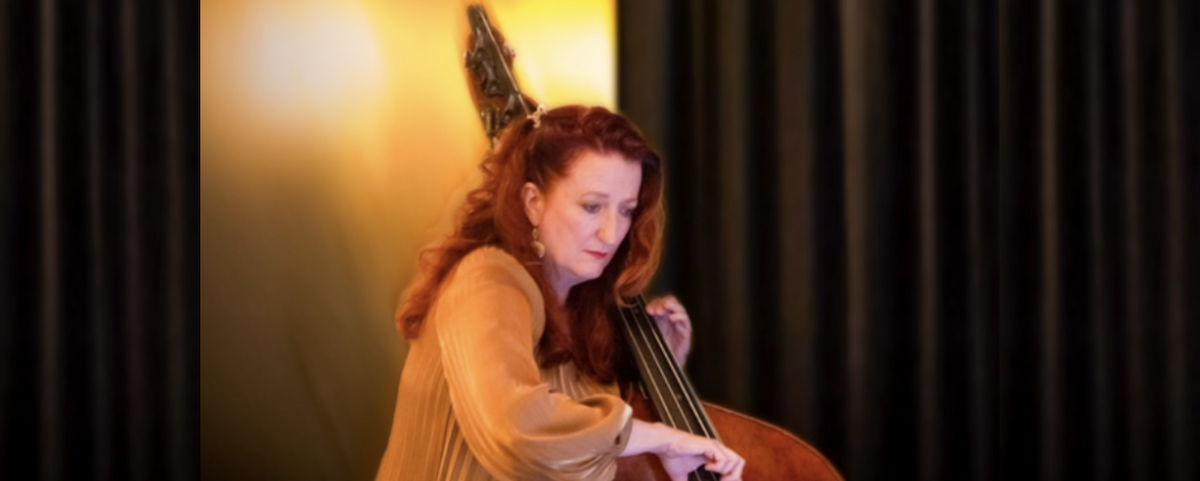
Three cheers and more for Festival Mozaic’s 2026 artist in residence, contrabassist (double bass player, bassist—or upright bassist, if you prefer) Susan Cahill.
Her recital on April 11 at the San Luis Obispo United Methodist Church reminded us that just because a musical instrument has a low timbre or has often been used as reinforcement to an accompanying role in ensembles does not mean that it can’t be used for solo performances. Cahill’s artistry ran the gamut from pathos to humor, lyricism to edgy excitement to “I am here and I WILL BE HEARD!” presence.
In her pre-concert lecture, Cal Poly music history professor Alyson McLamore prepared us listeners for what was to come by using a term from the painterly arts. “Pentimento” refers to discovering the traces of an image that has been overlaid by a newer one, and McLamore played us several recorded samplings of musical sonorities hidden within the pieces Cahill was to perform.
The engineering nerd side of my brain likes to point out that the lower tones of the contrabass contain many more audible overtones, yielding a very rich sound that is especially noticeable when combined with other, higher-ranged instruments.
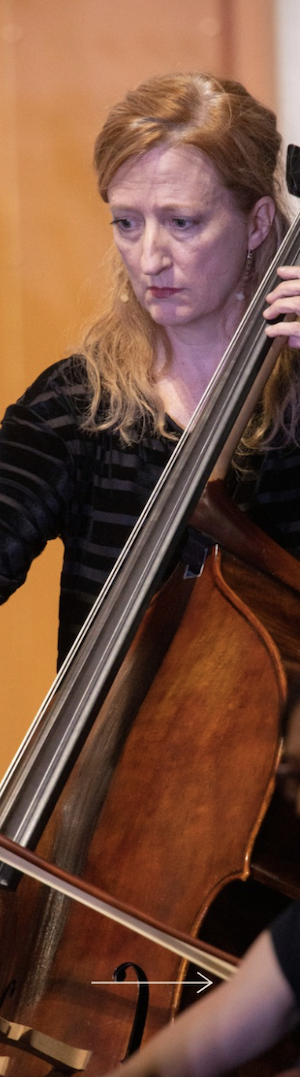 Cahill began with what might be called a quintessential pentimento offering: Her own improvisation inspired by composer Xavier Dubois Foley’s 2020 composition, Etude No. 3, “Lament.”
Beginning with sonorities in the lowest register of the instrument, one could feel the artistry in this work almost as much as hear it. As is the case with music composed over the last 125 years, performance techniques for individual orchestral instruments have been greatly expanded and refined, allowing today’s performers to treat audiences with awe-inspiring colors of sound. Cahill’s expert technique evoked moods from elegiac solemnity to the light-hearted airs of a Baroque spring.
The second work, Duo Concertante for Violin and Contrabass by 20th century Polish composer Krzysztof Penderecki (pronounced “Kristoff Penderetski”) called for Cahill to be joined by another spectacular string-playing wizard, violinist Eunice Kim.
McLamore characterized the work as portraying the performers alternately as “antagonists, dance partners and mimics.” Similarly, it sounded to me like slices of conversations between two longtime, intimate friends or perhaps life partners. The technical prowess demanded from the performers by the decidedly modernist Penderecki is daunting, but Kim and Cahill delivered it with exquisite aplomb.
Cahill took us on an aural journey back in time almost 280 years for her next endeavor. With the addition of veteran pianist Michael Tilley and violinist Kim, Cahill assumed the role of continuo player for the late-Baroque-era Sonata in D Major for Violin and Continuo by one of that era’s musical giants, George Frideric Handel.
Although continuo instruments are used in a supportive accompaniment role, they are critical in creating the harmonic texture for the soloist, and the richness and inventiveness of Cahill’s embellishments gave a decided fullness to Tilley’s realizations. Kim lent a marvelous period-like sound to her violin by eschewing the use of vibrato. Handel would have smiled.
The program’s last two works brought us back to the late 19th and 20th centuries. First was Vilmos Montag’s Sonata in E minor for Contrabass and Piano, written for his brother Lajos, who was the author of a widely used series of method books for double bass performance. Needless to say, the sonata covers a broad range of extended techniques, all clad in a multicolored tonal tapestry reminiscent of works by Ravel or early Scriabin. Cahill rendered it all with grace, eloquence and flair.
Violinist Kim was brought back onstage for the final work of the evening: Rachmaninoff’s Trio Elegiac No. 1 in G minor for Violin, Contrabass and Piano.
Rachmaninoff was only 19 when he composed this trio, and it exhibits pentimento-like elements gleaned from a similar trio by Tchaikovsky. It still demonstrates a level of sophistication that was brilliantly showcased by the ensemble of Kim, Cahill and Tilley.
It begins with murmuring tremolos from the strings that is soon overlaid by the principal theme from the piano. Rachmaninoff deftly passes the melodic responsibilities through each instrument, ending with the piano in the accompanying role with arpeggios, then chords interspersed with brief flourishes while the strings pass the original theme canonically back and forth, all fading into a somber, heartfelt end.
The audience showed their appreciation with an extended standing ovation.
Author’s Note: October 25, 2018, was a date of mixed feelings for me. It was my 70th birthday, but my happiness at that milestone was tempered by the fact that my wife and I were wheelchair bound, recovering from the impact from a car while crossing the street. Our injuries were not catastrophic, but the healing process hampered our lifestyles. Cue a guardian angel in the form of then-Festival Mozaic Board President Joanne Miller. She called to inform us that she had two places at her table for that evening’s Notable Encounter Dinner and asked if we’d like to join her. I replied that it would be great, but we were a bit incapacitated. “No worries,” she said. “I used to take care of my aging father when he could no longer walk. See you tonight.” Joanne deftly maneuvered us into her SUV, packing the wheelchairs in the rear cargo space. We got to the dinner venue and were wheeled to the center-front table where we enjoyed dinner and a delightful pre-performance lecture recital led by . . . Susan Cahill! I let both her and Joanne know that they saved my birthday.