
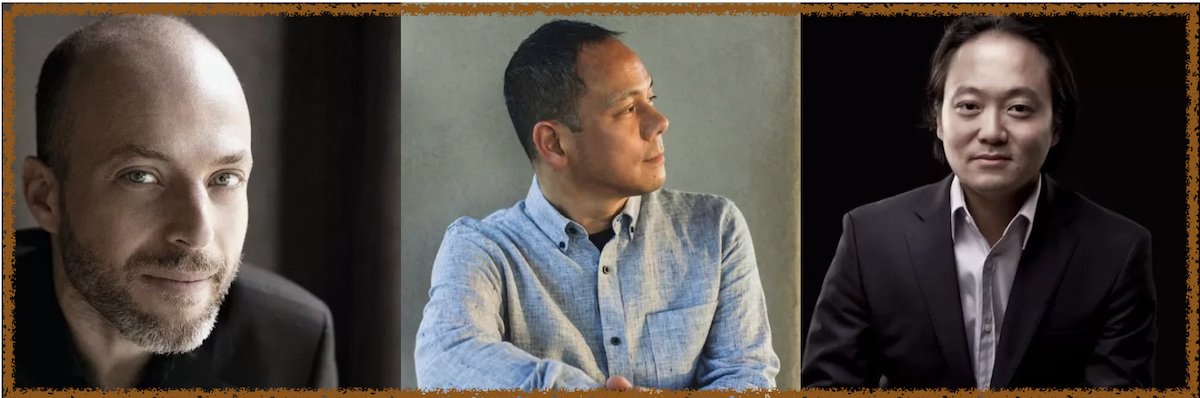
Orion Weiss, Bion Tsang, Scott Yoo
I enjoy attending Scott Yoo’s “Notable Insights” and Alyson McLamore’s pre-concert lectures for Festival Mozaic. I may not always agree with them on some niggling detail or other, but they invariably bring up things I hadn’t thought of before.
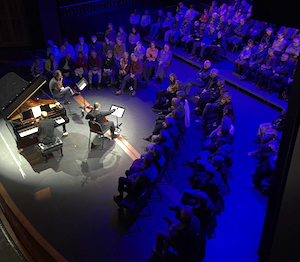 In the case of the February 20 “Strauss on Stage” presentation prior to the Chamber Concert the following Sunday, February 22, Yoo revealed his reason for choosing the program that would feature one work each by Richard Strauss and Franz Schubert at the opposite ends of their careers.
Yoo’s lecture focused on Strauss at the beginning of his foray into musical composition with the “Sonata for Cello and Piano in F.” He pointed out that Strauss was only 17 when he submitted it as an entry into a contest for new cello and piano works. It did not win, but after reworking it, the sonata had a successful premiere that helped launch Strauss’s career. It is now part of the standard cello repertoire.
Yoo’s colleagues, cellist Bion Tsang and pianist Orion Weiss, supplemented the lecture with excerpts from both the contest version and the more polished premiere piece. The latter was superior to the contest entry, but in spite of a masterful performance by Tsang and Weiss of the entire sonata on Sunday, I felt that the piece was good, but not as moving as I had hoped.
What stood out to me was an excess of doubling of the melodies by both instruments in the first two movements, and an overall sense of the cello being subordinate to the piano, which is at odds with the concept of solo-plus-accompaniment compositions.
Having heard the work in recordings by other artists and heard Tsang and Weiss collaborate on other music, I will say again that this is not an issue of interpretation or technique. This sonata just didn’t have enough “there” there for me. I will admit that my familiarity with Strauss’s more mature repertoire probably influenced my expectations.
As Strauss matured, of course, his compositional artistry skyrocketed, making him a preeminent master of the tone poem as well as Lieder (German art-songs) and grand opera.
It’s rather unfair, then, to compare Strauss’s sonata, his opus 6, with Schubert’s “Piano Trio No. 2, opus 100,” performed in the second half of Sunday’s concert.
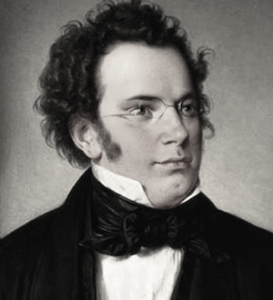
Schubert’s trio was composed close to the end of his life and most certainly at the peak of his craft. As McLamore pointed out in her pre-concert lecture, rather than being composed for the serious endeavor of winning a competition, Schubert wrote this trio as a gift for a friend’s engagement party. It was very well received.
Fast forward 200 years: Yoo, Tsang and Weiss gave this Austrian masterwork a marvelous execution. The listeners were treated to Schubert’s masterful rendering of early Romantic tonal architecture, including deft trading of melodic and supporting harmonic elements among the three instruments, each sharing the acoustic spotlight—with the largest portions enjoyed by the violin and cello.
One of my favorite criteria for judging such artistry is how the intertwining of the music with the performers’ aesthetic is so engaging that time seems suspended. This work certainly did not feel as if it was 45 minutes long. No wonder the performers received a vigorous and prolonged standing ovation.
Both Romantic-era composers have become highly placed in the pantheon of Western art music. Many accolades and thanks to Yoo, Tsang and Weiss for reminding us with such magnificent performances.
Two Giants of Western Art Music
Some fascinating commonalities I found with respect to these two giants of the Romantic era:
- Strauss’s sonata—catalogued as opus 6–was not deemed worthy of winning the competition, but achieved popularity after Strauss reworked it and it was performed for the public.
- Schubert’s first cataloged work—opus 1—was “Erlkönig,” a Lied setting of Johann Wolfgang von Goethe’s eponymous poem that is a tour-de-force for both the singer and accompanist even today. In spite of the popularity of Schubert’s Lieder (he wrote over 500), the listening public of early 19th century Austria considered the genre “second tier,” according to McLamore’s research.
- Strauss’s fame grew from his mastery of the tone poem wherein music is used to tell a wordless story by dint of imitative sonorities. One of his most famous is “Also sprach Zarathustra” (“Thus Spoke Zarathustra”) that opens with a bone-rattling pedal double-low-C from a pipe organ, double-bass violins and contrabassoon. A massive C major chord builds on top of this that immediately changes to C minor, then repeats the opening notes, this time building in C minor then switching back to major. The title for this opening is “Sunrise.”
- Similarly, Schubert’s Lieder includes significant word-painting. In “Erlkönig,” he calls up the impression of horse hoof-beats with rapid, staccato triplets in the accompaniment to illustrate the song’s setting of a father frantically driving a carriage carrying him and his sick child home. If that isn’t enough, Schubert calls on the singer to express four different characters that are part of Goethe’s poem: a narrator, the father, his ill son and the evil spirit of the child’s fever-dream (Erlkönig).