
One of my favorite graduate composition classes was “World Music.” This was more accurately (if a bit more awkwardly) named “Introduction to the Field of Ethnomusicology”—the study of the musics (not a typo—like “fish” and “fishes”) of chiefly indigenous and folk cultures around the world.
So, I was pleased to be able to review Festival Mozaic’s February 19 evening concert, Lucia Micarelli: “Anthropology,” at the Harold J. Miossi Cultural and Performing Arts Center at Cuesta College.
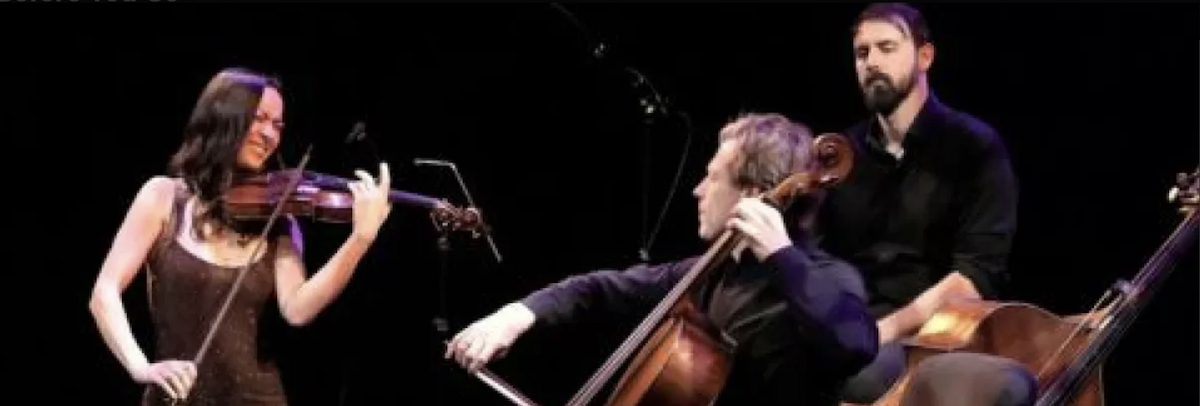
 A top-notch violin virtuoso, Micarelli joined forces with equally facile cellist Eric Byers and contrabassist Nathan Farrington to present the audience with a 16-course sonic banquet, plus two encore desserts. Seven of the offerings included vocals: six from Micarelli and one from Farrington—a sweet and surprising rendition of “Are You Lonesome Tonight?”
The concert was brilliantly executed and energizing from start to finish.
My favorites included the opener, “1B” by Grammy-winning composer and bassist Edgar Meyer. A rousing bluegrass trio, it got the audience fired up with foot-stomping rhythm and sparklingly agile playing.
I got a sentimental tug from the offering “Be My Husband.” Beginning with Byers sitting in a chair and alternating foot-stomps with hand claps roughly every second, Micarelli inserted a melancholy ballad about a male lover who had been incarcerated and forced to work on a chain gang. Why my reminiscent pang? Micarelli had created the song as an imagined response to a real chain gang work-song called “Rosie,” which I first heard in my World Music class almost 30 years ago. Both were viscerally intense and full of pathos.
Zoltán Kodály’s “Duo for Violin and Cello” was a fascinating excursion into two compositional approaches popular in the early 20th century that had roots in Asia: pentatonic scales and the folk idioms of Kodály’s homeland, Hungary.
Kodály’s work begins with the violin intoning a long, fluid pentatonic (five note) melody reminiscent of Ralph Vaughan Williams’ “The Lark Ascending” which, interestingly, was composed the same year. It then brings in the cello, and the two instruments embark on a series of back-and-forth then ensemble sonorities that included both the pentatonic and more angular modes of Hungarian folk music—a really attractive and eclectic mix.
The rest of the concert showcased a broad range of technical and aesthetic prowess, from the High Renaissance music of Thomas Tallis to Micarelli’s haunting interpretation of Joni Mitchell’s widely acclaimed and beautiful allegory, “Both Sides Now.”
Lucia, Nathan, and Eric: I humbly thank you.