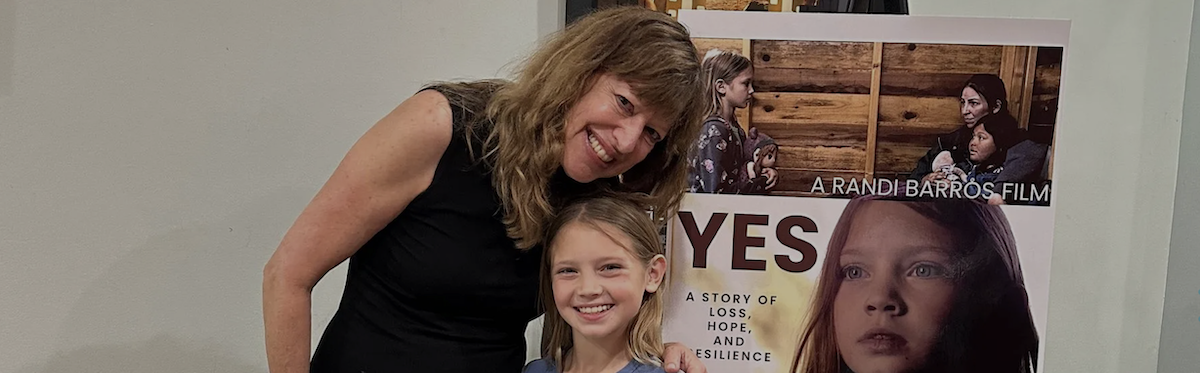
Filmmaker Randi Barros and actor Kira Guchko at the AFI sneak preview of “YES”
Last June, residents and students in the town of Noci, Italy, gathered beneath the night sky around a historic villa as finalists for the Noci Film Festival awards lit up a movie screen. Among them was YES, a 20-minute film by San Luis Obispo filmmaker Randi Barros.
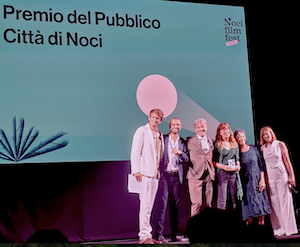
“We chose to award the short film YES by Randi Barros for its ability to tell a moving and powerful story of empathy and solidarity,“ a spokesperson for the Noci Youth Jury said when handing its Audience Award to Barros. “The film tackles important themes such as loss, loneliness and hope, and shows how even the youngest among us can make a big difference in the lives of others.”
The film about migration and human connection, written and directed by Barros, is told through the eyes of two eight-year-old girls. Barros and executive producer Jennie Lew Tugend both attended the festival, and they stayed in an apartment in the heart of the town. From kids to adults to a youth film camp, everyone in town gathered from 9 p.m. until midnight to celebrate the films.
“I was so honored that we won the Audience Award among all the films we saw there, because there were so many good ones,” Barros says. “They could not have been more warm and welcoming. They were really happy to see a film that was nuanced about immigration.”
From a small-town festival in Italy to the San Luis Obispo International Film Festival, YES has traveled widely since its October 2024 release, earning numerous awards from diverse audiences.
Its very first screening took place in July 2024 at the American Film Institute in Los Angeles, shown to friends, family, cast, and crew while it was still a work in progress. “It was kind of finished, but not completely finished,” Barros says. “It was really fun because all of the cast members came, and the American Film Institute is just such a beautiful, storied place.” About 100 people attended the screening.
The film’s first festival appearance followed at the La Femme Film Festival in Los Angeles, which is dedicated to women creators. The screening took place while Barros was still hoping to get into larger festivals. “One of the good things is that some of the students who had worked on it, who couldn’t make it to the AFI screening, came to that one,” Barros says.
Alongside members of the cast and crew, including cinematographer Curtis Yap, new audiences were introduced to YES at the Pasadena International Film Festival, its first official in-competition screening. “A lot of people came up to me and just said how much they loved it, and also how timely it was,” Barros says.
As the film reached more festivals, its story of migration only became more resonant. Barros says she originally thought the script, written during the Biden administration, might have been too harsh.
“There’s a part of the film where one of the characters is in his car, and he’s listening to right-wing talk radio, and they’re talking about locking the kids up,” Barros says. “And I thought that was pretty harsh. Little did I know what was coming.”
 According to Barros, YES is not meant to be a political film, but one centered on human connections. “It’s about how meeting one person can change your life, and that there’s more that unites us than separates us,” she says.
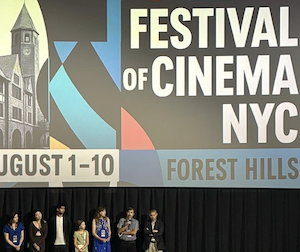
YES continued its festival run at the Festival of Cinema NYC, and the Planet Female Global Story Fest in Connecticut where the film won the best of fest short feature award. Barros was greeted at the screenings by friends and family in the area. “I got to see a lot of friends from the East Coast who came, and also that was the first time my daughter saw it,” Barros says. “That was really special for me.”
YES screened in December at the Culver City Film Festival. With only a few more festivals to hear from, Barros says she is focusing now on a new feature script project to be filmed this upcoming summer.