

“Backward I see in my own days where I sweated through fog with linguists and contenders.” — Walt Whitman (“The Poet of Prizefighters”)
Audiences love stories about fighters, because the story of a fighter is the easiest analogy to apply to our own lives—a series of conflicts that we must face if we’re to continue on with our own stories.
And I love it when a pop film superstar of high production blockbusters appears in an indie film with an engaging story and shows they can push themselves and their virtuoso talent in raw, intense form.
These two loves come together in The Smashing Machine.
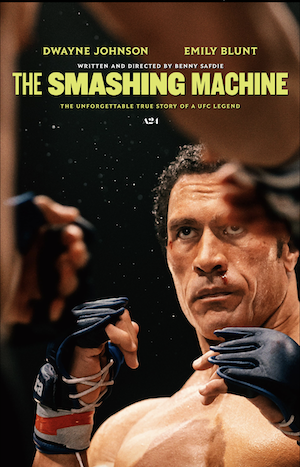 This tour de force by director Benny Safdie (Uncut Gems) tells the story of UFC and MMA pioneering fighter Mark Kerr and his friend Mark Coleman as they navigate the violent world of extreme fighting. This is one you won’t want to miss.
The Smashing Machine features pop film superstar Dwayne “The Rock” Johnson as Kerr, and at first glance, you may not recognize him.
I once saw Johnson in Jerry’s Famous Deli in West Hollywood back in the early zeroes—around 2002. He wore a smart gray suit and had the stately air of a gentleman in every respect. In my distant memory, I want to say he gave me the slight upward nod of a man you’d want as a friend. He was not the hulkishly reserved brute we see in this film, though his depiction of Kerr still has that sense of honor and likable demeanor.
Johnson has starred in countless films since his debut in 2001’s The Mummy Returns. His stock-in-trade ranges from action-packed thrillers to head-scratching cornball flicks (come on, this guy was in 2010’s Tooth Fairy playing the titular role), but his great business savvy, showmanship, and charismatic sense of humor have always been constants.
In The Smashing Machine, which he also produced, we have the distinct delight of witnessing Johnson pushing himself and the narrative to greatness as he gives the best performance of his career.
Safdie has an acute acumen for working with actors in this fashion, and he gives us a story that mixes gritty realism and masterful storytelling in his signature style of mixing reality and dramatic fiction.
Here we get the story of a fierce warrior with a gentle spirit and thoughtful speech. “I have this theory,” Kerr says in the film. “If someone punches me or kicks me, I’m gonna impose my physical will on them.” He then goes on to talk about the importance of control and the danger of emotions.
Throughout the film, we see Johnson’s acting skills pushed to the limit as Kerr struggles between emotions, discipline, control, and the aggression necessary to be a competitor in the ring. Kerr finds that when life becomes complicated, control is more difficult to maintain, and when relationships become strained, emotions grow stronger.
Relationships are at the heart of the film as Safdie takes on the themes of the isolating forces of winning and losing, and the struggles of addiction and recovery.
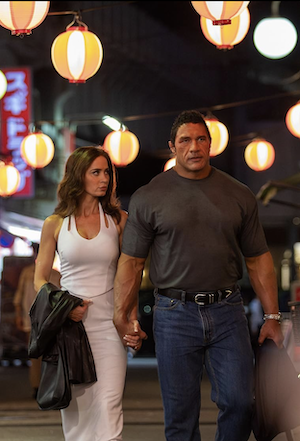 Pay attention to the careful cinematography. We see scenes of Kerr wandering alone around Tokyo as he prepares for a fighting tournament. Later, he works to hang onto his sobriety while his girlfriend Dawn (long time Johnson collaborator and bestie Emily Blunt) goes out for drinks with a friend. The women are framed in the restaurant’s courtyard through the bars of a fence as they down shots.
While these scenes lengthen the film’s duration, they add to the relatable humanity of these larger-than-life people. Relatable moments and intense relationships are what make life, and a good film, worthwhile.
Relationships are ultimately the strongest force in the film, rising above control and emotions. Kerr’s dynamic and tumultuous relationship with Dawn tests both of them. The relationship with his comeback trainer Bas Rutten (an impressive acting debut by the MMA legend himself) is an archetypal old-master-helping-the warrior-regain-his-skills-and-mojo.
Kerr’s relationship with Coleman (UFC’s Ryan Bader, in an amazing and promising acting debut) becomes pivotal in the movie as they progress from opponents to training partners to best friends—and back to potential opponents.
In a scene in a doctor’s waiting room, an elderly lady asks Kerr if they hate each other when they fight. Without hesitation, Kerr answers, “Absolutely not.” It’s a sincere denial, and we understand that this is the bonding love of comrade adversaries. It is in these friendships that the striving and suffering of Kerr is redeemed.
The Smashing Machine affirms that even giants must struggle in their conflicts as we must struggle in our daily lives. This movie shows us that winning may be the best feeling, but losing is a profound teacher as well, and at times it may be better losing for the right reasons instead of winning just because everyone expects it.
The film features great and memorable performances from the primary actors, and while Rutten and Bader are making their official acting debuts, true wrestling fans know that much of professional fighting (especially wrestling) is already about showmanship.
Dwayne Johnson is the heart and soul of this movie, and he shows his love and passion for the craft of acting and his respect for the world of professional fighting and its people. He leads this cast to show us that actors can contend, and contenders can act.
Fans of the theatre and fans of the contest should get out and see this one. The Smashing Machine stands as the best movie I’ve seen this year, and I predict it will be a contender in March’s Cinema Championship.
Editor’s Note: The Smashing Machine is now playing at The SLO Film Center at the Palm Theatre.