
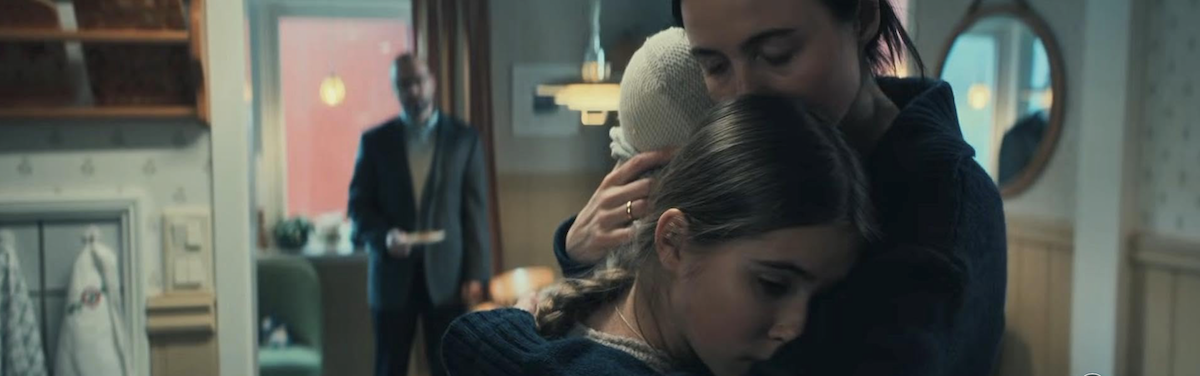
Amidst a backdrop of dramatic mountains and deep fjords in western Norway, a Romanian Norwegian immigrant family becomes the center of a clash involving the child welfare system and residents of a small, generations-old, coastal community.
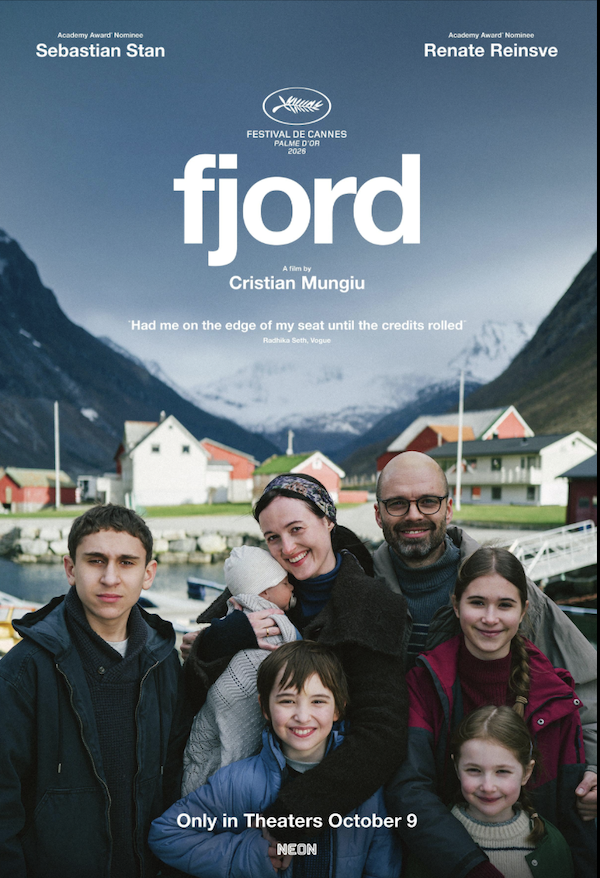 At the heart of writer/director Cristian Mungiu’s film Fjord is bruising found on the cheek and shoulder of the Gheorghiu family’s teen daughter, Elia. Her physical education teacher brings in child welfare social worker Gunda, and from there the story escalates quickly, involving the police, the courts, and eventually outrage from Norwegians and the world through coverage of the family’s plight.
Prior to this incident the Gheorghiu family had begun settling in after emigrating from Romania to Norway. Both parents are working professionals, father Mihai (Sebastion Stan) helping with IT at a high school and mother Lisbet (Renate Reinsve) working as a nurse at an elder care facility.
Stan and Reinsve play the parents with authenticity, always nuanced and believable, demonstrating the restraint of their characters.
Cultural differences are present from the start. The family’s beliefs and traditions, conservative and deeply religious, vary from Norway’s more progressive and secular norms, but there is little overt hostility from either side.
Elia is vague about what happened to her but a police investigation results in all five of the family’s children being removed from their parents pending the outcome of Mihai’s criminal trial for physical punishment, which is strictly prohibited in Norway.
 Mungiu has written the film in shades of gray, leaving the viewer to determine if prejudice and clashing cultures are at fault, or if fault lies with the couple.
The remainder of the film covers several months as the couple visit their children in foster homes, make court appearances, and avoid escalating the situation. When this strategy fails, Mihai contacts a journalist and gets the Romanian government involved.
The family faces a dilemma: wait for the outcome of Mihai’s trial, or take their children and return to Romania. They make what they believe to be the best decision for their family.
Having been a counselor for more than three decades, I anticipated being frustrated by the film. But it is so well crafted that I found myself always interested, curious, and engaged. While the main storyline takes precedence, family and community side stories are woven in, relieving tension through distraction.
 It is not difficult to see both sides in this drama, even while wishing the children aren’t the ones most impacted. It is left up to us to decide: is this a culture clash and overreaching of the child protective system in progressive Norway, or are authorities justified in their assessments and actions towards the couple?
Mungiu weaves in both perspectives, that of the family and of the official elements of the community, and his directing brings the story together in a believable way. The use of often-stark lighting serves to enhance the somber feeling, and the sparse use of music does the same for the tone of the film.
Not a fan of overly lengthy films, I was surprised at the end that 146 minutes had flown by. The Palme d’Or is not given lightly at the Cannes Film Festival; it is earned through excellence. In 2026, it was Fjord that deservedly took the prize.
Editor’s Note: Fjord is now playing at the SLO Film Center at the Palm Theatre.