
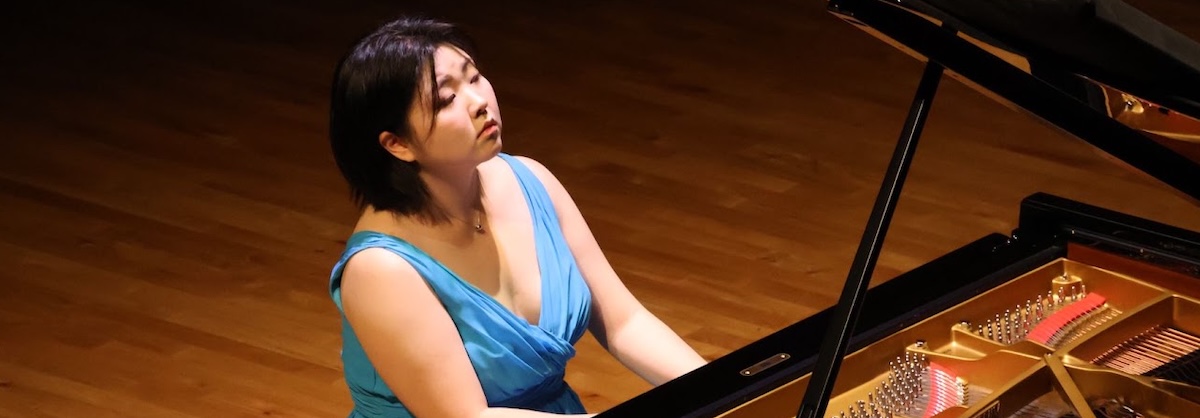
Hyunjin Roh, winner of the 2025 Paderewski International Piano Competition
The opening of the November 7 San Luis Obispo Symphony and Paderewski Festival concert honoring the winner of last year’s Paderewski Festival International Piano Competition was preceded by a somber announcement.
Visiting from Los Angeles, the Culture Consul of the Republic of Poland, Mateusz Gmura, requested that we acknowledge the victims of that morning’s mass shooting in Krakow, Poland. Following a somber moment of silence, Maestro Andrew Sewell then took to the podium and launched the orchestra and audience into the rarified atmosphere of music by three giants of 19th century Romanticism.
Maestro Sewell’s meticulous baton deftly led the ensemble through the intricate patterns of rhythm and dynamics to great effect.”
It began with the vigorous “Mazurka” from Polish composer Stanisław Moniuszko’s Opera “Halka.” This work started with the full orchestra setting the upbeat dance mood with a classic, brisk mazurka rhythm sounding the third note of the tonic E flat major scale in unison. Three cymbal crashes then heralded the main theme, and we were off and dancing.
The orchestra’s rhythmic precision and excellent intonation were at once amply displayed—any miscues when playing unison would be pretty hard to ignore. Maestro Sewell’s meticulous baton deftly led the ensemble through the intricate patterns of rhythm and dynamics to great effect.
The second work of the evening was the inspiration for the program’s title “Keys of Grandeur.” It showcased pianist Hyunjin Roh, winner of the 2025 Paderewski International Piano Competition performing Ludwig van Beethoven’s Piano Concerto No. 5 in E-flat op. 73.
From the start, the audience was treated to a dialog between a polished symphonic orchestra and a remarkably talented young pianist trading and merging sonorities demonstrating the genius of the composer’s art.
In the very outset of the concerto’s first movement we were treated to Beethoven’s innovations in the artform as the piano answered the orchestra’s introductory chords with a marvelous panoply of scales, arpeggios and other virtuosic gestures.
The piano and orchestra sounded almost playful in their back-and-forth treatments of this music.”
As the movement progressed, the orchestra played with excellent balance and sensitive dynamics, while Roh countered with smooth and clean chromatic and diatonic scales, glistening trills and fluent transitions between duple and triple metric passages.
The second movement was hallmarked by Rho’s and the orchestra’s delicate sensitivity producing an almost choral sound. One of Beethoven’s structural innovations here is a relatively short movement that “magically” segues into the concerto’s finale.
This last segment of the concerto is a rousing seven-part rondo—that is, a work with a theme that is repeated seven times with a variety of connecting interludes. The piano and orchestra sounded almost playful in their back-and-forth treatments of this music. Rather than a competition between two aesthetic rivals, this whole magnum opus can be characterized as two friends who work so well together that they can complete each other’s sentences.
The audience rewarded them with a prolonged standing ovation.
The final masterwork of the evening was a piece by Pyotr Ilyich Chaikovsky—also spelled Tcaikovsky, which is an artifact of the French language which doesn’t have a hard “CH” sound so they “faked” it by putting a “T” in front.
The composer proclaimed in a letter to his brother, “I believe it comes into being as the best of my works.” He was referring to his 6th symphony—which he titled “Patetichkaya” or “Passionate,” and in my humble opinion is an apt description.
The Russian word “Patetichkaya” sounds a bit like “Pathetíque,” but differs in meaning from the Western European/American idea of arousing pity. “Patetichkaya” is closer to the definition of the root word “pathos” meaning to evoke strong emotion.
There followed moment after moment of timbral and melodic interweavings that epitomized Chaikovsky’s mastery of orchestration, which Maestro Sewell procured with exquisite finesse.”
Maestro Sewell elicited the intensity of emotion right from the start: the first movement began very quietly with a low thrumming from the cellos and contrabasses and a somber, yet beautiful bassoon solo, all of which gradually grew in tempo, timbre and intensity, then morphed into a transcendent melodic ensemble of strings and woodwinds. The principal theme then emerged in the high strings backed by a rich horn accompaniment.
There followed moment after moment of timbral and melodic interweavings that epitomized Chaikovsky’s mastery of orchestration, which Maestro Sewell procured with exquisite finesse.
He and his ensemble sailed on through the gracious second movement with its well-known primary theme invoked by cellos and high woodwinds. The third movement began with a quiet, rapid rustling of high strings through which was soon heard fanfare-like calls from mid-range brass that soon blossomed into a majestic march. The boldness and intensity increased until a series of descending scales brought it to a close.
This created such a sense of finality that some in the audience began clapping until they realized that the Maestro had not signaled the end of the work; there was yet one more movement.
“Slowly plaintive” (adagio lamentoso) is the tempo mark for movement 4, and indeed it is, almost like a liturgical chorale. Maestro and orchestra united in expressing the heft of emotion therein. Chaikovsky’s final sonorities seemed to close the circle of life, ending this movement with the same orchestration as the opening of the first movement: low strings and bassoons.
This gave me the uncanny feeling that this symphony encapsulated the sensations others in the audience may have experienced from the entire concert: the sadness of the moment of silence for the victims of the Krakow shooting through the ebullience of the Mazurka and the majesty of Beethoven’s concerto, all finally encased in Chaikovsky’s symphonic genius. The composer himself died nine days after conducting this work.
Thank you, Maestro Sewell, Hyunjin Roh and the entire orchestra. Your second standing ovation was well-deserved.