
Photos courtesy A24 Films
Editor’s Note: Spoilers ahead. If you are planning to see this film, you may not want to continue reading—unless you don’t mind having some plot points revealed.
You Can See Everything, directed by Lance Oppenheim and comedian Nathan Fielder, is one of the most unique documentaries I have ever seen.
Fielder, of Nathan For You fame, moves in with the infamous Elizabeth Holmes and her family 34 days before the start of her prison sentence, raising the first round of many questions the film asks the audience.
The first-ever self-made female billionaire, Holmes is the founder of the defunct health technology startup Theranos and is currently serving a prison sentence for wire fraud and conspiracy to defraud investors.
 The almost-three-hour film starts off as a view into the family dynamic of Holmes and Billy Evans, her boyfriend and father of her two children. Fielder’s trademark dry delivery is used to call attention to the absurdity of the couple’s situation and relationship.
They met at a party during the height of Holmes’ controversy and began cohabiting shortly after. Fielder questions both on the motives behind their relationship. Is Holmes using Evans for his family’s immense fortune? Is Evans using Holmes for her fame and intelligence? Or are the two truly in love?
The time Fielder spends with Holmes and family makes up the first half of the film. The documentary crew examines Holmes’ retrospective perspective, which is complete denial of any wrongdoing.
She claims to have never lied, and that she cannot pinpoint what went wrong to lead her to her current situation. As an audience member, I am confused. Does Holmes truly believe she has done nothing wrong, or is this a continuation of her manipulation?
Here Fielder begins to explore the theme of miscommunication, exemplified by one scene. Fielder asks Holmes to consider an old interview clip, where she claims the Theranos signature model can perform more than 200 different blood tests. The controversy is that the sentence is true and also false, depending on how you view the word “can.”
Holmes claims that theoretically, once further chemistry was developed, the machine could perform those tests. Is it possible this woman, who in another part of the film demonstrates her failure to understand basic comedy, could masterfully spin her words to be easily misinterpreted?
For the last half of the documentary, Holmes has little screen time, with the film centered around the bizarre relationship she maintains with Evans whilst in prison.
 Once her sentence begins, we start to see how controlling Evans really is as a partner, from the use of Holme’s likeness to posting explicit bits from her X account. Most shockingly, he asks the documentarians for compensation without her knowledge. How true is their relationship?
Is Evans really controlling Holmes, or are they playing parts to shift guilt off of Holmes and make her out to be a naive innocent?
This is a variation of the film’s most important question: Is Holmes a well-meaning genius, who has been manipulated by the men in her life so grossly it led her to where she is, or is she herself a master manipulator, who makes all those around her question reality?
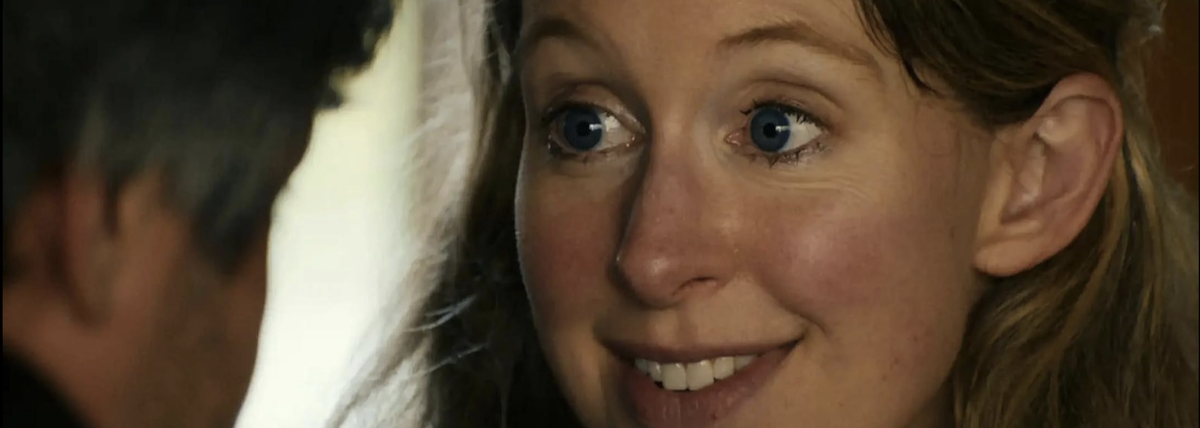
From a filmmaking standpoint, You Can See Everything is genius. Shots are held uncomfortably long and close on faces, giving the audience an opportunity to gaze into the eyes of a subject and ponder whether they truly are the eyes of a liar.
While the audience roars with laughter at Fielder’s dry delivery of lines, I think he comes across as extremely serious, and while there are certainly humorous moments, the film feels consistently tense.
The score by Ari Balouzian is incredible, adding an almost horror-like ambiance to the film.
I came into You Can See Everything with high expectations. I knew very little about it, except its incredible critical acclaim as the highest-rated movie on Letterboxd in its opening weekend.
It is a phenomenal, mind-bending film that doesn’t feel like a documentary. I did enjoy it. However, I think I expected something that I didn’t get.
I strongly recommend viewing it in theaters with an audience.
Editor’s Note: You Can See Everything is now playing at the SLO Film Center at the Palm Theatre.