
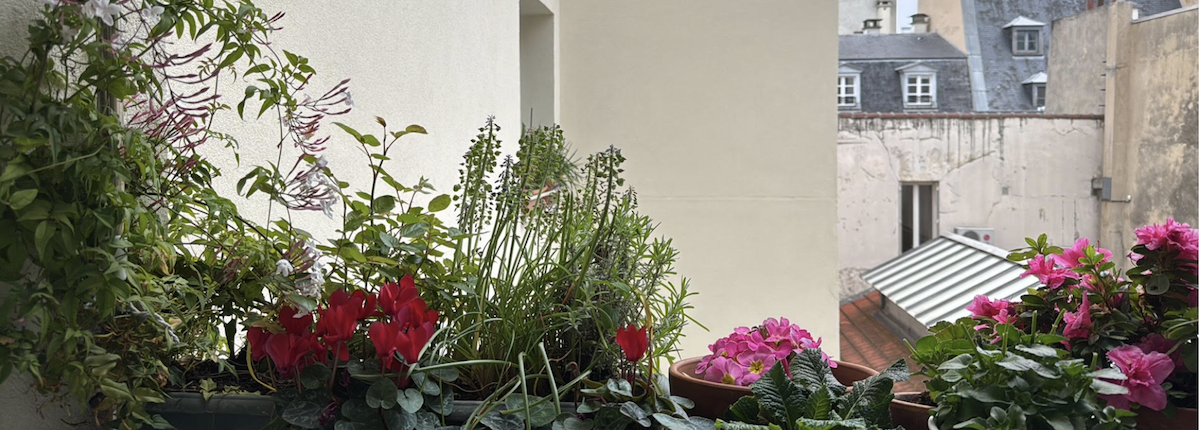
A volume of stories drawn from a former Central Coast writer’s life in Paris is now available in hardcover and as an e-book.
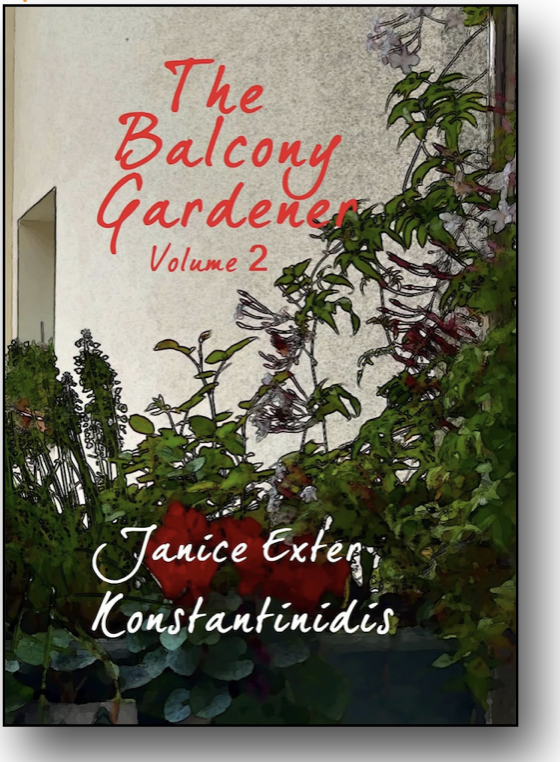 Australian-born Janice Exter Konstantinidis, who traded a large garden on the Central Coast for a small Parisian balcony, has published The Balcony Gardener Volume 2 as a follow-up to her first volume, published last year.
Konstantinidis has written several works across poetry and prose, including a memoir and Words of Beak, a collection of bird-inspired limericks created in collaboration with avian photographer Lorraine Flakemore.
The short stories in the Balcony Gardener volumes follow her Parisian adventures—”where intention often exceeds available space.” They chronicle the mischief and quiet shenanigans of the Balcony Gardener, her dog, and a cast of colorful characters. SLO Review frequently publishes their adventures, and Konstantinidis agreed to speak with me about her work, her writing process, and her advice for up-and-coming authors.
Charlotte Alexander: When did you start writing the stories that make up the first Balcony Gardener? How did you decide in what order the stories appear in both volumes?
Janice Exter Konstantinidis: The first Balcony Gardener stories began after I moved from California to Paris. I had always been a garden lover, and I have always believed that “if you plant it, it will grow.” But in Paris I no longer had a large garden. I had a balcony, a new city, a different language, and the unsettling but exciting experience of beginning again. Being in contact with plants has always mattered deeply to me. Growing things gives me a sense of steadiness, patience, and connection to the living world. Plants ask for attention, but not drama. They respond to care in their own time. Whether in a large garden or in pots on a balcony, tending plants has always helped me feel grounded and restored. The balcony garden soon became more than a place for plants. At times it became a metaphor for my own change and adjustment to Paris: learning a new rhythm, living in a smaller space, navigating another language, and noticing how my own perspective was shifting. I was still a gardener, but I had to learn what gardening meant in this new life.
I wanted the reader to feel the year turning, the balcony changing, and the Balcony Gardener’s world becoming richer and more populated as the stories unfolded.”
The first story came from a moment of complete mortification. While watering the plants on my balcony, I accidentally doused the gardienne (caretaker) below with water. My embarrassment over that incident pushed me to write the first Balcony Gardener story, in which she opens her apartment door to find a thoroughly soaked gardienne standing there. That moment gave the series its beginning: ordinary domestic disaster, social embarrassment, and the comic possibilities of balcony life. Later, as the stories developed, I began sending them to a local gardening newsletter in Washington State. A friend there had seen one and asked if she could use them in her newsletter to add a cheery note. From that point, the stories began to follow the seasons more deliberately, taking into account what would actually be planted, tended, or harvested at different times of the year. Of course, the Balcony Gardener, being who she is, mischievous at heart, the stories could not remain only about plants. She began to gather a colorful little world around her, including her neighbor Madame Dupont and her much-loved dog, Teddy. Their presence brought warmth, humor, and a little theatrical mischief to the balcony. The Balcony Gardener also became known for her love of teas and infusions. In almost every story, she manages to invent a new tea, sometimes sensible, sometimes eccentric, and sometimes with consequences no one quite expected. The teas became part of the ritual of the series, along with watering, pruning, planting, and waiting.
I hope readers find in the stories a sense of pleasure in small things: a pot of herbs, a dog underfoot, a neighbor at the door, a mishap that becomes funny in retrospect, and the feeling that even in later life, one can begin again.”
When deciding the order of the stories in both volumes, I followed the seasons first. But I also paid attention to tone and emotional movement. I wanted the reader to feel the year turning, the balcony changing, and the Balcony Gardener’s world becoming richer and more populated as the stories unfolded. The first volume introduces the balcony, the plants, the mishaps, and the central characters. The second volume allows that world to deepen, becoming a little stranger, a little wiser, and more aware of memory, aging, and acceptance. So, the order was chosen by season, growth, and emotional progression. I wanted each story to feel as if it had found its proper place in the turning of the year. I hope readers find in the stories a sense of pleasure in small things: a pot of herbs, a dog underfoot, a neighbor at the door, a mishap that becomes funny in retrospect, and the feeling that even in later life, one can begin again.
CA: You were born in Australia and now live in Paris. But you spent a good deal of time on the Central Coast. What brought you to SLO County, and what are your most potent memories of your sojourn here?
JEK: I was born in Australia and now live in Paris, but I spent more than 20 years on the Central Coast of California. This became a very important chapter in my life. What brought me to SLO County was part of my larger life in California, but what kept me connected there was community. I had always written, though not formally, and a friend suggested I join a local writing group. That suggestion opened a door. I became involved not only as a member but eventually as part of the board, serving in various roles, including president, for over seven years. Those years were important years in my life. Through the writing group, I discovered, with real delight, that I had a distinct voice in my writing. Over time, I developed that voice through practice, encouragement, critique, and the discipline of showing up. I attended classes led by a fellow member, took part in a critique group, and found the local Central Coast Writers’ Conference immensely valuable. It gave me instruction, confidence, and a broader sense of what a writing life could be. Perhaps most importantly, I felt I had found my tribe.
In SLO County, I found people who cared about sentences, stories, drafts, revision, and the strange persistence required to keep writing.”
Writers can be solitary, but they also need places where their work is understood. In SLO County, I found people who cared about sentences, stories, drafts, revision, and the strange persistence required to keep writing. During COVID, that sense of community became even more important. We worked hard to keep the organization afloat, moving general meetings to Zoom. It was not always easy, but I felt strongly that the organization needed to continue during that difficult time. Writers needed connection, and I believed it mattered to preserve a place for them to gather, even virtually. My most potent memories of SLO County are not only of the writing community, though that remains central. I also remember the physical experience of arriving there: the different smell in the air, the hummingbirds, which delighted me, the quality of the light, the coast, the gardens, and the sense of space. Looking back, I think SLO County gave me two important gifts. It gave me a landscape I still carry in memory, and it gave me a writing community where I began to understand my own voice. It was there, in many ways, that writing became less private and more fully part of my life.
CA: How has living in Paris affected what you write about?
JEK: Living in Paris has affected what I write about because it changed the scale and texture of my daily life. I was 74 when I arrived in Paris. When I decided to leave the United States, I thought: what better adventure at that age than to live in a new country? I moved from California, where I had lived with more space and a larger garden, to a Paris apartment with a balcony. That shift altered my attention. I began to notice smaller things more closely: the changing light, the sound of the street below, the behavior of neighbors, the plants surviving in pots, the market stalls, the dogs, the doors, the courtyards, and the rituals of ordinary life. Paris also placed me inside another language. That has been both humbling and enlivening. When you live in a language that is not your first, you become more alert to gesture, tone, facial expression, and silence. You listen differently. You watch more carefully. That has entered my writing.
I think Paris has made my writing more observant, more intimate, and more attentive to thresholds: the space between inside and outside, past and present, solitude and community, one language and another.”
But Paris also gave me something more private and more necessary. I was finally able to come to terms with writing my memoir. That was difficult work, but once I had faced it, something in me opened. It freed me to write about the things I loved: gardens, seasons, small domestic habits, animals, birds, neighbors, food, weather, humor, and the strange consolations of daily life. The city has deepened my sense of time. Paris carries its history openly. It is there in the stone, the churches, the bridges, the narrow streets, and the buildings that have held generations of lives before mine. Living among that continuity has made me think more about memory, aging, survival, and belonging. At the same time, Paris has given me a great deal of comedy. The Balcony Gardener stories come partly from the absurdities of adjustment: misunderstandings, mishaps, neighbors, watering accidents, and the effort to create a garden in a small space above the street. Beauty and embarrassment often live side by side here. Humor matters to me because it allows difficulty to become bearable without denying that it exists. I think Paris has made my writing more observant, more intimate, and more attentive to thresholds: the space between inside and outside, past and present, solitude and community, one language and another. It has given me a smaller physical world, but in many ways, a larger imaginative one.
CA: What is your writing process—a certain number of pages a day, or when the mood strikes you? What inspires you?
JEK: My writing process is not based on a fixed number of pages a day. I do not usually set myself a required amount. I write when something begins to press on me: an image, a memory, a phrase, a comic situation, or a feeling I do not yet fully understand. Sometimes I sit by the Seine and write on my phone. I find this peaceful and wonderfully absorbing. My focus can become very intense there. That is one of the gifts Paris has given me: the ability to sit beside the river, in the middle of the city, and become completely drawn into the work. I am inspired by many things, but chiefly by the movement of the seasons, the transience of life, and the exquisite beauty of nature. I notice changes in light, weather, plants, birds, and the atmosphere of a place. These things often find their way into my writing, not as decoration, but as part of how I understand time, change, and human feeling. Often, the beginning is quite small. It may be something I have noticed on the balcony, a dog in the street, a neighbor, a change in the weather, or an odd moment that seems to contain the beginning of a story. I usually know there is something worth following when the ordinary moment begins to open into something larger.
My process is part observation, part memory, and part patience. I wait for something to catch my attention, and when it does, I follow it.”
I have always written in some way, but over time, I have learned to trust my own voice. I do not force it too much. I let a piece arrive, then I return to it, revise it, reshape it, and listen for what belongs and what does not. Revision is a large part of my process. The first draft may catch the feeling, but the later drafts find the shape. My process is part observation, part memory, and part patience. I wait for something to catch my attention, and when it does, I follow it. This can happen at any time of day or night. I often begin the day with the start of a limerick. I love to “limerickize” almost anything I can. This began when I was quite young and had things to tell my fourth-grade teacher that I thought might get me into trouble. Turning them into limericks somehow made them safer, or at least funnier. Writing a limerick has been, and still is, a wonderful release, and they make me giggle.
CA: What do you think about the state of the publishing industry today? How has it changed during your writing life?
JEK: The publishing industry has changed enormously during my writing life. Once, publishing seemed like a very distant and formal world, with clear gatekeepers: agents, editors, publishing houses, reviewers, and bookstores. A writer often had to wait for permission to enter. By the time I had finished my memoir, I decided to self-publish. I did not expect to make a living from writing. That was never my primary motivation. I write for self-expression and storytelling. Essentially, I write for myself first, to understand, to remember, to shape experience, and to enjoy the act of making something in language. Self-publishing gave me a way to bring my work into the world without waiting for permission. I did not want to go through the formal and traditional route of publishing, partly because it can take a very long time, and at this stage of my life, I would rather spend that time writing, finishing the work, and letting it find its readers.
I am grateful for the possibilities available now, but I still believe the center of writing has not changed. It begins with voice, imagination, memory, playfulness, patience, and the need to tell a story in one’s own way.”
Today, there are many more ways for writers to publish and be read: independent publishing, online platforms, newsletters, e-books, and small presses. In that sense, the industry has become more open. But it has also become more crowded and demanding. Writers are often expected not only to write, but also to promote, market, manage platforms, and create a public presence. For someone like me, whose deepest interest is in the writing itself, that can feel secondary to the real work. I am grateful for the possibilities available now, but I still believe the center of writing has not changed. It begins with voice, imagination, memory, playfulness, patience, and the need to tell a story in one’s own way.
CA: What advice do you have for younger writers or writers just starting out?
JEK: Keep writing and to be patient with yourself. Voice does not always arrive fully formed. Sometimes it has to be heard gradually, through practice, revision, and the willingness to write imperfectly for a while. I would strongly encourage new writers to join critique groups, but with this proviso: trust your instincts and be true to your voice. Critique can be extremely valuable. I find it critical to my own work. A good critique group can help a writer see what is unclear, where the structure falters, where a sentence needs tightening, or where the heart of the piece is strongest. But not every suggestion should be accepted. As I see it, a writer has to learn how to listen carefully, then decide what truly serves the work. There is a difference between improving a piece and allowing other people to take it away from you. I would also recommend buying the best dictionary and thesaurus you can find. Words matter. Precision matters. Sometimes, the exact word changes the whole weight of a sentence. I am very fond of rhyme, and I am particularly careful about my rhyming poetry. I do not often change a rhyming poem once I have written it, because the rhyme, rhythm, and movement are part of its construction. Crafting poems is one of my great loves. Perhaps at 76, I have earned the right to be a little touchy about meter and construction. I also think writers have to protect what is most alive in their work. I will add that many of my written pieces don’t rhyme. There are times when the constraints of working in rhyme can detract me from spontaneity, so I like to do a little of both, depending on the subject.
Write because something in you wants to speak. Write because stories matter. Write because language can hold memory, beauty, grief, humor, and truth. And remember that it is never too late to begin.”
Read widely, but do not be intimidated by the writers you admire. Let them teach you, but do not let them silence you. Pay attention to the world around you: the weather, the people in a room, the way someone speaks, what is not said, what changes with the seasons, and what memory keeps returning to you. A writer’s material is often closer than it first appears. Find other writers if you can. A class, conference, writing group, or thoughtful community can be enormously helpful. I benefited greatly from being part of such a community. It gave me encouragement, discipline, and the sense that I had found people who understood why writing mattered. I found my tribe. Most of all, write for the right reasons. Publication is wonderful, but it is not the only measure of a writing life. Write because something in you wants to speak. Write because stories matter. Write because language can hold memory, beauty, grief, humor, and truth. And remember that it is never too late to begin.