
“Write about an emotional discovery you made which led to a personal and profound change in your life.” Little do students know that on their first day of class, their response to this prompt may later become the foundation for making a film.
At Cal Poly, students can move from writing scripts in Storytelling (Interdisciplinary Studies in Liberal Arts 340) to filming them during a different quarter in Cinematic Process (ISLA 341).
Students enrolled in Cinematic Process during the Winter quarter develop their films as part of Cal Poly Short Cuts for the San Luis Obispo International Film Festival.
The festival gives students an opportunity to create work for an audience beyond the classroom.”
In Storytelling, instructor Randi Barros (an award-winning screenwriter, director, and film editor) assigns two screenplays: one asks students to write a 3-5 page screenplay based on an emotional discovery, and the other requires a 5-10 page screenplay about a character who wants something badly and another character who refuses to give it. Through revision and feedback, these scripts are improved over the course of the class.
By the time students take the Cinematic Process class, they have strong scripts ready for action.
Then pitch day comes. During winter quarter, this marks the point when the class officially merges with another Cal Poly course, Digital Video 2 (ART 483), taught by artist and associate professor of media arts Jim Werner. Bringing together writers and technicians, this collaboration has been part of the process for nearly a decade.
“It’s really great to be able to collaborate with them, because it just elevates the films by having those skills,” Barros says. “I feel like Jim and I balance each other really well, because I’m coming more from the writing, story creation and editing perspective, and he’s coming more from the cinematography, sound and technical kind of perspective.”
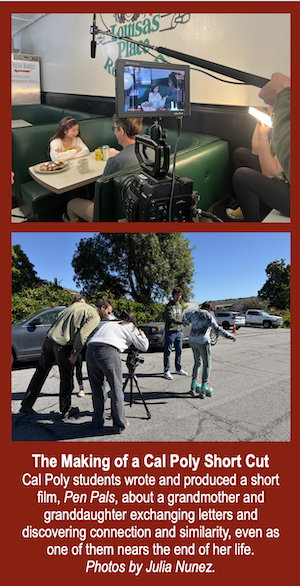 On pitch day, Cinematic Process students present the combined classes with a prepared slide deck, making the case for why their scripts should be selected for production. The class votes by ranking the films they most want to work on—and that they think can be completed in six weeks. The class instructors submit their own rankings as well.
“I love seeing the scripts get off the ground,” Barros says. “I can kind of feel the hope of the students, and sometimes my best favorite scripts aren’t picked, but it’s really interesting to watch the films start from a script.”
Once the films are announced, the class groups into teams of about five each. In addition to film teams, the class moves into festival groups and are assigned roles in the execution process, such as casting, poster creation, web promotion, news promotion and technical.
Before they can film, most groups need actors (and not just their friends), which is why an audition process is held right away. Leading up to auditions, the casting team reaches out to local acting groups by email and flyers. Usually there is a need for actors ranging in age from eight to 60.
The film teams then scout locations—usually the campus, local businesses, beaches or even actors’ homes—and coordinate shooting dates. Cal Poly has equipment such as cinema cameras, boom microphones, lighting and more that teams can use.
Members of a team must take on at least one job such as producer, director, cinematographer, sound recordist, production designer, or editor to help the production stay organized. Often roles are shared among team members. “I see students become friends in a lot of ways,” Barros says. “Lifelong friendships come out of the class.”
Along the way, the instructors check in with each team while continuing classroom lessons on editing, color correction, sound design, title creation, and more. Class members get to view and critique each film in progress at least twice.
For the 2026 San Luis Obispo International Film Festival, finished shorts were due April 3, leaving time for revisions before they are screened for the festival audience on Monday, April 27 at 7 p.m. at the Fremont Theater.
The festival gives students an opportunity to create work for an audience beyond the classroom, something Barros says encourages them to do their best work.
“If you’re making something just for a class assignment, you might do a good job,” she says. “But if you’re making something and it’s going to be on a screen, and your friends, and family, the actors, peers and community are gonna see it—It makes such a huge difference because everybody ups their game for that.”
Cal Poly Short Cuts features six short films created by Cal Poly students for the 2026 San Luis Obispo International Film Festival: Career Fair, Flatline, Girl Neighbors, Pen Pals, Squares, and Teddy. The screening is sponsored by Cal Poly’s Center for Expressive Technologies, Interdisciplinary Studies in Liberal Arts, and Art and Design department.