
Photos by Agata Grzybowska
When we think of William Shakespeare, we imagine the playwright, the man from Stratford Upon Avon, the man whose words arguably changed the world. They have influenced the arts for hundreds of years and have endured and been adapted to many cultures and forms.
But we probably don’t think of Shakespeare as a family man and father, and that is just what Chloé Zhao’s new film, Hamnet, explores.
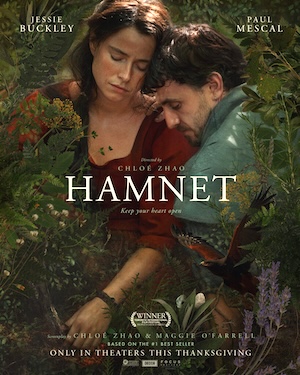 The film investigates the themes of loss and its relation to creation through the dynamics of a regular and singular family: the Shakespeares.
Based on the 2022 novel of the same name by Maggie O’Farrell (who co-wrote the screenplay with Zhao), Hamnet follows the full arc of life, from courtship to marriage, the forming of a new family, the arrival and adolescence of children, and the premature death of one of those children. What follows from this is the painful redemption of that death through the joy and agony of creating Hamlet the play and Hamlet the character.
The film opens in the beautiful green countryside of England. Agnes Hathaway (Jessie Buckley) is out in the woods with her falcon. While viewers may think of Shakespeare’s wife as Anne, in her father’s will she is “Agnes,” and Zhao didn’t want to invite confusion with the actress Anne Hathaway.
Buckley is great in this role, and Zhao shapes her character as an herbalist and something of a woman of the wilderness (she births their first child in the woods by a dark cave-like opening deep in the trees).
While sporting with her falcon, Agnes is watched by a curious tutor come to teach Latin to the boys in her family. Though she initially resists the young and amorous tutor’s advances, he is able to charm her with the story of Orpheus and Eurydice and they become lovers.
 After something of a shotgun wedding, we see what is even today a somewhat typical progression of a marriage, and the strong influence a spouse can have on the aspirations of a partner.
Agnes and William (brilliantly portrayed by Irish actor Paul Mescal) first live with his family as he works in his father’s glove-making trade, until he gets a break and begins commuting to work in London to write plays for the theatre. The family grows with the Shakespeare children arriving: Susanna, then the twins Hamnet and Judith.
The best parts of the film, its center so natural it could almost be missed, are the scenes of family life with the children.
The scenes of William and the three children rollicking around, playing silly games, also serve as the source and testing ground for famed characters, scenes, and situations that become the famous plays.
The children have fun enacting the three witches from Macbeth, and we watch as William and Hamnet dramatize and carefully practice a fencing match with sticks. Jacobi Jupe in the title role draws the viewer in with his boyish sense of wonder and innocent earnestness.
Among these incidental and wonder-filled scenes are moments of the girls with their mother Anne reciting what plants are used for and what they represent (as Ophelia sings in her madness in Hamlet). The subtle integration of the language from the plays is done so well that it could go unnoticed, and multiple viewings will surely yield new discoveries of Shakespeare’s immortal words.

As the children are the joy of the family and the heart of the film, so the tragedy must come from them. Young Judith is taken with the plague, and in an act of childish heroism Hamnet climbs into bed with her and takes the fatal sickness from his sister. Agnes uses her knowledge and almost mystic skill with herbs and natural preparations to save Judith, without knowing that Hamnet has fallen ill as well, and he is eventually lost to the plague in an emotional scene.
Perhaps the most poignant line in the film is spoken by Shakespeare’s mother Mary (Emily Watson): “What is given may be taken away at any time. We must never take for granted.”
The last parts of Hamnet pay homage to Hamlet by giving the viewers a look at the play in its conception and staging in London. Within the film the production is re-imagined and visionary.
Through the first three-quarters of the film, Shakespeare is never referred to by name, and at times I wondered if they were ever going to say it. It is only when the grief-stricken Agnes arrives at the Globe in London to see the play Hamlet (and is asked who she seeks) that we hear his name. Perhaps this is truly the moment when the person we know as William Shakespeare manifested into the legend we have come to know down through the centuries.
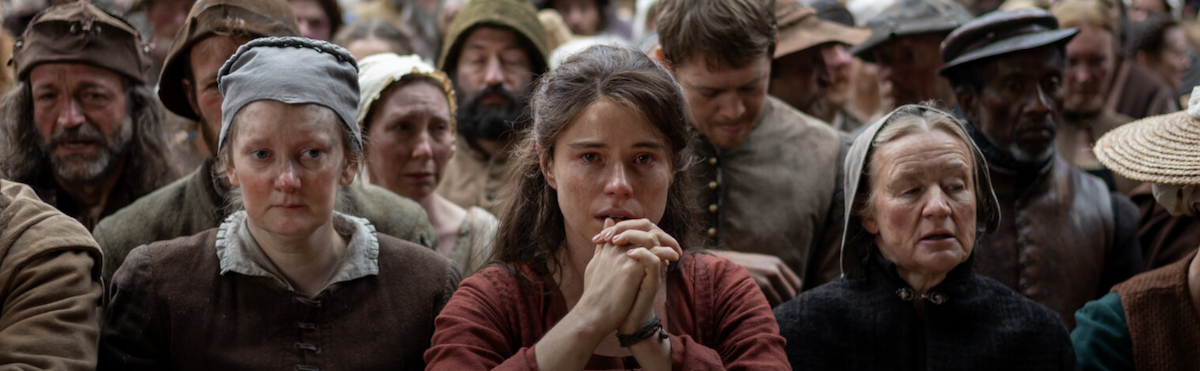
The film has great scenes of Renaissance life, beautifully diverse locations, colorful cinematography, and most of all a great and moving story about family, loss, and creation. The cast has some new actors who we’ll want to see again in other projects.
Hamnet will appeal to all—not just lovers of Shakespeare—who appreciate a good story about the struggles, sorrows, and joys of family.
Editor’s Note: Hamnet is now playing at The SLO Film Center at the Palm Theatre.