
One of my professors once told us there had been three major shocks to the human race: Copernicus shattered our fantasy by telling us that we are not at the center of the universe, Darwin humbled us by telling us that we are only animals, and then Freud broke it to us that we are, in fact, sick animals.
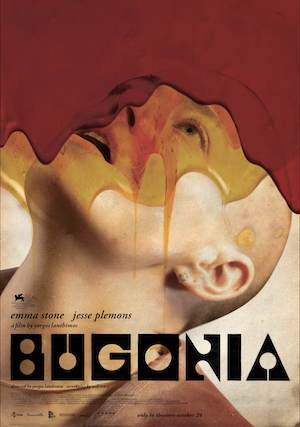
Bugonia, the latest film directed by Yorgos Lanthimos (The Lobster), has been labeled horror/sci-fi, absurdist black comedy, dark comedy, crime/thriller, and just plain sci-fi. My own personal designation would be something along the lines of Post-modern American Gothic/Twilight Zone (not bad, weighing in at 12 syllables).
 Although, instead of blending genres, the film is something of a splice: a kidnapping and captivity narrative, then a shock of an ending plot shift.
Bugonia, written by Will Tracy (The Menu), offers a cloudy critique of the dismal and savage state of humanity on planet Earth. The majority of the film follows the bizarre obsession of low-level corporate worker and avid beekeeper Teddy (Jesse Plemons, The Power of the Dog) with the CEO of the biotech corporation that employs him.
Teddy believes the CEO, alpha female and uber-yuppy Michelle (Emma Stone, Zombieland), is an operative for an alien empire that is subjugating the people of Earth (not to mention wiping out bee populations).
Teddy has extensively researched the aliens on the internet and puts himself and his lovable and loyal autistic cousin Don (Aidan Delbis, The Miracle Project) through a grueling training regimen (including chemical castration!) in preparation for kidnapping Michelle and confronting the aliens in order to free humanity.
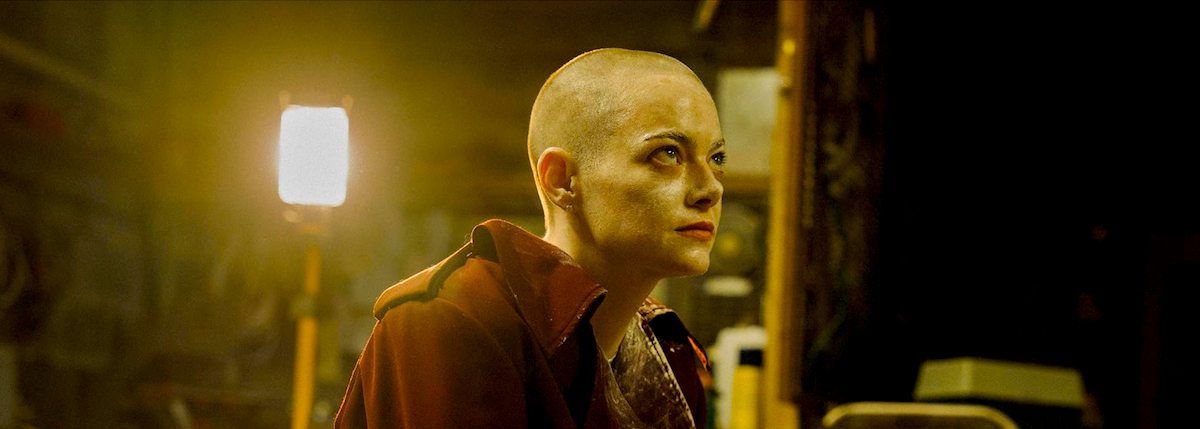
These two unlikely defenders of the human race succeed in kidnapping Michelle, and the film becomes a hostage situation drama at an old, secluded, and distinctly American house. Michelle is restrained, her head is shaved (her hair is an antenna for communicating with the mother ship), and she is slathered with antihistamine cream to dampen her alien nervous system. With her angular features, large eyes, and the white cream, Stone certainly looks like some sort of alien, and seems to have little to no emotions, including fear.
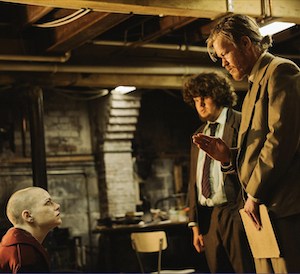 The dramatic scenes between Teddy and Michelle—interacting as captor and hostage—are the heart of this film. As confident and resolute as Teddy is in his business suit, with his long red hair pulled back in a neat ponytail, there is never any doubt that Michelle is in control of the situation.
Though Teddy tries everything from calm talk to electric shock, Michelle remains stoic: “You can’t beat me because I am a winner and you are a loser, and that’s f#@king life.” The one thing they do agree on are the bees: “Honey bees. Earth’s most admirable creation.”
Teddy’s cousin Don is a reluctant henchman and nervous observer and something of a conscience for the trio. These tense scenes span a range of situations from outright torture to the three sitting down to dinner together for a “civilized” meal and conversation. The acting is superb in these scenes, and it’s particularly enjoyable to see the range Plemons displays, matching or excelling the diverse roles he has played over the last decade.
As the tension between Teddy and Michelle reaches its peak, the film makes a radical departure from True Crime realism, crossing the splice into straight-up sci-fi. At this point, one couple in the theatre stood up and hurriedly departed as if they’d had too much. I had a strange feeling of relief as everything in the film changed, and I was unsure how to take what I was watching.
Bugonia is an elaborate critique of humans as self-destructive “sick apes,” and it plays out like a shaggy dog story with a deus ex machina ending. As the final sequence unfolds, it feels like an elaborate con is being played, and we watch in stunned confusion as the plug is pulled on us.
If you allow yourself the liberty to go along with the game and be taken in with everyone else, seeing the film is worth your time. It will continue long after viewing to provide revelations to consider.
Editor’s Note: Bugonia is now playing at The SLO Film Center at the Palm Theatre.