
Thomas Wolfe’s novel famously advises You Can’t Go Home Again.
Ellen Sharpe seems determined to prove him wrong.
Ellen is going nowhere fast. She fled the hardscrabble rural life of East Texas for the promise of Austin, but an alcoholic can never outrun her next drink. She’s just been fired from her job at a record store and has no job, no real future.
When her mother suffers a stroke, Ellen reluctantly returns home to face her and the mixed-race daughter she left behind, along with a past chock-full of regrets, resentments, and what-might-have-beens.
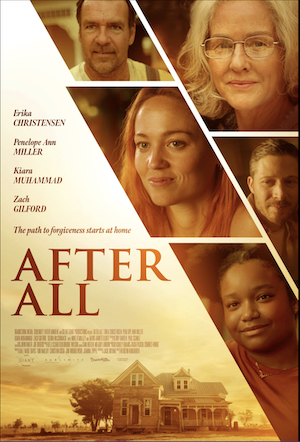 Thus begins After All, a new independent film about generational trauma, the ever-present bonds of family, and the search for redemption. That’s a tall order, as they might say in the Lone Star State, but filmgoers are in good hands here, thanks to a solid script, a sensitive director, and three talented actresses who anchor the story.
Ellen (Erika Christensen) has a heavy cross to bear, forced to confront painful memories of an abusive, racist, and schizophrenic father (David James Elliott) and a military brother who died overseas (seen in imaginary conversations with Erika). Then there’s her ex-high school sweetheart (Zach Gilford), still around after surviving a suicide attempt. It seems a life worthy of Job.
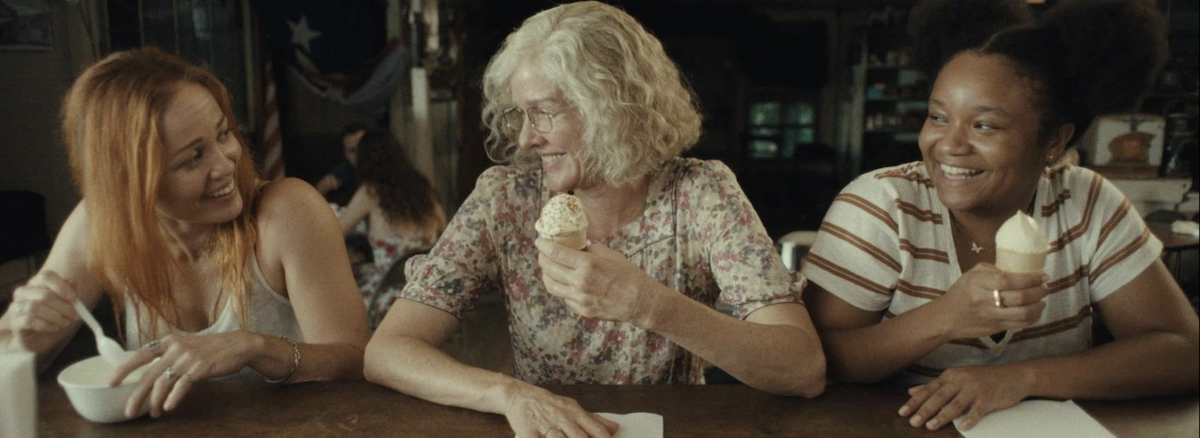
Ellen is caught between her mother, Verna (a barely recognizable Penelope Ann Miller) and 15-year-old daughter, Haley (an impressive Kiara Muhammad), while trying to navigate between a troubled past and an uncertain future. Neither Verna nor Haley is about to make that easy for her. All three women, mostly family in name only, have their own issues, face their own demons.
Family drama can be a difficult film genre to navigate. The good ones, including Ordinary People, To Leslie, What’s Eating Gilbert Grape?, and Lady Bird, resonate because they capture real life, real challenges, without being overly sentimental or manipulative. Such films offer characters with whom we identify and struggles many of us have faced.
 It all begins with the written word, and credit here goes to Jack Bryant, who teaches screenwriting at Ithaca College in New York. Bryant’s script is sensitive and observant, void of obvious histrionics. “She had to make do with what life had given her,” Ellen says to Haley at one point about their matriarch—that’s everything you need to know about Verna, conveyed in 11 simple words.
In truth, I haven’t seen Christensen on screen since her riveting portrayal of Michael Douglas’ drug-addicted daughter in Traffic a quarter of a century ago. But since then, she’s made her mark in TV series such as Parenthood and Will Trent. As Ellen, Christensen finds a role that matches her considerable talent—there’s not one false note in how her character responds to the cruel hand she’s been dealt.
Miller, a longtime veteran of the screen (large and small), is equally compelling. She avoids the obvious choices and instead offers us a woman whose memory may be fading, but whose emotional presence remains. Miller goes all in with Verna, sharp-tongued and prone to speaking her mind, whether it’s welcome or not.
 The scenes between Verna and Ellen seem like emotional ping pong—tender at times in the back and forth, suddenly whiplashing into something more riveting. That’s the strength of After All, the core of the story, as mother and daughter are forced to acknowledge their past mistakes and attempt some kind of fragile future.
This is not an easy story to witness. The film touches on a wide array of heavy themes and issues: Dementia. Estrangement. Alcoholism. Suicide. Bullying. Trauma. Take your pick. And director Kerstin Karlhuber (Fair Haven) doesn’t hold anything back in putting it all up on the screen.
Karlhuber takes her time as the story unfolds, allowing the characters to breathe over the course of an hour and 44 minutes. Some may not appreciate the slower pace, preferring a quicker resolution, but Karlhuber respects both the characters and the audience enough to let things play out realistically.
Her deft use of flashbacks provides the necessary background we need to understand how these three women got to this point, a crossroad, in their lives. Karlhuber shows a steady hand in letting emotions run freely and honestly without going over the top. No easy task.
Given the subject matter, After All is not a film that one “enjoys.” But I was moved by the story, impressed by the acting, grateful for the restrained directing. All the elements come together. The ending may not surprise, but I found myself rooting for Ellen and grateful that she was able to prove Thomas Wolfe wrong.
After All is available now on streaming platforms, including AppleTV, Amazon, Fandango at Home, Google Play and Verizon.