

When I first read the logline for James Sweeney’s new film Twinless, which is billed as a dark comedy, and saw the accompanying photo of two likable looking fellows, I was imagining something along the lines of the 1988 DeVito/Schwarzenegger light comedy Twins.
 I was intriguingly surprised, however, at the twisting turns of Sweeney’s take on the twin-comedy genre. This film is nothing like Twins or, say, 2008’s Step Brothers. In Twinless, the dark suddenly subsumes the comedy, and we get a story that plays with the very idea of dualities and the double throughout, eventually making us question everything we thought we understood in this tale of two twinless friends and their strange developing bond.
The movie begins with an unusual support group: one specifically for twins who have lost their twins to death. Roman (Dylan O’Brien, Maze Runner Trilogy), who is straight, has lost his gay twin brother, Rocky, to an automobile fatality. Dennis (James Sweeney, Straight Up), who is gay, has lost his straight twin in a similar accident. The two meet and become fast friends, start to spend much of their time together, and learn about each other’s lives and lost brothers.
The film has also been dubbed psychological drama, and it examines ideas about identity and the stability of such a phenomenon in the individual. Dennis critiques the common advice “Just be yourself” with the exclamation “What version of me? I hate most of them!”
Sweeney pulls back from multiple versions, and plays with the ideas of duality, alternates, and opposites throughout the story, weaving them into the very narrative structure of the film. In a party scene, the screen splits and we follow Roman on one side pursuing his love interest, while on the other screen we couple with Dennis and his attempts at romance. Watching this, for much of the first half it really does seem like the film will be a lighthearted rom-com.
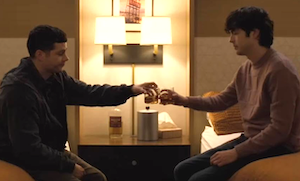 It lures us into this comfortable acceptance of watching a feel-good story with ideas of support, community, and friendship—before pulling away that veil to take a bleary-eyed look at a raw reality different from our perceived understanding, and we realize it was always right under our rose-sniffing noses.
Watch carefully as the film plays with parallel couplings, mysterious replacements, double love interests, alternate versions of reality and the ironic split between complacent expectations and shocking outcomes. The genre is a double switch, as this “dark comedy” is a mask for what we slowly realize is more of a suspense thriller in the end, and those who like that sort of story will be puzzled and delighted by Twinless.
As I walked home in the San Luis Obispo night musing about trust and deception working on the same emotional mechanism, I was struck by a sudden revelation: even the title Twinless has a double meaning.
Editor’s Note: Twinless is now playing at The SLO Film Center at the Palm Theatre.