
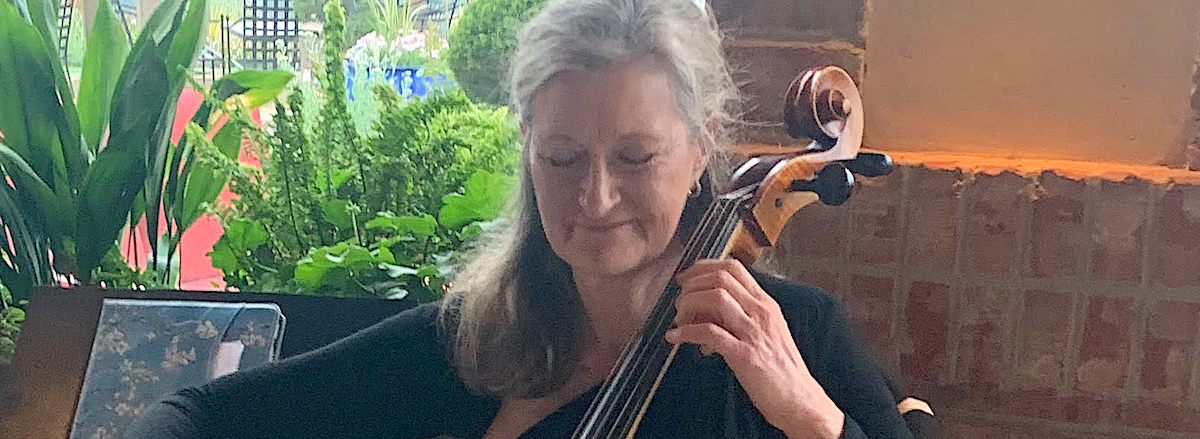
Veteran music educator Lynne Oliverius of Los Osos is taking on a new position. But there are strings attached. Earlier this year, Oliverius was appointed chairman of the board of the Suzuki Association of the Americas, a group of more than 6,000 teachers, parents, and educators dedicated to “making music and early childhood education available to all young people.”
Based on the principle that “all children possess ability and that this ability can be developed and enhanced through a nurturing environment,” Suzuki was originally created by Japanese teacher and violinist Shinichi Suzuki after World War II.
Oliverius has made Suzuki a central core of both her personal and professional life for nearly 50 years. She agreed to share her journey and passion.
David Congalton: How did you first encounter the Suzuki Method?
Lynne Oliverius: I was 17 when the original Suzuki Tour Group from Japan came to my hometown of Pekin, Illinois, thanks to a sponsorship from my parents and others. Some of the group stayed in our home and the Japanese tour teachers also held meetings there. It was truly wonderful to witness the inception of the method here in the U.S.
DC: And you were the first teacher to be trained in a four-year program here in the U.S., correct?
LO: Yes. My life’s work in Suzuki music education began as an undergraduate at Western Illinois University. After graduation, I founded three Suzuki Music schools in Illinois. The program that was created around me at Western is the one that is still being used in Suzuki undergraduate education. That makes this new board chairmanship so very special to have the connection to the roots and continue to move us into the future.
DC: I’ve read about Dr. Suzuki, who passed away in 1998. Sounds like a fascinating man. Did you ever have a chance to meet him?
LO: I did. At age 19, I traveled to Munich with my cello teacher, Dr. Tanya Carey, to create the cello method books with the Japanese teachers. Dr. Suzuki and his wife were there, also working. At the final banquet, he danced with me and said, “Oh, you are so tall!” When he would come over to the U.S. after that, it was our joke, “You so tall.”
 DC: So, what exactly is the Suzuki Method? How does it differ from traditional music education?
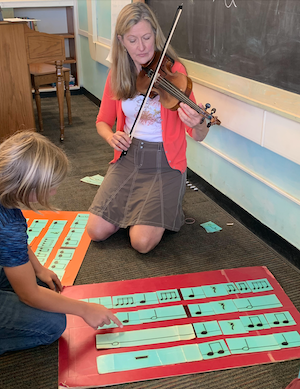
LO: We had a long period where the standard music educator’s cry was “Suzuki students can’t read music!” The Suzuki method or the “mother-tongue” method first employs the ear and then the eye. Just as a child learns to speak his native or mother tongue because of what he hears around him, so the musician first learns sound and how to create that sound on the instrument through hearing. We have master recordings of all our pieces and the ear is trained through listening and the playing of the teacher. String musicians must have very strong aural skills to be able to play in tune. We are “fretless,” so the pitch comes from where our ear tells us to place the finger. For other Suzuki musicians—piano, trumpet, flute, recorder, voice—they too are listening for pitch, rhythm and musicality. When the method came to the U.S. in 1965 and after some experimentation, we incorporated note reading in earlier stages than the original method did. Now Suzuki students are strong musicians in all aspects.
DC: Is Suzuki a controversial approach in music education or has it become widely accepted?
LO: Suzuki is extremely popular in all the Americas with the U.S. having the greatest number of trained teachers. Our fastest areas of growth are in Central and South America. Our very rough estimate of the number of students currently studying the Suzuki Method is 145,000. So many lives have been touched by Suzuki music education and most have not continued in a music career. People in all walks of life who were part of the very welcoming environment of Suzuki education carry the foundation of learning with them and apply it to their lives. Some have told us that it is part of who they are. I definitely agree with that for me personally.
DC: Are you the only Suzuki educator in SLO County, or are there others?
LO: Besides myself, according to our website, there’s one violin teacher in Atascadero. There are teachers that may have some training, but are not SAA members. And there are many others in our area that use the music since it can be purchased without any sort of training. What differentiates a trained Suzuki teacher is an understanding of the fundamentals and techniques that are taught through the pieces and the importance of the parent/adult-teacher-child learning triangle. But training is easily accessible through online platforms and SAA even offers scholarships to encourage training.
DC: You were appointed to the national board of the Suzuki Association of the Americas in 2022, and later served as chair-elect for two years. Here you are now in the top position. What are they expecting from you?
LO: I’m the chief governance officer and I’m charged with the duty of fiscal responsibility. We fund teacher training programs in the Americas that are reaching populations in need and scholarships to students and teachers in pursuit of music education. I lead all the board meetings and oversee six committees. Our board is diverse and consists of a state senator, a Princeton dean, conservatory professors, Suzuki teachers and conductors, a Fortune 500 retired manager, and lawyers—both here and in Latin America. Our mission is to create a better world, one learner at a time, nurtured through Suzuki education.
DC: If you’re responsible for all of the Americas, I suspect you’ll be spending a lot of time on the road.
LO: There is no written expectation of travel, but there are several [trips] I’ve chosen to do for the organization to be present and active in my role. I’ll be in Edmonton for the first conference of the newly-formed Canadian National Organization and then to San Francisco for our Suzuki Association of the Americas Bi-Annual Conference. Then I’m off to Chicago for a leadership summit and possibly a trip to Brazil and Mexico. I also attend smaller events such as camps and chapter meetings when possible.
DC: That’s a pretty busy schedule. As chairman, I imagine there’s a lot expected of you. Do you feel the pressure?
LO: Last month, I listened online to the Annual General Membership Meeting. It was my board and the executive director. I felt quite a weight on my shoulders as all of our 34 countries gave reports and showed pictures of their work—some in remote villages, other in bustling urban centers. Language swirling around, and all united through the universal language of music. The realization that these people were counting on me to help them be successful seemed quite an intimidating task.
DC: You’ve had quite the musical journey from Central Illinois to now leading an international organization. How did you feel in assuming the chairmanship?
LO: Honored and humbled. Truly, I feel a deep sense of pride in what the Suzuki method has done in strengthening families of all types, raising up children with kind hearts and strong disciplined skills in creating mastery not only in music, but in all subjects. May I be worthy of the honor and serve to the highest of my abilities, remembering to lead with a kind heart and dedicated soul.
Editor’s Note: This interview has been edited for length and clarity.