
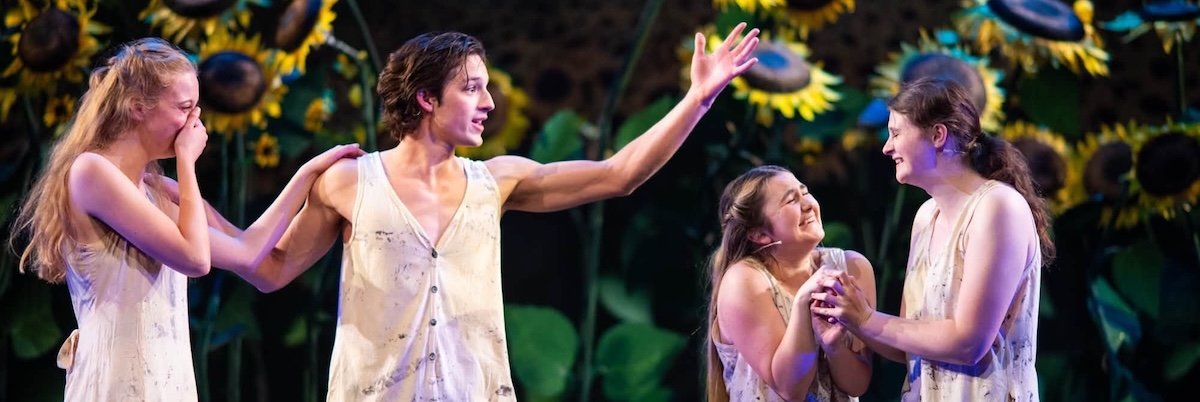
If you’ve ever fallen asleep to awaken from a dream feeling both addled and amused . . . well then, on many levels you could appreciate Cal Poly Theatre and Dance Department‘s recent production of A Midsummer Night’s Dream.
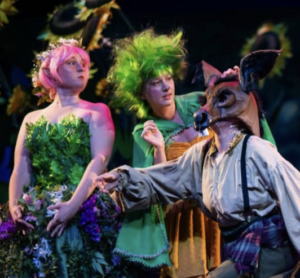 Cal Poly associate professor and director Karin Hendricks-Bolen took both a pedagogical and a whimsical approach to what is undoubtedly Shakespeare’s most beloved comedy. Her more than two dozen actors mouthed the Bard’s words quite nimbly, sticking mostly to his text except where needed to accommodate some inclusive casting, while the technical crew took obvious delight in shaping the play’s two settings: the Duke’s court and a truly original star-lit fairy forest.
Indeed, the idea of a woodland bower serving as the backdrop for Oberon and Titania’s little spat—and Puck’s many machinations—now seems practically prehistoric, given Joshua Schneider’s scenic design that instead saw the play’s lovers and mechancals cavorting among golden sunflowers.
Hendricks-Bolen opened the show with a spotlight on a single flower—not a sunflower, alas—but a blossom whose magical juice later sets in motion the comical misadventures of lovers misperceiving the objects of their love, much to our delight. Even the opening scene’s threat of death to a daughter defying her father can’t dampen the mood—it only serves to set up the plot that we know must all end happily ever after.
What ensued was a joyful romp that confounded our expectations, including original and mercurial music, choreography, and costumes, all designed by Cal Poly instructors and without a doubt quite a generous gift to their student actors, singers and dancers.
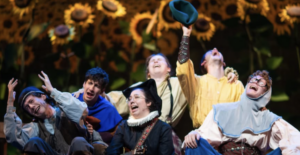 The ethereal music (most of it composed by assistant professor of music technology and composition Julie Herndon and Treebird—a trio of performer-composer-movers including Herndon, Michiko Theurer and Marie Finch) accompanied limber performers including a talented ensemble of sprites played by Tamara Botwin-Lazarow, Giselle Candelario Castillo, Jack Elonzo Campos, Struthers, Alyssa Shavely, Charlotte Virginia White, and Estee Wylie. Choreography by Leann Alduenda, director of the Dance Program, included a lovely sequence with petal-like props accompanying Titania into her slumber.
Aiden Jantz as Puck, Lori Mae Hernandez as Quince, Maya Seagraves as Bottom and Eduardo Winarski as Snug also proved adept in their movements and interpretations, connecting with the audience on a visceral level that drew us into the fun of both playing pranks and play-acting.
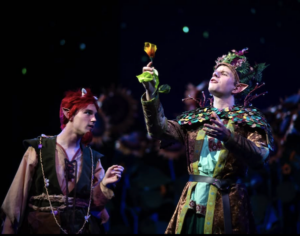 Inventions like having Demetrius and Lysandra going after each other with sunflower stems instead of swords further strengthened our understanding that no characters would be harmed in the making of this show, keeping its whimsy and its lightness intact.
The costumes by theatre professor Thomas John Bernard were in some cases quite simple and functional (as in the case of the lovers, who took various pieces of red, white and black on and off throughout) and at other times quite rich and elaborate (as in the case of Oberon and Titania, befitting the king and queen of the fairies). The contrast worked to keep our focus on the outcome of the human love story, figuring the intricate other-worldly relationships would sort themselves out without mortal intervention.
This Dream was an imaginative, satisfying reverie that once done (with another few dance steps, no less) left us smiling and appreciative of the collaborative nature and diversity of the Cal Poly Theatre, Dance and Music departments.