
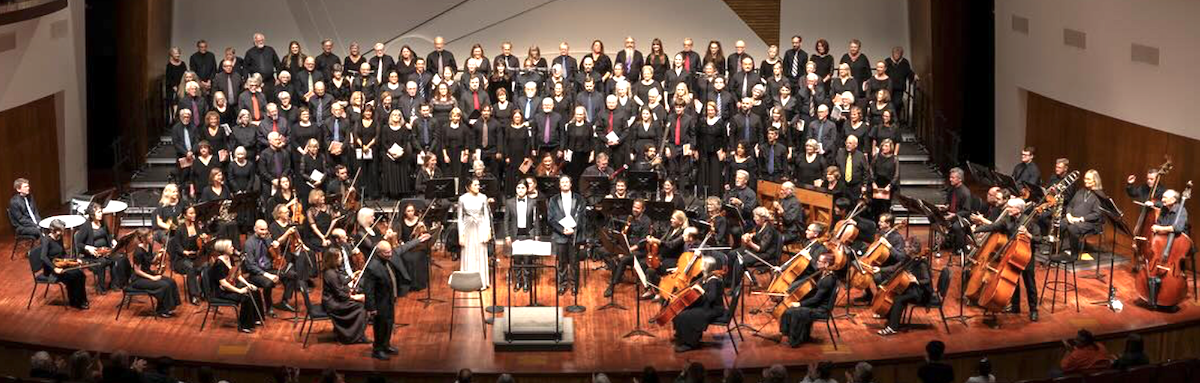
Photo by Brian Lawler
Wow! Spectacular! Awesome! Heck, I’m going to have to use a thesaurus to find any more superlatives to describe the San Luis Obispo Master Chorale’s rendering of Joseph Haydn’s grand oratorio The Creation.
The group’s presentation at the Performing Arts Center SLO on April 19 left little doubt why the oratorio is considered by music scholars, the general public, and Haydn himself as his greatest compositional achievement.
Haydn’s work was greatly influenced by his hearing performances of George Frideric Handel’s two famous oratorios, Irael in Egypt and of course, Messiah. Echoes of those masterworks can be heard throughout The Creation, yet Haydn’s piece is still uniquely his.
As Cal Poly music history professor Alyson McLamore pointed out in her program notes, The Creation’s libretto is an amalgam of Genesis from the King James Bible and John Milton’s Paradise Lost with an added dose of late Enlightenment Age philosophy (thank you, 18th century British astronomer William Herschel).
It was first translated to German, which Haydn used for setting the music, then retranslated to English by one of his patrons who was not that fluent in the language. Thankfully, the English version we heard from the Master Chorale was completely reworked by the famed American choral conductor Robert Shaw and composer Alice Parker in 1957.
Maestro Davies’s ensemble singers impressed us with their clear enunciation, dynamic and rhythmic precision, and beautiful blend.”
This work requires the forces of a full orchestra, large SATB choir and soprano, tenor and bass soloists. Music Director Thomas Davies brought together his 110-voice choir, 50-piece orchestra, and super-star vocalists—soprano Amy Goymerac, tenor Xavier Prado and bass Colin Ramsey—who proceeded to mesmerize the audience.
Right off the bat, Haydn strayed from a verbatim interpretation of the opening of Genesis by naming his overture “Representation of Chaos.” Musically it represents chaos by seriously bending the rules of structural harmony common to Haydn’s contemporaries.
For example, a common practice in the music of Haydn’s era was to begin a work with either a scale or arpeggiated (played a note at a time) chord in the tonic key. “Chaos”—in the key of C minor—starts instead with a gargantuan unison. The entire orchestra (including timpani drumrolls) plays a C in the middle of their respective ranges that is sustained according to the conductor’s wishes. Definitely an attention-grabber.
What follows is not a typical establishment of a key by means of a standard chord progression, but a seemingly random wandering through many different keys, or atonality, for about six minutes.
The rest of the Genesis story is musically interpreted from the creation of light to the idealized love of pre-Fall Adam and Eve.

The three soloists acted as narrators, first as the archangels Gabriel (Goymerac), Uriel (Prado) and Raphael (Ramsey), through the common devices of recitative and aria. After their “creation,” Goymerac assumed the role of Eve and Ramsey, Adam. Prado remained as impartial narrator. Goymerac, Prado and Ramsey were absolutely spellbinding in these roles, exhibiting flawless, nuanced technique appropriate to the Classical era. In their roles as Adam and Eve, Goymerac and Ramsey sang a love duet that truly tugged at our heartstrings.
The choir provided support to the narratives where extra emotive heft is needed. Maestro Davies’s ensemble singers impressed us with their clear enunciation, dynamic and rhythmic precision, and beautiful blend.
The orchestra is called on to bestow textural richness as well as dramatic support by means of extensive word painting. Master Chorale Orchestra members moved the audience not only with the drama and beauty of their sound but with their interpretive skills. I’m certain almost everyone will remember the moment when Ramsey as archangel Raphael tells us that on the sixth day, the Earth brought forth even the worm. He is accompanied by Paul Curtis’s contrabassoon that created a wriggly, even somewhat slimy sounding tone-portrait. I think Handel would have tipped his hat had he been alive to hear it.
At the conclusion of the final chorus, the audience virtually jumped to its feet in boisterous applause interspersed with shouts of “Bravo!”—twice recalling the conductor and soloists to the stage.