
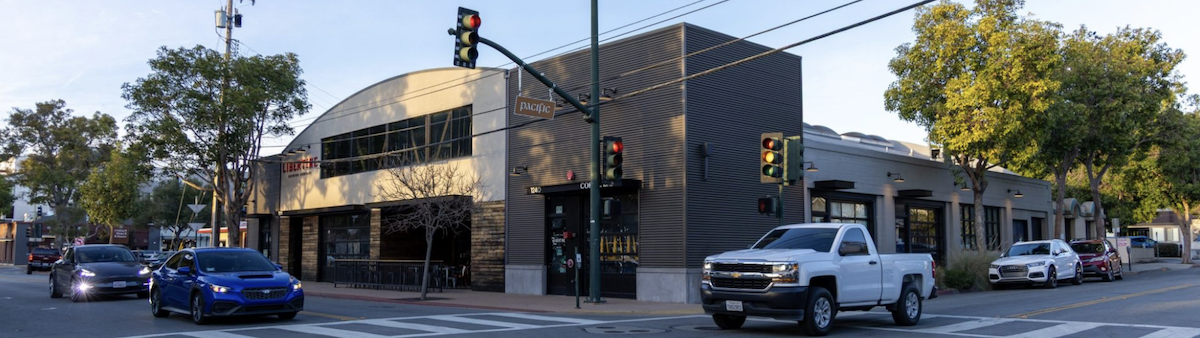
Photo by Lloyd Esola/Mustang News
Editor’s Note: This article originally appeared in the Mustang News on February 15, 2026. It has been edited and updated by SLO Review staff.
Libertine Brewing Company could face the consequences of a decades-old municipal code that is applicable to San Luis Obispo’s commercial zone. The conflict has become the focal point of a broader conversation about noise enforcement in the downtown area.
San Luis Obispo’s noise ordinance, which was written in 1996, does not include specific provisions distinguishing residential neighborhoods from the commercial downtown zone.
John Pranjic, Libertine’s event and marketing manager, said the venue has received complaints in the past but was never formally cited.
“Every time the police department was dispatched to our location, the police department themselves said, ‘No, you guys are all good. You guys sound like all the other bars downtown,’” Pranjic said. “‘You guys aren’t doing anything that’s abnormal. You guys have all of your permits. You guys have everything that you need in order to behave this way.’”
The venue continued to operate under the assumption that the business was doing everything okay. This mindset changed when they started receiving citations related to noise complaints.
“It wasn’t until January that the police department and code enforcement suddenly changed their enforcement of this policy,” Pranjic said.
Timothea Tway, the city’s director of community development, said the city received several noise complaints regarding the Libertine, which triggered a code enforcement investigation and a notice of violation on January 8.
The city is holding an administrative hearing on February 23 where business owners and residents will have the opportunity to discuss the ordinance with city officials.
The administrative hearing will review one of the Libertine’s minor use permits, which allows the business to have live entertainment during specified hours and includes noise precaution guidelines, such as closing doors and windows after certain times.
The Noise Ordinance and Permits
San Luis Obispo’s noise ordinance prohibits any “noise disturbance” that is plainly audible at a distance of 50 feet from the source and across a property line. The ordinance also restricts the operation of radios, musical instruments and amplified sound between 10 p.m. and 7 a.m. if the sound creates a disturbance across a residential or commercial real property line.
Residents can report code violations through county or city reporting systems.
“It’s important for the community to know that no decision has been made,” Tway said. A zoning hearing officer will consider comments from all parties before determining whether to change, revoke or keep the permit.
The complaints prompting enforcement reportedly came from a resident living near the downtown area, according to Pranjic. He said the Libertine staff attempted to communicate directly with the individual but were unsuccessful.
Impacts on Downtown
While Libertine is currently facing the citations, Pranjic said he is concerned about how the ordinance could affect other downtown businesses if enforced in the same manner. He said the current interpretation raises broader questions for venues that host live music and late-night events in the city’s commercial downtown zone.
“[The city] is actively implementing its stated goal of migrating large and unlawful student gatherings away from sensitive residential neighborhoods and into controlled professional environments, like Libertine, like the Penny, like Region Event Center, like a number of different places in downtown.”
Pranjic believes removing those options would not eliminate nightlife activity.
“When professional venues are systematically shut down due to restrictive noise ordinances, and the desire for nightlife doesn’t disappear, it just goes back to underground spaces,” Pranjic said. “Small coffee shops that aren’t permitted, other spaces that aren’t managed or supervised. That’s not what the city should want.”
Jazmine Hornor, a local DJ who has hosted events at Libertine under the name “soso” and runs the event series “Touch Bass,” said she hopes the city recognizes the importance of downtown venues.
“I really hope the city sees the importance of keeping venues like the Libertine functioning,” Hornor said. “The Libertine is in the downtown sector of the city, which is where citizens should be able to celebrate and enjoy art and music.”
Artists such as Hornor have expressed concern, even so far as to amplify broader community efforts. Local musician Vince Cimo created an online petition, which urges the city to reconsider how the ordinance is being enforced.
“I just wanted to try and do something to help [Libertine] build a case against getting shut down and get some other local musicians on board because I know he’s helped a lot of people,” Cimo said.
Administrative Hearing February 23
A public administrative hearing will be held in City Council Chambers at City Hall, 990 Palm Street, on Monday, February 23 at 2:30 p.m. or later, which includes an item to re-review the Libertine Brewing Company’s minor use permit to operate with late-night service and entertainment.
The city has posted the hearing agenda and detailed staff report online. Members of the public can submit public comment for consideration until February 22 via email to community development assistant planner Mallory Patino ([email protected]).
Under “Public Notices” on its website, the city has posted the following statement which reads, in part: “The City recognizes that this situation has generated strong feelings in our community, including among neighbors, the business and its patrons, and members of the cultural arts community. We remain committed to supporting cultural arts and to maintaining a vibrant and livable downtown that balances the needs of neighbors, artists, businesses and patrons . . . It’s important for the community to know that no decision has been made. Each perspective matters and the City Zoning Hearing Officer will consider comments from all parties affected before deciding whether to change, revoke or keep the permit as-is. The hearing officer will also consider both late-night service and entertainment activities and neighborhood livability.”