
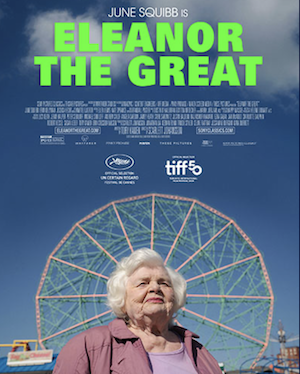
Eleanor the Great begins with two elderly women who are best friends waking up in their Florida home—a fitting beginning to a film that treads the lines between dreaming and waking, between creative storytelling and the “hard news cycle.” It leads viewers on a strange trek from Florida to Manhattan, but also through memory, identity, and the relationship of narrative, friendship, and grief.
One of the women, played by Rita Zohar (Laura Adler’s Last Love Affair), dies suddenly, and the other, the title character played by June Squibb (Nebraska) moves back to New York City to live with her daughter and grandson.
 Eleanor subtly undergoes a strange transformation while her subconscious mind processes her loss without her seeming to know it. The vehicle for this transformation is an error of location, and a support group. (Support groups, identity, and mis-narrative seem prominent in recent films—see James Sweeney’s Twinless.)
Looking for a choir class at a Jewish Community Center, the 94-year-old Eleanor is inadvertently invited into a support group for Holocaust survivors. She tries to leave when she realizes her mistake, but is comforted and coaxed by the group members. She begins to tell a vivid story of enduring the horrors of the Holocaust—but while she is Jewish, she is not a Holocaust survivor.
Scarlett Johansson, in her directorial debut, skillfully brings together several competing forms of narrative in the film. Erin Kellyman plays Nina, an idealistic young college student who has abandoned creative writing, joining the group to write an article for her journalism class.
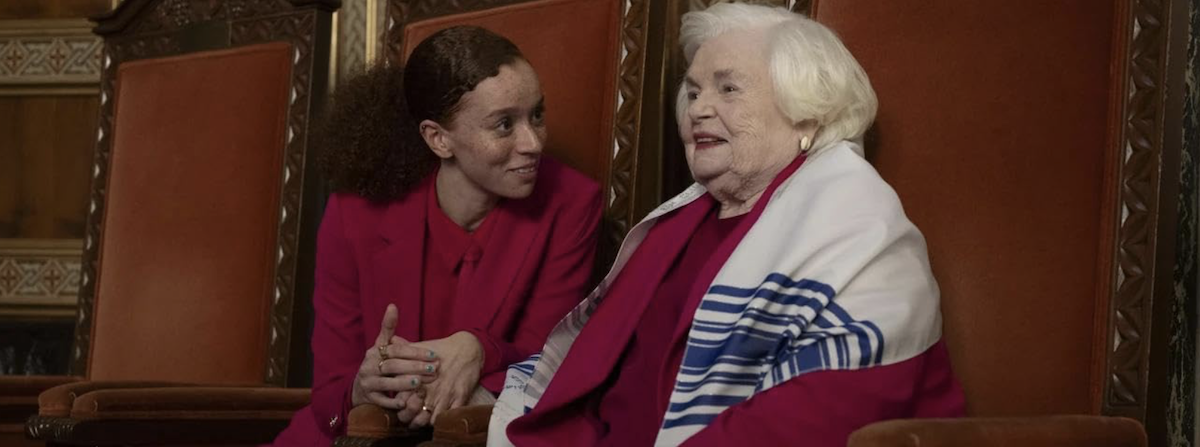
Nina pursues Eleanor for her story, and eventually the reluctant Eleanor and Nina become close friends. Nina is Jewish, Black, and gay, an outsider who also has lost her mother. It’s touching to see this unlikely pair explore their identities, and help each other rediscover their Jewish faith while perhaps unknowingly filling voids in each of their lives.
Fiction, reality, and identity crash when as a result of rediscovering her faith and identity as a Jewish woman, Eleanor decides to have a Bat Mitzvah. During the ceremony, the wool is pulled from everyone’s eyes.
But the film doesn’t end where we think it must. Rather it becomes much more of a study of the psychological implications of trauma and grief. We are challenged to see the complexity of what appears to be a manifestation of grief that makes us consider the purpose of stories and the obligation of survivors to bear the memory of loved ones.
Eleanor the Great is worth watching for great performances, an intricate examination of narrative, and the revelation that truth can be presented even in the midst of a deception.
Editor’s Note: Eleanor the Great is now playing at The SLO Film Center at the Palm Theatre.