
Photos by Melinda Sue Gordon © Universal Studios
The excitement and controversies surrounding the ramp-up to Christopher Nolan’s epic new film and interpretation of Homer’s Odyssey is not your typical over-anticipated marketing buzz.
The Odyssey not only lives up to the hype, but surpasses it with the arrival of the film in theatres. Its launch and nationwide—indeed worldwide—run in cinemas is an event much like the premieres of Gone With the Wind (1939), The Wizard of Oz (also 1939), The Ten Commandments (1956), Cleopatra (1963), and Doctor Zhivago (1965).
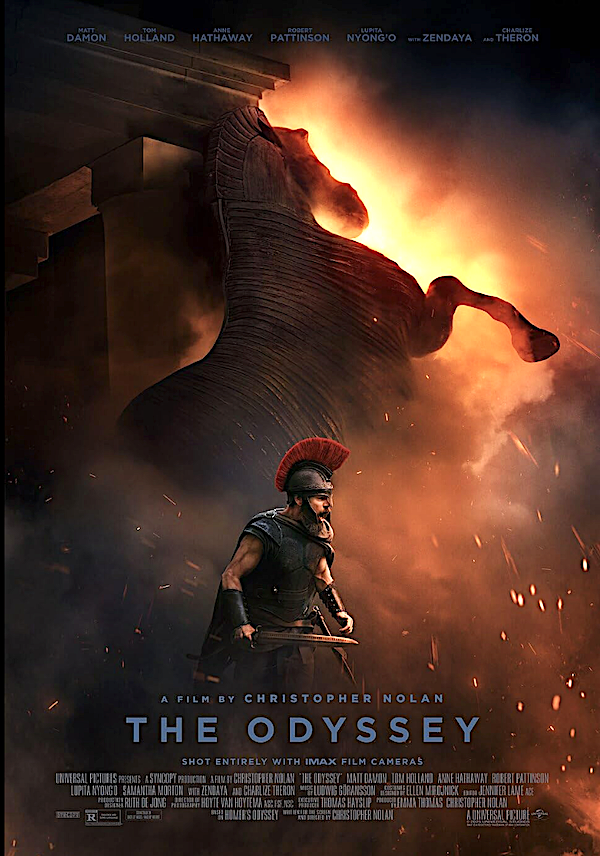 The Odyssey is a legendary story that covers all genres—what my world literature professor called “the bedrock of all Western literature.”
This film’s varied and exquisite cinematography ranges from panoramic vistas of the wide ocean to wide-ranging emotional close-ups on the faces of multiple great actors of our time.
Nolan’s creative and critical vision renders a story of one man dealing with overwhelming loss on a personal and a global scale: as a father, as a husband, as a tormented combat veteran grappling with the terrible things he’s suffered and committed, and ultimately as a man trying to return to his family, his home, and a normal life that has long since disappeared.
Nolan reimagines Odysseus as a reflective war veteran and officer, still in charge of a crew that is slowly losing faith in him as he gradually grapples with a loss of faith in himself.
The revelation of this movie is its focus on Odysseus not as a scheming con artist and trickster, but as a critically-minded empiricist trying to understand the chaos and horrors of a world that seems to have no answers. He cannot spare the time to rebuild himself as he’s still trying to guide his men safely home.
This interpretation has more in common with The Pacific (2010), the critically acclaimed HBO series about U.S. Marines fighting through the Island Hopping Campaign in WWII and then individually making their difficult ways home, than with Nathan Juran’s The 7th Voyage of Sinbad (1958)—though it’s not without relation to the latter.
In relation to Homer’s epic, many critics and Hollywood movers and shakers have bemoaned the movie’s lack of verisimilitude. I wonder if they even know to which translation they refer. Historical translators have reimagined the book moderately to radically over the centuries, and making such claims seems a trendy way to appear more intellectual.
“It is probably viewers who haven’t read Homer who are likeliest to enjoy The Odyssey,” argues one eminent critic. We should be entitled to expect more than this sort of pseudo-intellectual virtue signaling from The New Yorker.
I’ve studied various translations over the years and have had the honor, responsibility, and pleasure of teaching the book (mostly using the Fitzgerald and Wilson translations) to my college World Literature I class for the last seven years. I find myself challenged, instructed, and most welcomingly entertained by Nolan’s ambitious and impressively visionary production of this classic epic.
The Odyssey finds Odysseus on Calypso’s island as a castaway and a man aged by the atrocities he has both endured and administered. The movie completely overlooks his sexual affair with the demi-goddess, and casts her as a mythological therapist to whom he recounts his story. He works through his trauma by remembering what by necessity he has had to forget.
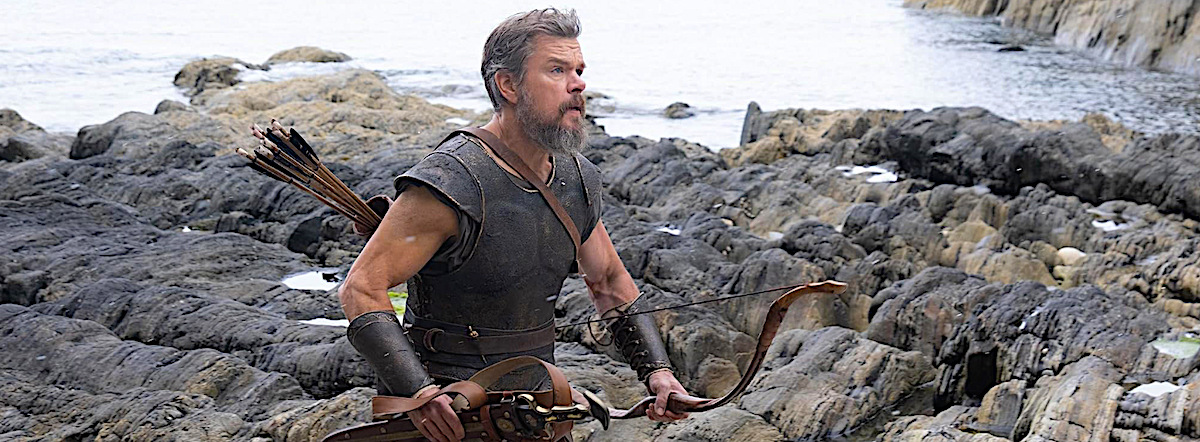
I had my doubts about Matt Damon (Good Will Hunting) as Odysseus, but he executes the role perfectly as the genius strategist and victorious mariner who lives long enough to overthink his life choices and their consequences.
Odysseus has many sides in the original story. He’s not just the conscience-lacking trickster of so many plans that made the Greeks and himself victorious in war and peace. He’s a man who still has nightmares and wracking guilt as he recalls the cries of his mariners as they’re snatched from the deck of his ship by the monstrous and multi-headed Scylla, and as they are eaten by the cyclops Polyphemus (are you ready for Bill Irwin—Sesame Street‘s Mr. Noodle—in this role?). Here Damon redeems himself from the Bourne Identity trilogy. (Okay, they were very popular, but really somewhat ridiculous.)
Calypso (Charlize Theron with such magical acting expertise that you won’t even notice it’s her) is the empathetic clinician guiding Odysseus to remember and come to terms with the endless traumas he’s endured.
American author and literary legend (and my dear friend and mentor) Maxine Hong Kingston has long held the view that the Odyssey is essentially the story of a war veteran, and whatever the circumstances of his homecoming, a war veteran really takes 10 to 20 years to actually “return” home.
Odysseus the war veteran must confront his dead, face his monsters, and return to a country and land that is no longer familiar—maybe even hostile—to him. Eventually he must renew familial relationships and recreate his home.
Almost miraculously, Nolan fulfills this structure in the living framework of The Odyssey. Tom Holland (Spider Man) wins us over as the hopeful son left behind who desperately wants to believe in and know his father. Telemachus lives among hordes of men trying to bed and marry his mother—and kill him.
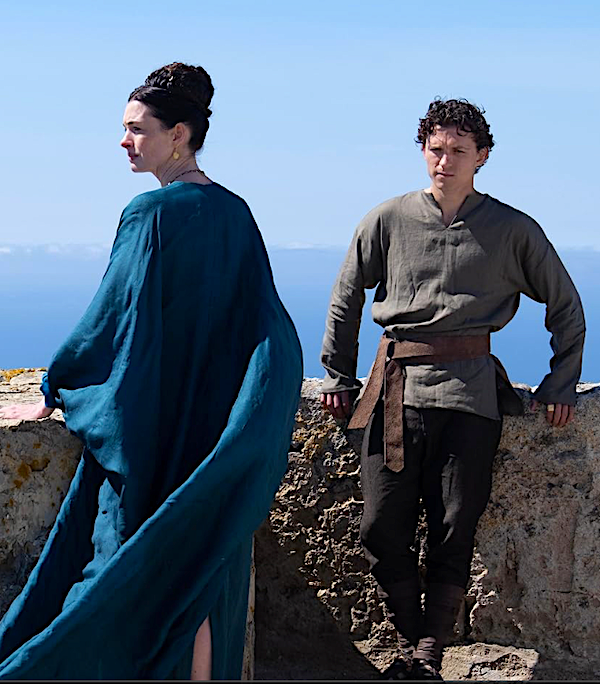
Anne Hathaway is perfect as Penelope, the mother who must keep order in her house, raise her son, and avoid becoming what we in the Marine Corps referred to as a “WestPac widow.”
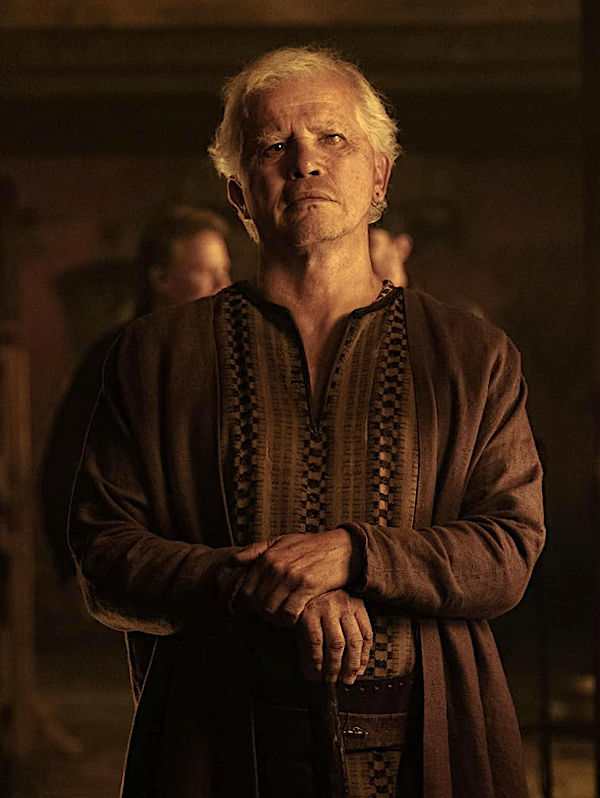
Nolan reimagines the humble but pivotal character Eumaeus, Odysseus’s swineherd and most lowly servant, who proves to be the most loyal and faithful to Odysseus, his son Telemachus, and his kingdom. Empathetically portrayed by John Leguizamo, an actor who has ripened into a master of the craft over the years, he is one of the film’s most pleasant surprises.
There is so much to discuss about this film based on a book that was said to instruct princes how to behave during peacetime (the Iliad instructs princes how to behave during war). It draws heavily on Virgil’s Aeneid—where the story of the Trojan Horse actually is told (not in either the Odyssey nor the Iliad).
In a time when literature classes are under threat of being cut (even by deans of humanities), it is hopeful and exciting to sit in a packed Palm Theatre screening with an audience diverse in age, orientation, gender, and ethnicity and experience the synergy of an enraptured and captivated collective.
I recommend getting out and seeing this one on a big screen. All you curious and hungry viewers, experience Homer’s world: immerse yourself in Homer’s wine dark sea, the shadowy Temple of Pylos, and the dark recesses of Polyphemus’s cave.
I watched the Harryhausen special effects of The 7th Voyage of Sinbad on Channel 5 Saturday afternoon TV when I was a kid, mesmerized by the cyclops and self-generating saber-wielding skeletons. Just as I was entranced, when your children catch The Odyssey on their futuristic 3D device or Meta screens, you can tell them of the awe and wonder of seeing it in a packed and darkened theatre with people clapping as the credits rolled.
If Homer’s epic is the beginning of Western literature, then it’s also true that it is the culmination of ages-old culture and oral tradition. The movie’s last scenes radically reimagine the book’s ending, bearing a stark caution for our own world and time.
Throughout the film, the characters hear foreboding stories of “the people from the sea” who will come and bring destruction on Mycenean civilization; in the end, it is the Greeks themselves.
We must heed Odysseus’s final lines on the world they are leaving behind: “Songs will be all they’ll have to remember the last of us who could write.”
Editor’s Note: Writer Tom Patchell dedicates this review to Hannah Emmack, “embedded tutor, universal talent, and fellow mariner in Odysseus’s crew.” He urges everyone to read the Odyssey and the Iliad by Homer, as well as Virgil’s Aeneid and as many of the classics as you can. Advising that you cannot expect the riches they will yield until you have experienced them, he suggests enrolling in his World Literature I class at Cuesta College this fall to learn more about these works.