
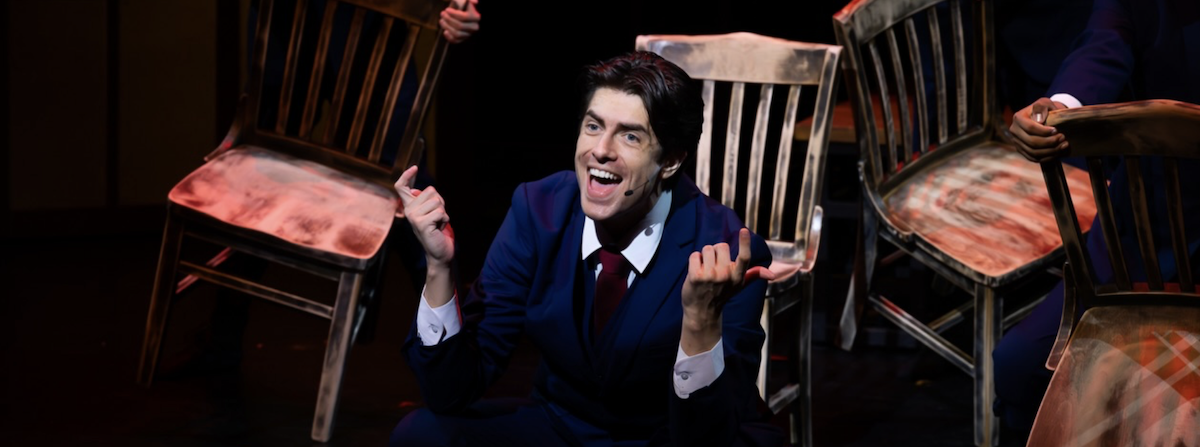
“Ten minutes ago, you could see the entire horizon . . . now only the dusk.”
So says Moritz, a teenage student full of potential in a German boys’ school in the late 1800s, and one of the main characters in Spring Awakening, the musical that ended a short run on May 17 at the Harold J. Miossi Cultural and Performing Arts Center at Cuesta College.
 The sentiment expressed in Moritz’s statement reflects darkly on the fleeting nature of youth and life, and the revolutionary spirit that often disrupts oppressive social structures before it is inevitably snuffed out.
This award-winning musical, based on a German play of the same name that premiered in 1891, deals with a range of challenging and controversial topics—teenage sex, sex education, homosexuality, forbidden texts and desires, abortion, death, and suicide—in its exposition of the age-old struggle of youthful rebellion and societal order.
Adolescent angst has been a topic of human interest and art long before the rise and decline of emo culture, and will no doubt keep our interest for ages to come. While watching Spring Awakening, I kept thinking of Dead Poet’s Society, which had to have gained some influence from the original play.
 The contemporary musical, which gives the original story an avant-garde rock/folk score, was written by Steven Sater with music by Duncan Sheik and premiered on Broadway in 2006 (though it had a longer period of showings and development before that).
Cuesta’s production was directed by Zoe Saba, with fight/intimacy direction by bree valle. It’s said to be valle’s last Cuesta production, as she retires at this semester’s end.
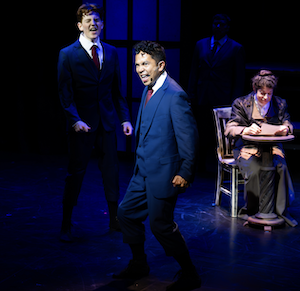
Spring Awakening’s story follows a class of boys and a group of schoolgirls through a formative period in their teenage lives as they experience puberty and navigate the realizations and primal urges that accompany it. The staging worked well with tension and contrasts throughout. The lighting was often dim, with the boys uniformly dressed in dark navy blue suits, white shirts and red ties, while all of the girls were in white dresses.
In separate ways both the boys and the girls become curious about their bodies and sexuality while trying to maintain their places and uphold the expectations of their rigid society. The sometimes violent and tragic results of youthful desire and exuberance erupt within the oppressive social structures.
 The two main characters among the boys were the philosophical Melchior (Taylor Lee Chambers) and the brooding and tormented Moritz (Ritchie Bermudez Hills). Both actors gave great performances as these characters endure and suffer the divergent consequences of both acting on and repressing their powerful desires.
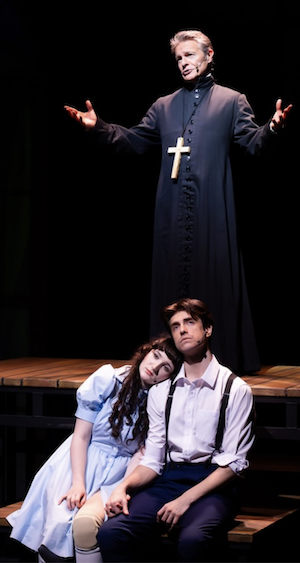
Among the girls, their counterparts—the adventurous and dreaming Wendla (Abbi Colvin) and the Bohemian Ilse (Danielle Blauer)—suffer consequences in an asymmetrical mirroring of those of the boys. With their skilled acting, Colvin and Blauer captured the flightiness of whimsy and the intensity of mental and physical struggles and yearnings.
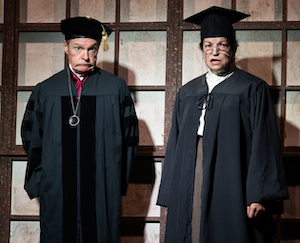
Saba did great work showing the separate worlds that the boys and girls create within the greater social dominance of the adult world. All of the adults were played by one man (Todd Long) and one woman (Victoria Culman), and one of the amazing delights of the play was to see the breadth these two actors displayed in their varied performances.
One of the great structural contrasts underwriting the production’s themes is the disparate rock/folk musical numbers that hemorrhage out of its dark and light scenes—all handled effectively by music director Mark Robertshaw. The jarring juxtaposition is disorienting and offsetting, while providing a number of conflicting emotions within individual numbers (such as“You’re F#@ked”).
The dynamism of the dance sequences and movements on stage also provided structural contrast to the oppressive sets and social structures. This stage work takes sophisticated coordination of the meticulous choreography by Jason Sumabat and the quick and proficient work of the often-unsung running crew (bravos to Keke Anderson, Alphie DeCoster, Dominic Mendenhall, and Stephen Schrel), along with sensational stage management by Bridget Aggen, this year’s winner of Cuesta’s Bermudez-Hills Scholarship award.
Spring Awakening pushes the limits of college theater as a dynamic mix of old and new, static and dynamic. Despite the heavy topics, it was worth seeing for its artistic reach, great performances, and great stagecraft.
It was also valle’s swan song. As artistic director of the Cuesta College theatre arts program, in 2021 she received a Gold Medallion from the Kennedy Center American College Theatre Festival for her work as a theatre director. On behalf of myself and SLO Review, thank you, bree, for enhancing art and theatre for Cuesta College and the Central Coast. May your horizon ever be completely visible and open!