
Lauren Gunderson’s podcast How to Playwright: A Creative Podcast for Theatre Lovers is a must-listen for writers, theatre insiders and anyone else who enjoys the particulars of how a play is conceived, constructed, and ultimately conveyed into the hands of a director to shape into an experience for an audience.
By chance I happened to listen to her most recent episode—”Explosive Midpoints!!” (yes, with two exclamation points) published March 8—just prior to seeing the March 13 opening night of Wife of a Salesman at SLO REP.
The fourth production of this season’s Ubu’s Other Shoe staged reading series was written in 2022 by another American playwright, Eleanor Burgess. She, like Gunderson, often explores feminist themes through strong female characters and complicated relationships.
Wife of a Salesman really has little to do with Arthur Miller’s Death of a Salesman. Burgess is just using the salesman’s wife as an entry point to the kinds of issues that women of that time period—and of the current day—face.
But I was struck by how Wife of a Salesman is the perfect example of Gunderson’s contention that a play not only needs a strong beginning and ending (a strong point of this production), but a striking midpoint upon which the entire direction of the play pivots. Gunderson calls the midpoint “the power move” of the story—”big stakes, big shifts, no turning back.”
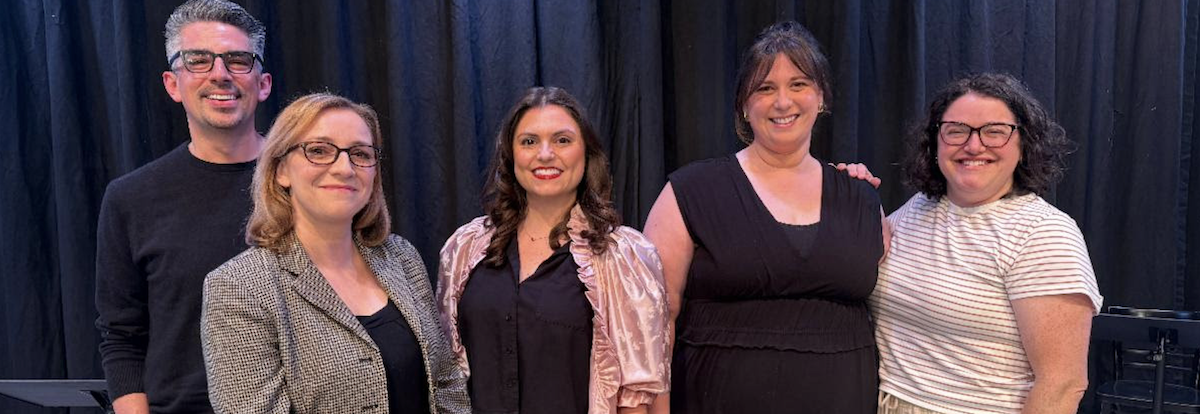
Ably directed by Kerry DiMaggio, this 90-minute staged reading of Wife features an intelligent and energetic depiction of “The Wife” by Christina Diaz and a sly and disturbing portrayal of “The Mistress” by Heather MacLeod.
Their meeting, which Burgess has served up as a sounding board for marriage, womanhood, and motherhood, makes up the entirety of the play. This prolonged dialogue could have turned a bit tedious, except for two developments: one is a shift in context, at first a bit perplexing but ultimately adding substantial nuance to the conversation. The second is a surprising reveal at a pivotal midpoint that ups the ante for the two characters and gives Diaz and MacLeod an opportunity to up their intensity.
And that midpoint, as Gunderson describes, ushers in the play’s heart and soul. It allows us to understand if not anticipate the tragic and, certainly to the opening night audience, shocking ending.
Shannon Peters (the narrator) and Roberto de Leon (who is part of the shift in context) are steady in their brief supporting roles.
Staged readings such as these provided by Ubu’s Other Shoe give local performers and audiences another, always welcome, always educational, way to experience theatre on the Central Coast.