
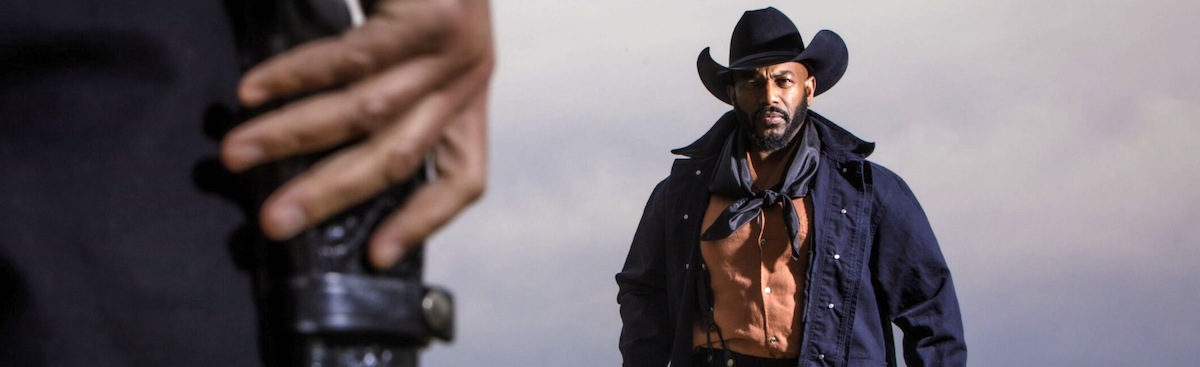
Photo by Mark Velasquez
Gunslingers and cowboys and frontier towns. Hard-ridden horses, saloon girls with hearts of gold, and sheriffs with shiny badges. Good vs. evil fighting it out in shoot-‘em-ups and drunken brawls and rough and tumble skirmishes over land.
At least that is the wild, wild “Old West”—as Americans began immortalizing it almost immediately after-the-fact—of song, Zane Grey books, and film (anyone remember William S. Hart?).
The American frontier in the decades after the Civil War was a chaotic, sometimes lawless, mostly messy land of opportunities. I had never envisioned using words like refined, precise, or meticulous to describe it.
Til now. Those are the words that come to mind after seeing PCPA‘s opening preview night performance of Shane, a relatively new play by Karen Zacarías from the 1949 novel by Jack Schaefer.
Make no mistake, this is not the 1953 movie adaptation of the book starring Alan Ladd. It is not a white-washed version of Wyoming before the turn of the century, which in reality was mostly a melting pot of immigrants who had displaced the land’s original inhabitants unthinkingly if not cruelly.
Zacarías tells her culturally authentic story of a stranger with a violent past through the eyes of an eight-year-old boy, re-telling as an adult this mysterious man’s lasting effect on the boy’s family and community.
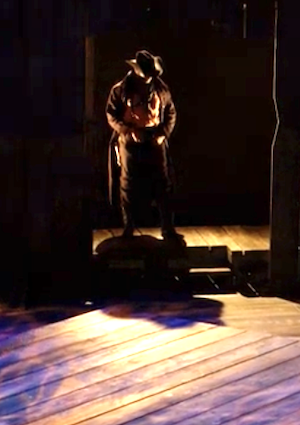
Bobby Starrett (Alexander Pimental), with stars in his eyes, narrates the story of Shane (Corey Jones, looking as if he was born to play this part) who is revealed to the audience frozen in the spotlight of Bobby’s revered remembrance of a legendary man.
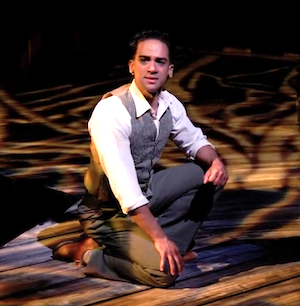
Michael Palumbo’s scrumptious lighting, Jason Bolen’s eloquent set design, and Tracee Bear’s dramatic costuming, along with stunning fight and movement direction by Kevin Asselin and precise acting by all—wrap this play in a marvelously meticulous memory of what one man recalls learning from another man just what it is to be a man.
This is a memory play. Director Erik Stein reminds us of this constantly through the dramatic deceleration of key action scenes—bringing us, rather unusually, to the play’s musical accompaniment composed by Joe Asselin. It might as well be another character in the ensemble as much as it gives the actors (and us) precise rhythmic cues and clues.
Here, the male performers’ thigh-slapping and foot-stomping to a score reminiscent of Hollywood Western toe-tapping twangs is an entirely masculine and modern interpretation. I urge you to take a look at the trailer PCPA has posted online to give you a good sense of this story’s lyrical translation to the stage.
It seems every detail has been honed to give us a remembrance as true to one teller’s past as could be expected. At only 90 minutes, and with no intermission, Shane is a fine, refined spectacle worthy of your time and contemplation.