
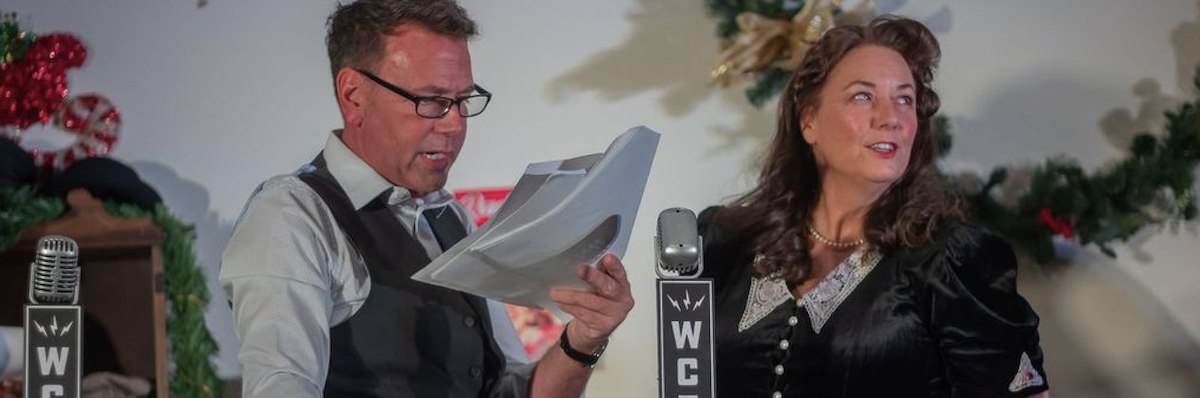
Geoff Higgins and Kristen Saunders
It’s a wonderful play.
It’s not a conventional play—it has actors playing voice actors putting on a radio play, so they get to read most of their lines.
Nor is it a perfect play—it’s a version of a film based on a short story loosely based on a Dickens classic that suffers just a teeny bit from too many iterations.
But Wine Country Theatre’s absolutely delightful production of It’s a Wonderful Life: A Live Radio Play shouldn’t be missed. It runs through December 14.
If you haven’t seen the movie, or have never listened to a radio drama, this production will give you a heavenly introduction to the story of George Bailey . . .”
Fans of the 1946 movie It’s a Wonderful Life, starring James Stewart and Donna Reed and a host of recognizable character actors, will enjoy being reminded of their favorite bits (“Buffalo Gals,” anyone?) from the beloved fantasy, annually rated among the best Christmas films ever made.
Fans who remember radio drama, and in particular American audio plays from the 1930s through the advent of television in the 1950s, will relish a return to storytelling that depends on dialogue, music, and sound effects to help a listener imagine the characters and story.
If you haven’t seen the movie, or have never listened to a radio drama, this production will give you a heavenly introduction to the story of George Bailey, a man who with the help of his guardian angel Clarence discovers what his world would be like if he had never existed.
It’s a Wonderful Life: A Live Radio Play takes place on a Christmas Eve in the 1940s, as does the radio play It’s a Wonderful Life presented within it, and you have the honor of being the audience for both.
In the course of a good two hours (with a 15-minute intermission) you will enjoy the efforts of 10 busy and multi-talented performers and a solid production team behind the scenes who give you an excellent idea about how an entertaining radio show (and a most entertaining play) is produced.
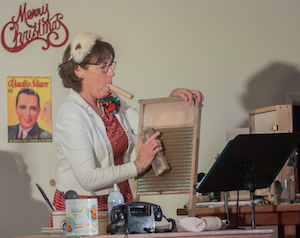
The stage is set with Christmas decor, five standing microphones for the voice actors, and an area stage left where foley artists work their magic. In this case the show’s mostly-on-the-ball foley artist is played by Marjorie Hamon, game to recreate everyday sounds in real time such as footsteps, doors closing, and punches and slaps that (thankfully) are not actually delivered by the voice actors.
It’s difficult to single out individual performers from this merry band of players, but I would end up on Santa’s naughty list this year if I didn’t mention two: Geoff Higgins and Scott Saunders.
Higgins, voicing George, channels Jimmy Stewart so well you need to see him as well as hear him to believe how marvelously he pulls it off.
Saunders shoulders the role of the announcer (always with a true-to-the-era cigarette close at hand) with the pragmatism of someone who’s seen it all before, and then some. He incites the audience to clap and laugh (and supposedly cry and swoon, too, although this production doesn’t really lend itself to crying or swooning).
As with all the players, these two take on other voices as needed, with everyone doing a fine, fine job of delivering the variety of voices and characters called for by the action.
You will likely look back on this production with a smile for one thing or another . . .”
Although the performances are meant primarily to be heard, the period hair and costume designs by Grace Anthony add a dimension of post-war reality to the proceedings. Virtually all of the men wear sharp suits and ties, and often a change of hats (in addition to a change of voice) helpfully indicates a change in character, often to comedic effect.
You will likely look back on this production with a smile for one thing or another: radio kisses (probably the biggest laugh of the show), old-time radio ads (updated with some current advertisers), and snippets of holiday songs sung lustily by the cast, including “Hark! The Herald Angels Sing” and “Auld Lang Syne.”
And of course, the bell ringing to mark the moment when Clarence gets his wings.
Co-directors Cynthia Anthony and Jacob Shearer have collaborated this holiday season to wrap up and deliver a first-rate present for audiences of all ages. Perhaps it could become a Christmas gift to the community every year?