
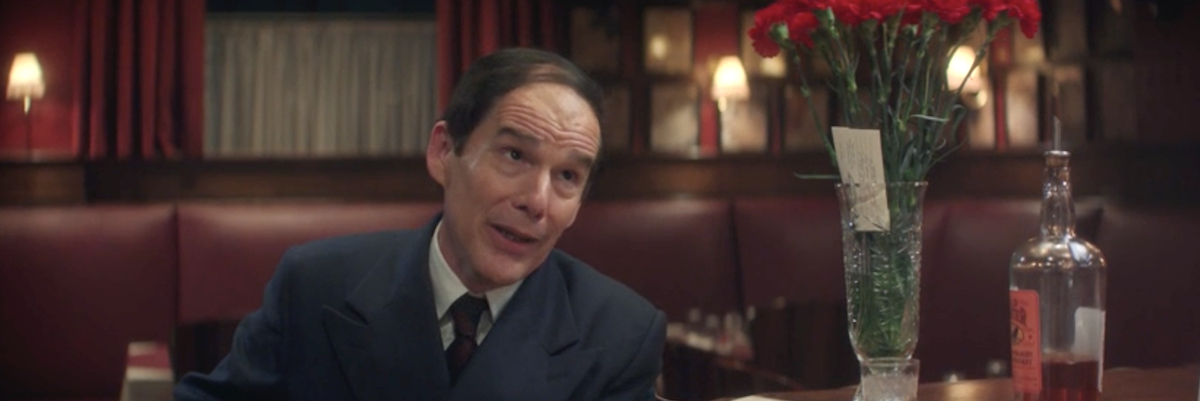
In the film Blue Moon, director Richard Linklater has given actor Ethan Hawke a play-like stage for his performance as the musing musical lyricist Lorenz (Larry) Hart.
Hart was the word half of the prolific musical composing duo Rodgers and Hart from the 1920s into the early ’40s, and “Blue Moon” is the title of one of their best known songs.
The film opens with a well-dressed man staggering down a trash-can-filled alley in the rain, falling drunk onto the pavement. The scene quickly moves to the bar at Sardi’s, the famous New York restaurant that serves as the location for an opening night celebration of the 1943 Broadway musical Oklahoma. That show was composed by Rodgers (well played by Andrew Scott) but the lyrics were not by Hart.
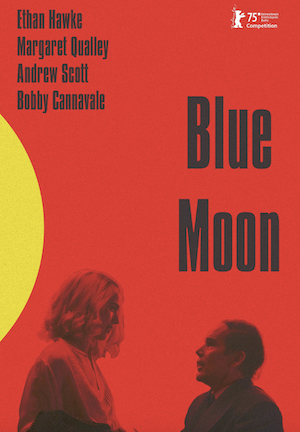 The movie is stage-like, with an order similar to a three-act play, set in a single, dimly-lit, wood-paneled space.
The first 45 minutes show Hart, who has left the premiere of Oklahoma mid-performance, talking at the other three occupants of the room: bartender Eddie (a scrappy Bobby Cannavale), writer E. B. White (a watchful Patrick Kennedy), and a soldier/piano player (a sweet Jonah Lees). All three are backboards for Hart’s criticisms and commentaries on Rodger’s musical, on his infatuation with young co-ed Elizabeth (firefly Margaret Qualley), and on his own talent and character.
Hawke is nearly unrecognizable as Hart. Film tricks make him barely five feet tall, balding with a plastered comb-over, with a barrel-shaped body wrapped in an oversized double-breasted navy suit throughout the 100-minute film.
It is difficult to like this Hart, sad and alone. He talks . . . a lot. He talks of love, for both men and women. He talks of music, songs, and lyrics. He talks of alcohol. And he talks of Elizabeth, with whom Hart is infatuated—fantasizing about a life with her and a play about her.
The second part of the film includes a scene between Hart and Elizabeth where he adoringly listens to her recount a love affair with another that ends with her telling Hart how she feels about him: love, “but not that way.”
Qualley is good as the blond, breezy, perky, naïve-but-worldly-enough young woman who knows that her friendship with Hart has advantages.
In the third act, Hart and Rodgers discuss their past and a limited future together. Scott is terrific as Rodgers, balancing patience with his tired and exasperated friendship with Hart. The scene explains Hart’s character and why Rodgers is reluctant to work with him. Rodgers leaves to join the Oklahoma celebration in his honor, leaving Hart behind in the bar.
If you want to see Ethan Hawke act in what is nearly a one man play, giving his best to give heart to Hart, or if you’re interested in learning about the complex personality of a musical lyricist, see Blue Moon.
At the screening I attended, the audience sat in silence as the credits rolled—during which the real outcome of the relationships depicted onscreen unfold. I think most were not sure of what to make of what they had just seen: a sad take on a talented but troubled artist, in an environment that he pretends to be his.
Editor’s Note: Blue Moon is now playing at The SLO Film Center at the Palm Theatre.