
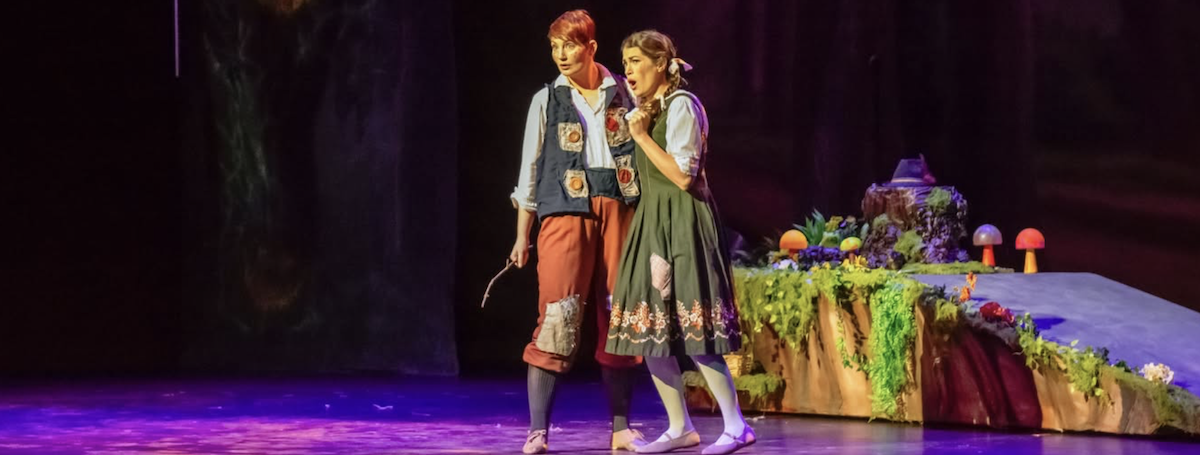
In my September interview with Opera SLO director Brian Asher Alhadeff regarding the company’s October production of Hansel and Gretel, I closed by noting “A ginormous gingerbread house and a forest add to the staging, and the colorful folk costumes of the era promise to deliver an eye-catching spectacle.”
That turned out to be a HUGE understatement.
Stage director Justine Prado Manro and set designer/production technical director Erik Mario Austin teamed up to create a stunningly beautiful panoply of physical scenery and visual effects for the October 18 and 19 performances at the Performing Arts Center San Luis Obispo.
For example, while a dreamily mellow horn quartet opened the overture, the audience was shown a darkened stage with a few small, illuminated areas that gave just a hint of a structure. As the music progressed, lighting designer Nate Deack gradually brought up the lights until we could see the interior of Hansel and Gretel’s home with the children engaged in their opening action.
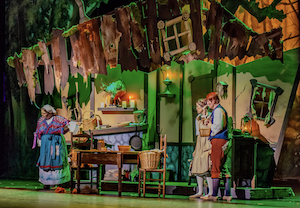 Costume designer Sherry Sparks’s mastery of vintage ethnic clothing, combined with projection designer Sean Mirkovich’s video artistry, made it easy for you to believe you were watching children at play in a humble cottage at the edge of a forest in 19th century Germany.
The overture (which composer Engelbert Humperdinck called an “introduction”) progressed through the many themes that would be heard later on, and gently morphed into a light-hearted melody to introduce the two principal characters for whom the opera is named.
The Opera SLO orchestra delivered a masterful rendition of Humperdinck’s impression of an encroaching evening in the deep woods of the forest.”
Soprano Amy Goymerac’s Gretel plays with a ragdoll while singing a charming children’s song about poor geese who must go barefoot because they have no shoes. When mezzo soprano Mandi Barrus, as her brother Hansel, mockingly interrupts her, it sets off a series of duets deliciously sung and acted.
Maestro Alhadeff had told me their voices were very well matched—another delightful understatement. Also their appearance (thanks to effective costuming and makeup), vocal technique, and acting made it really hard to believe that they weren’t siblings in real life. I also got the impression that their kids may have helped them “bust some moves.” Goymerac’s loose-limbed skipping was very evocative of a child in her first decade of life, and I was especially impressed by Barrus’s subtle changes in vocal timbre that made her sound like a tween boy.
As the action unfolds, the banter of the two siblings is marked by references to their family’s hardscrabble life, especially scant amounts of food.
The opera progresses by introducing the pair’s mother, marvelously sung by soprano Kaitrin Cunningham, angrily interrupting the children’s play because they have not completed the chores she’s assigned them. In the process she breaks a jug of milk being saved for the night’s supper. This reinforces the underlying story of the bare-subsistence life of the Romantic Era underclass. In exasperation, the mother sends her two impish kids out into the forest to collect wild berries to make up for the loss of the milk.
We are treated to a tapestry of sylvan sounds from a cuckoo’s piping to a chorus of echoes as Hansel and Gretel come to terms with being lost.”
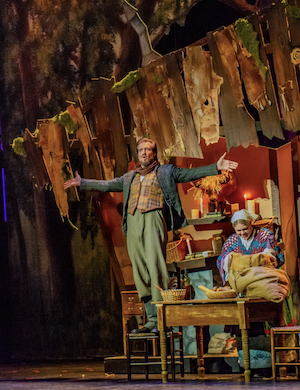
Enter baritone Gabriel Manro, deftly portraying the full-throated, happily inebriated father who has sold out his inventory of brooms, allowing him to come home with a full complement of groceries and booze.
Manro’s acting and impressive physical moves were quite convincing, and his singing was rich and full although a bit vibrato-heavy for my taste (perhaps part of his interpretation of a happy drunk). He registers a real, sobering shock when his now-remorseful wife admits to sending the children out to the forest inhabited by an evil witch.
 The second act is replete with the lush sonorities of late Romantic Era German symphonic music. The Opera SLO orchestra delivered a masterful rendition of Humperdinck’s impression of an encroaching evening in the deep woods of the forest.
We are treated to a tapestry of sylvan sounds from a cuckoo’s piping to a chorus of echoes as Hansel and Gretel come to terms with being lost.
They are soon visited by the Sandman—soprano Katelan Bowden, whose magical voice and brightly sparkling dream-sand leads them to sing the most well-known component of the entire opera: “This Night as I Go to Sleep.” This was followed by a pantomime ballet of 14 angels, beautifully choreographed by Andrew Silvaggio and delightfully executed by the dancers of Civic Ballet San Luis Obispo.
The opera culminates in Act Three when the children are awakened by sparkling-voiced—and costumed—soprano Alba Franco-Cancél as the Dew Fairy. The kids soon find themselves at the gingerbread house of the evil witch (artfully sung by mezzo soprano Jessica Gonzalez-Rodriguez). I found her Candy Land-like costume dazzling to the point of distraction—just not quite grim enough (although I’ll admit her exuberant cotton-candy beehive ‘do might well drive one to evil thoughts).
A true highlight of the opera begins at the end, with Gretel saving her brother by pushing the witch into her magic oven and baking her into gingerbread, bringing all the other children who were baked yet not eaten back to life. This leads to a massive choral finale that included Opera SLO’s newly formed and fabulous Children’s Chorus, all reprising the music of the Act Two evening prayer in a song of thanksgiving. Thousands of thanks to director of choruses Kristina Prozesky, and Children’s Chorus manager Luana Gerardis. The ensuing standing ovations were really well deserved.
If I didn’t give full credit to Maestro Alhadeff and the Opera SLO orchestra, I might have to take a remedial musicianship course—Bravo!
And of course, hats off to supertitle operator Jessica Hostetter.