

Opera San Luis Obispo’s next production is a delightful operatic setting of the Brothers Grimm fairytale Hansel and Gretel, sung in English and slated for two performances in October.
Composed by Englebert Humperdinck (a student of the Romantic-era superstar opera composer Richard Wagner—not the 1960s pop singer born Arnold Dorsey), it recreates the story with expansive music and refined charm.

Staging well-known musical adaptations of children’s stories has been a successful formula for OperaSLO under the baton of conductor Brian Asher Alhadeff, general and artistic director. Beauty and the Beast in 2024 and this spring’s The Wizard of Oz each filled the 1,286 seats at the Performing Arts Center SLO more than once.
Briefly, the story recounted by the Grimms is about two siblings, Hansel and Gretel, who are abandoned in a forest. They are caught by a witch who lives in a house made of gingerbread. The witch, who eats children, intends to fatten Hansel before eventually baking and eating him. Gretel, however, saves her brother by pushing the witch into her own oven. The children escape with the witch’s treasure and triumphantly return to their home.
I like to think Humperdinck’s operatic version marks the beginning of a mellowing of fairy tales to make them more kid-friendly. It is interesting to note that just seven years after the premiere of Hansel and Gretel, L. Frank Baum’s The Wonderful Wizard of Oz was published. Baum’s introduction to the book includes his stated desire to create “a series of newer ‘wonder tales’ in which . . . all the horrible and blood-curdling incident[s]” are eliminated.
Humperdinck’s sister, Adelheid Wette, was his chief muse and collaborator in the creation of Hansel and Gretel. An accomplished folklorist, composer, poet and playwright, she would create and produce short works to be performed for family celebrations. For her husband’s birthday in May of 1890, she asked her brother to set some of her script to music for her stage adaptation of the Grimm Brothers’ tale. These settings became the foundation and inspiration for Humperdinck’s opera. He, his sister and brother-in-law spent the following two years fleshing it out to the work you will experience this October.
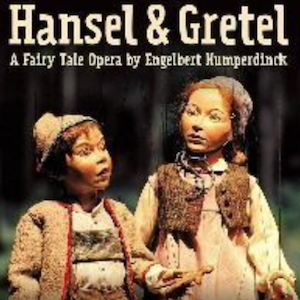 The starkness of the original tale is gentled by Wette’s verses and her brother’s music—from rollicking dance tunes like “Brother Won’t You Dance with Me?” to the intimate warmth of a children’s evening prayer (“As I Lay Me Down to Sleep”) and a dream ballet. This treatment realized immediate success at its December 23, 1893, premiere. It became so popular that many German-speaking countries adopted its performance as a regular Christmas event. It was translated into English later on and brought to America where it has also enjoyed success as one of the few operas that is geared toward a child’s perspective.
Although not quite as dramatic as The Wizard of Oz, which OperaSLO performed in May, there are lots of similarities: heroic children, spooky forest, wicked witch, happy homecoming.
Alhadeff notes that Humperdinck’s musical setting includes a large symphonic orchestra with many wind and percussion instruments, as well as a cuckoo clock whistle and a harp, making it more than twice the size of the ensemble used for The Wizard of Oz.
Also on tap is a ballet of angels, performed by members of the Civic Ballet of San Luis Obispo, and the opportunity to showcase OperaSLO’s nascent children’s chorus. A ginormous gingerbread house and a forest add to the staging, and the colorful folk costumes of the era promise to deliver an eye-catching spectacle.
Tickets for Hansel and Gretal are available online for two matinees at the PAC SLO on October 18 and 19 at 2 p.m.