

In 1989, I started working as a reporter at the San Luis Obispo Telegram-Tribune, where I had the good fortune of having the newsroom desk across from veteran reporter and columnist Dorie Bentley.
Dorie was one of those seen-it-all, covered-it-all, veteran journalists who had been in the county for decades. But what always fascinated me about her was how she first arrived in California in the late 1940s from her native Iowa.
She hitchhiked. 2,000 miles. From Iowa to Arroyo Grande. By thumb.
In talking about it, Dorie always seemed nonplussed about concerns over a woman hitchhiking across the country. “Everyone did in those days,” she would say. “It wasn’t a big deal.”
Depending on the kindness of strangers, having only your thumb to get you from one place to the next, seems to belong to another time, another era. Today, one recoils at the idea of someone just hopping in an unknown car without hesitation.

But hitchhiking was different “back then.”
For Cayucos author Dell Franklin, his time on the road in 1969 was nothing less than transformative and life-affirming—all captured vividly and unflinchingly in his new memoir, Hitchhiking, A Destiny.
With his gruff manner and disheveled appearance, Franklin is an acquired taste for some. He’s caused his share of trouble over the years. This is a guy who responded to computer problems by tossing it out the window. His personal filter expired long ago.
But make no mistake. In my nearly 40 years on the Central Coast, I would rank Dell Franklin as one of the finest local writers I’ve come across. He is our Charles Bukowski—the grumpy, rumpled Everyman with a perennial hangover, easily at home with the hookers and the homeless, the vagabonds and the victims.
Back in ’69, Franklin was an admittedly troubled young Army veteran in troubled times, trying to find himself after Vietnam.
“I was wallowing in a vortex of failure and needed not only to escape my situation, but myself,” he writes. “I was demoralized and depressed.”
In early February of that year, with only a few bucks to his name, Franklin decided to thumb his way from San Francisco to New Orleans and Mardi Gras. That was only the starting point. What was he in search of? A baby boomer can’t help but think of that Simon & Garfunkel ode where “they all come to look for America.”
What Franklin found is both memorable and mesmerizing. He was warned by many people, even back then, not to hitchhike. It was dangerous. He could be killed. By all means, stay away from the South. All the advice is ignored.
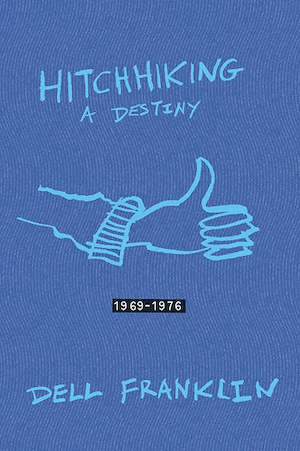 In Hitchhiking, A Destiny, Franklin encounters hookers, truckers, salesmen, runaways, and military deserters struggling to hold it all together. He works for a while on a Mississippi riverboat—captured beautifully in a separate memoir, Life on the Mississippi, 1969—and tends bar at a Jewish resort in the Catskills. He crashes one night in a Mexican border town bordello.
Big Charley rescues him from danger in northern Michigan. Fawn and Bunny, two wild women, pick him up, deciding to kidnap Franklin and take him to a motel for their own lascivious purposes, while being high-speed pursued by two rejected suitors (it’s pee-in-your-pants hilarious). Incensed rednecks berate Franklin for being a “hippie faggot” à la Easy Rider.
Yet, by the time Franklin finally puts his thumb down, he believes he has discovered what he calls “the generosity and humanity of our people”—the true soul of America. “Amid the ugliness of our politics and the wreckage of our cities and the hostility pervading the air, there was beauty everywhere.”
Like the great singer-songwriter Tom Waits, Franklin excels at composing little vignettes of the absurd and the ordinary. He creates a rich tapestry reminiscent of the road trips chronicled by the likes of Steinbeck and Kerouac.
His dialogue crackles, uncannily capturing the rhythms and attitudes of a time when political correctness wasn’t part of the cultural vocabulary.
Those who need trigger warnings, however, will likely be troubled by some of Franklin’s prose. He is willfully (and dare I say, thankfully) unapologetic, reflecting the language, sensibilities, and people of the era.
I lived through the ’60s. Thanks to Franklin, I feel like I’m back there again.
Hitchhiking, A Destiny is definitely a book worth thumbing through.
.