
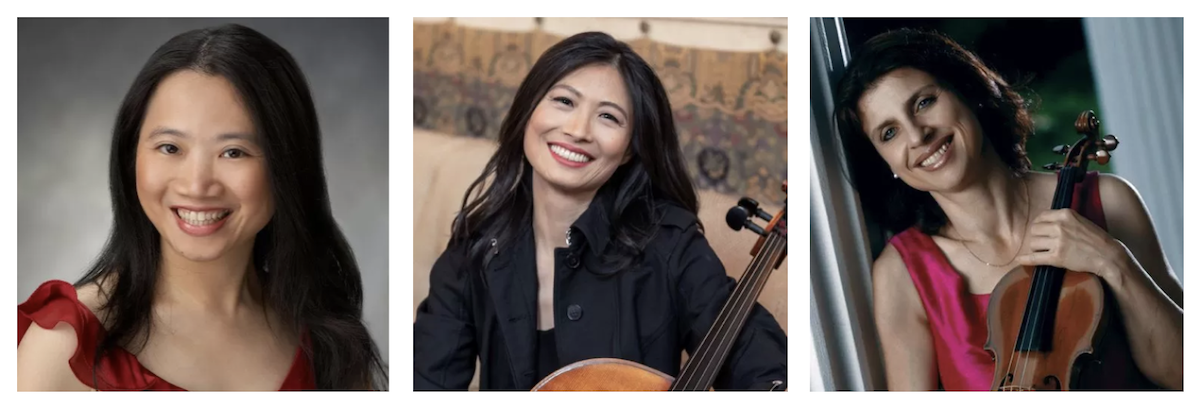
For her farewell concert as this year’s Festival Mozaic Artist in Residence, cellist Sophie Shao teamed up with pianist Amy I-Lin Cheng and violinist Carmit Zori to take the audience on an exciting and awe-inspiring acoustical ride through the past 140 years of chamber music involving the ensemble’s instrumentation.
The afternoon concert on Sunday, October 26 at Cuesta College’s Harold J. Miosi Cultural and Performing Arts Center began with a pre-concert lecture by Cal Poly musicologist and music historian Alyson McLamore. She explored creative links among the three works and the possible influences of each composer’s cultural environment.
Shao created the program by choosing a single work from today and each of the past two centuries to showcase certain aspects of the evolution of the craft of composition. Interestingly, she decided to travel backward through the ages.
In at least the first and third pieces, I heard reactions to stressors in the cultural and physical environments. I’d like to take a granular look at some techniques within each work used to reflect those influences.
Shao and Cheng collaborated in a sensitive and nuanced treatment of Ruehr’s work.”
For our current century, Shao chose a work she commissioned last year from MIT composer Elena Ruehr, “Sonata for Cello and Piano No. 2.” This performance was its California premiere. In the program notes, Ruehr says “One of the things … on my mind lately is the anxiety we feel about our changing planet. It seems to me that we are in a state of constant cognitive dissonance.” This results from our awareness of the danger posed by pollution-prone products and services that we’ve grown accustomed to using and tend to rely on.
Ruehr explains that in her sonata she sends the cello “on a journey, reacting and interacting with the environment the piano creates.” Besides anxiety, she says, “It is interspersed with the joy and comfort we find in the natural world.”
Ruehr’s use of the mostly post-19th-century compositional environment called the octatonic scale, combined with a much earlier structural technique known as a passacaglia, served her well to evoke the element of anxiety.
The octatonic scale consists of alternating half-steps and whole-steps that tends to keep the listener guessing what and where the central pitch is. In the modern use of the passacaglia, a short series of pitches is continually presented in different configurations, often layered, further thwarting a sense of predictability. Her “joy and comfort” were most noticeable in the diatonic major triads at the end of each movement.
Shao and Cheng collaborated in a sensitive and nuanced treatment of Ruehr’s work, deftly illustrating the emotional content of the composer’s art.
One has to marvel at the adroitness of Shao, Cheng and Zori when tackling this work—accepting all its eccentricities with confidence and dedication to preserving the composer’s unique expressiveness.”
Charles Ives’s “Piano Trio,” finished in 1914, portrays the sense of unbridled mirth he felt while reminiscing about his college days at Yale University. So much was he in this frame of mind while composing it that he subtitled the second movement “TSIAJ”—an abbreviation of “This Scherzo Is A Joke.” A true musical innovator, he begins the work like a Japanese No play, introducing each of the two string instruments with a different register accompaniment from the piano, then combining them into a quasi-quartet with Ives’ own unique layering of multiple tonalities, rhythms and timbres.
The TSIAJ movement dives into the happily sentimental territory of turn-of-the-century frat life by creating a hodgepodge of melodies derived from tunes popular with the fraternity brothers of the time.
The final movement is a mellower, more straightforward depiction of Ives’ memory of an on-campus Sunday church service, quoting snippets of various Protestant hymns ending with an almost direct quote of “Rock of Ages.”
One has to marvel at the adroitness of Shao, Cheng and Zori when tackling this work—accepting all its eccentricities with confidence and dedication to preserving the composer’s unique expressiveness. Really exceptional!
With Antonín Dvořák’s “Piano Trio No. 3,” we arrive at the later years of the 19th century. The cultural stressor Dvořák is reacting to might be called “Austrian Exceptionalism”—in particular, if a composition didn’t reflect the same level of perceived drama and heft as a work by Brahms, it was somehow inferior.
Dvořák’s reaction in this trio was to almost completely abandon references to the popular music of his Czech homeland and incorporate many of the elements of his friend Brahms’s compositions instead. As McLamore pointed out, these included 2-against-3 cross rhythms (e.g. triplet eighth-notes in the bass against duplets in the melodic lines), denser harmonies and adherence to more formal Classical-era structures like the sonata allegro.
Shao and friends again demonstrated their world-class artistry by maintaining the heft and grandeur dear to the hearts of late 19th century Austrian audiences, without abandoning the sensibilities of Dvořák’s craft.
As evinced by the audience’s standing ovation, we can say to Shao, Cheng and Zori, “So well done! Please return soon!”